
Wine
Agiorgitiko, and What Its Label Actually Predicts
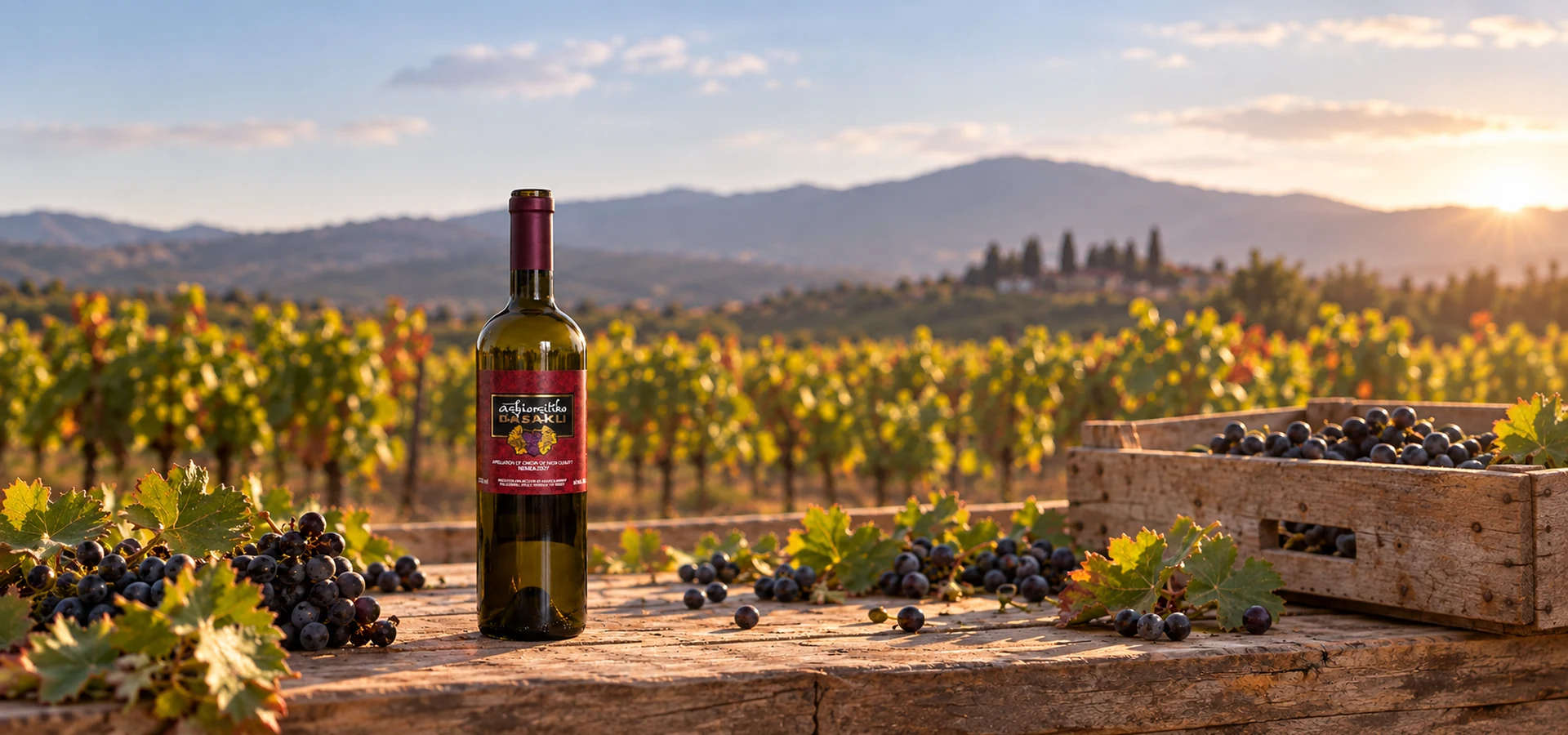
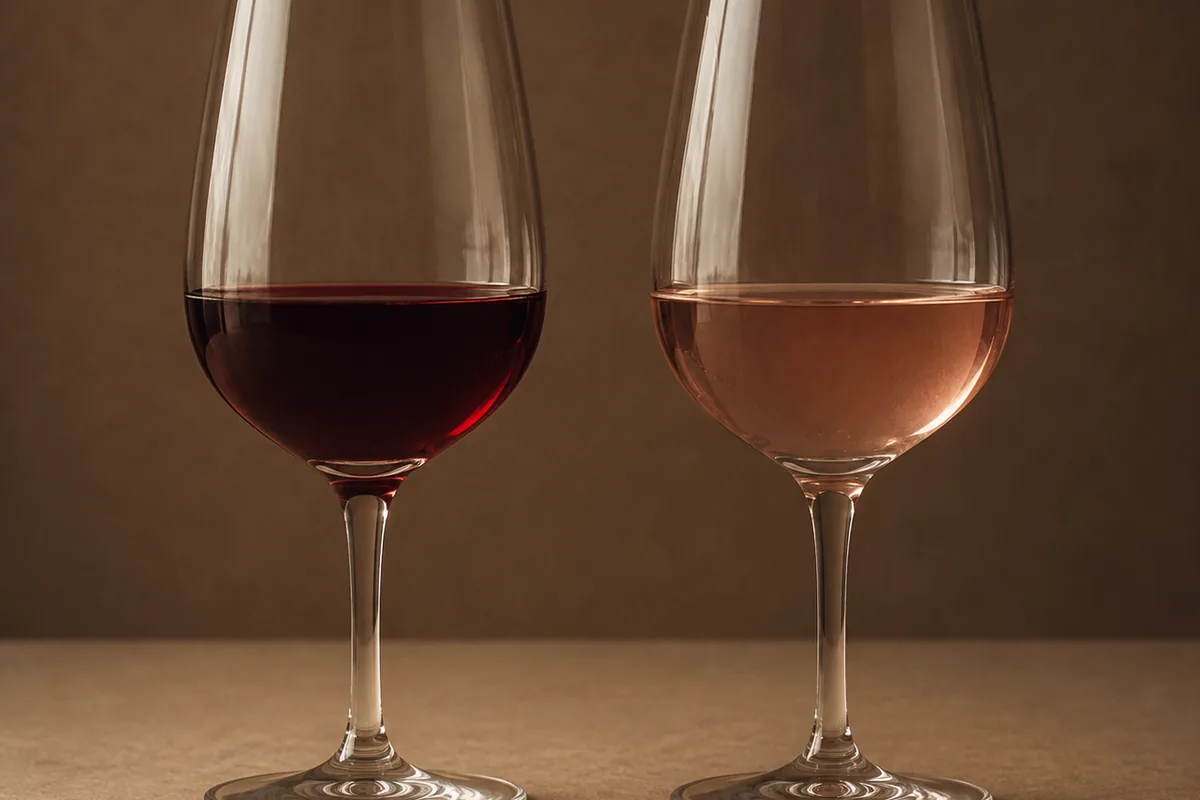
Agiorgitiko is a black-skinned Greek wine grape planted almost entirely in the Nemea appellation of the northeastern Peloponnese. The grape name is the least predictive word on the bottle, because published analyses of wines carrying it run from a 10% semi-sweet sparkling rose to a 14.5% oaked dry red.
At a glance
- Legal category
- The Nemea appellation, recognised in 1971 and recorded by the Greek national wine body, requires the wine to be made entirely from Agiorgitiko and permits dry red, semi-sweet red, sweet fortified red and sweet red from dried grapes. Outside that zone the same grape is bottled under the wider Peloponnese geographical indication.
- Typical strength
- 10 to 14.5 percent ABV
- Also called
- Saint George, St. George, Aghiorghitico, Agiorghitiko, Mavroudi Nemeas
What Agiorgitiko is, and where the grape actually grows
Agiorgitiko is a black-skinned Greek wine grape, and nearly all of it is planted in one appellation in the northeastern Peloponnese.
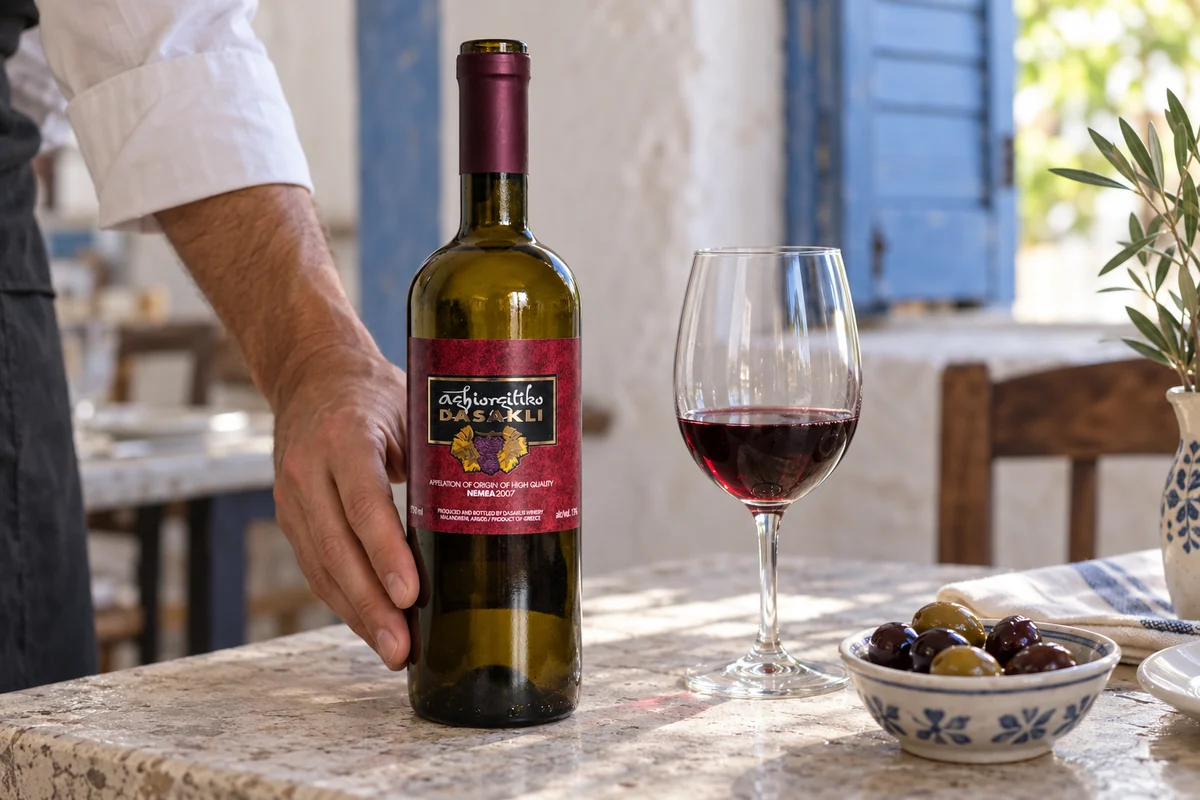
The international variety catalogue lists it as number 102, with noir berry skin, under Vitis vinifera subspecies sativa, and records Greece as its country of origin. That number is worth holding on to, because the name reaches English through a dozen transliterations and the catalogue entry survives all of them.
- Catalogue number
- 102 in the international variety catalogue, stable across every spelling of the name.
- Berry skin colour
- Noir, which settles the red question before the rose bottles later on complicate it.
- Country of origin
- Greece, with cultivation concentrated in the Nemea zone of the Peloponnese.
- Certified clone
- One, number 1252, approved in 2016, which is the whole certified planting material available outside Greece.
A 2025 survey of vineyard microbiology in the region describes the variety as cultivated almost exclusively in the Nemea zone.
That is the survey's own wording. It is a statement about where the vines are, not a planted-area figure, and nobody publishing for readers has put a hectare number behind it.
France has carried the grape on list A of its official catalogue since 2015, with that single approved clone, and Italy lists it as well.
Catalogue entry permits planting, which is a different thing from commerce. No meaningful volume of French or Italian Agiorgitiko reaches a shelf.
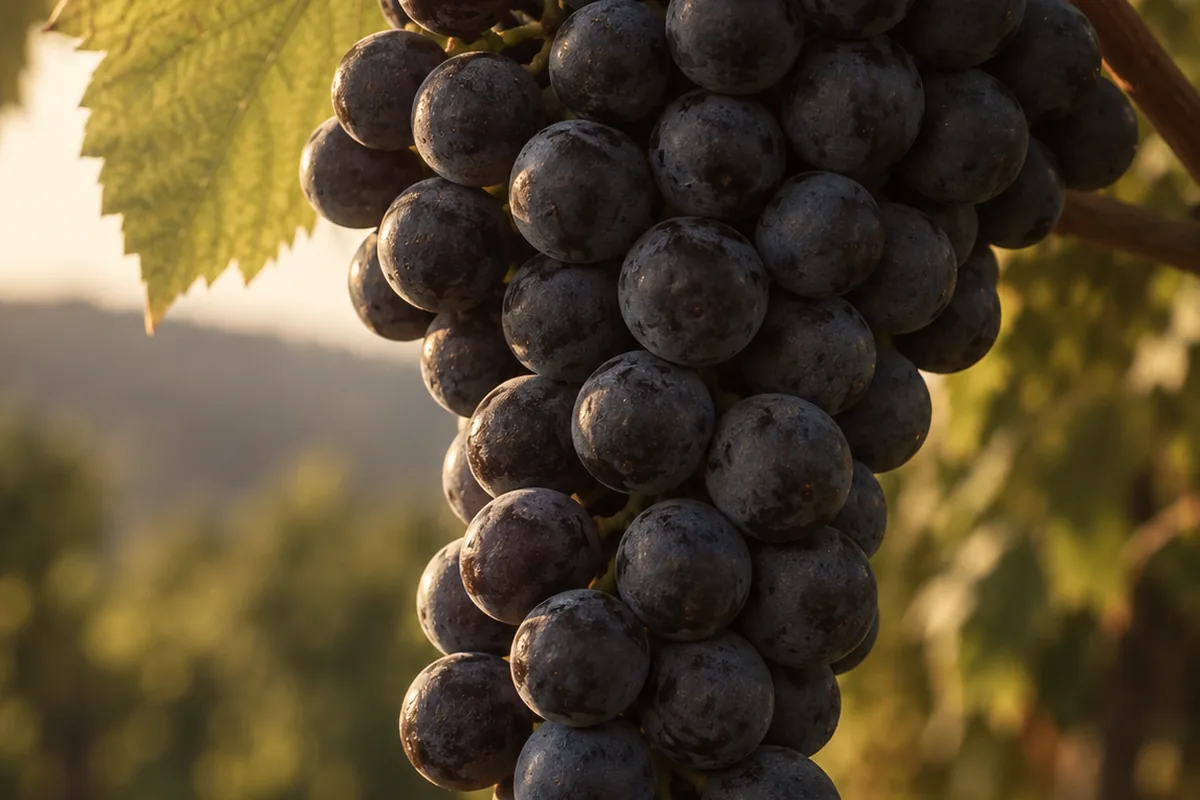
On the vine it carries medium to large compact bunches, and bud burst falls about three days after the Chasselas reference used to time every European variety against a common clock. Ripening lands mid-season, roughly three weeks after that same reference, which places Agiorgitiko well ahead of the late varieties that gamble on an October without rain.
What the appellation line tells you that the grape name cannot
Nemea became an appellation in 1971, and the rule behind the name is simple: the wine must be 100% Agiorgitiko.
The zone runs across seventeen communes in two prefectures, Korinthia and Argolida, which makes it the largest red wine appellation in Greece.
What the appellation does not do is fix a style. Dry red, semi-sweet red, sweet fortified red and sweet red from dried grapes are all permitted under the same name and the same single grape.
Outside the appellation, the same grape is bottled under the wider Peloponnese geographical indication, which loosens the rules further.
Four technical sheets published by producers show how far that travels in practice.
| Bottle | Classification | Style | Alcohol | Residual sugar | pH | Oak |
|---|---|---|---|---|---|---|
| Estate Nemea 2021 | Nemea appellation | Dry red | 14.5% | 2.8 g/L | 3.6 | 12 months French oak, half new |
| Winery Nemea | Nemea appellation | Dry red | 13.5% | Not published | Not published | None, 5 to 6 months on fine lees |
| Anemos Red 2023 | Peloponnese indication | Dry red | 13% | 1.3 g/L | 3.4 | None |
| Bee Rose 2023 | Peloponnese indication | Semi-sweet, lightly sparkling rose | 10% | 36 g/L | 3.5 | None |
Alcohol across those four moves 4.5 percentage points. Residual sugar moves from 1.3 to 36 grams per litre, which is a factor of nearly thirty under one grape name.
Three of the four come from the same estate, and two of those share one 420 metre calcareous site.
That is useful rather than a weakness in the sample. Holding the ground constant is what makes the classification and the treatment visible.
Notice also what the appellation did not predict. One Nemea bottle spent a year in French oak and another saw no wood at all, finishing instead on its fine lees for five to six months.
Read the classification and the style words first, then the grape.
Taking those in the other order is how a reader expecting a dry red ends up with a sweet sparkling rose.
Vine water status is the mechanism behind the site difference
Most writing about Nemea reaches for altitude and stops there. The published work on this variety goes a step further and names what altitude is a proxy for.
Work published in 2006 measured vine water status directly at three non-irrigated plots across the 1997 and 1998 vintages, both very hot and without summer rainfall.
Water availability differed between the sites because the soils held different amounts of it, and the differences correlated closely with how early shoot growth cessation and veraison arrived.
From there the effects run in a chain the reader can follow.
Water deficit accelerated sugar accumulation and the breakdown of malic acid in the juice, which is one route by which a hot dry site hands the winemaker riper fruit and less acid at the same time.
Deficit arriving early in the growing season raised anthocyanin and total phenolic concentration in the berry skins, and the same pattern carried through into the wines made from those plots in both seasons.
Bound aromatic compounds rose too, and in tasting trials the wines from the stressed vineyards were preferred.
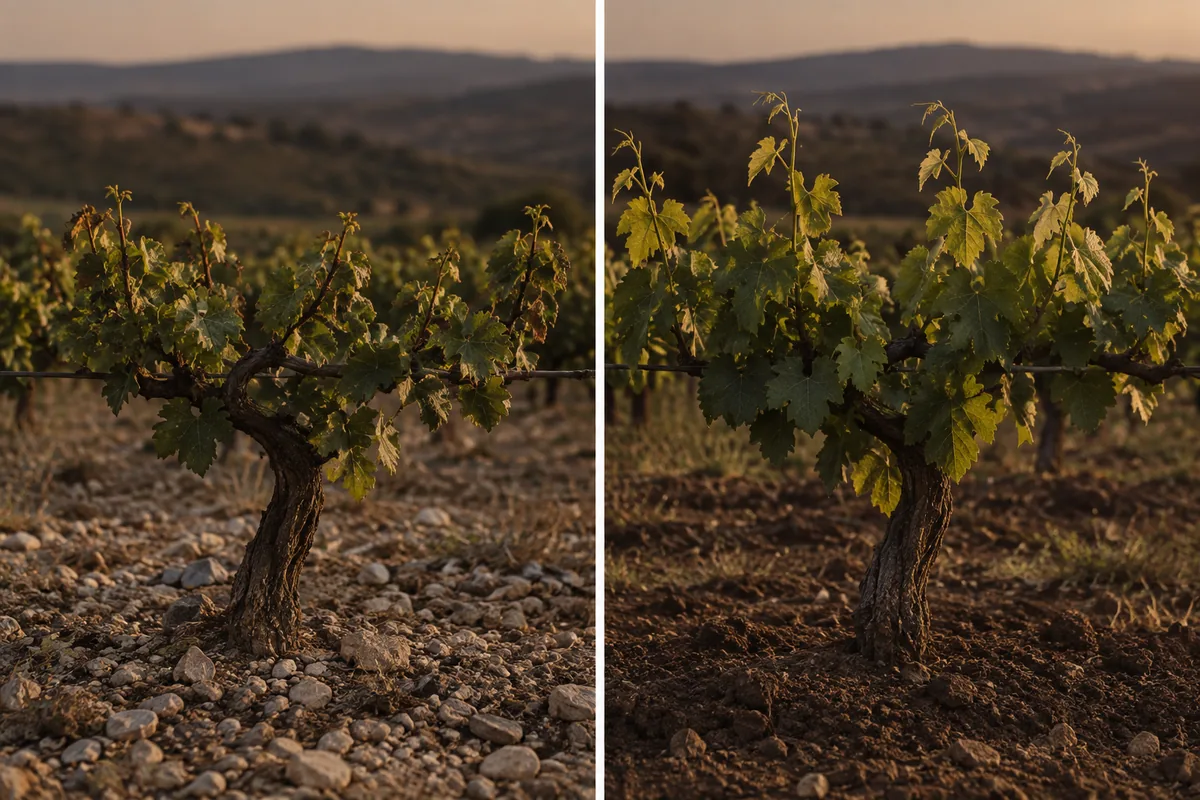
Elevation is where this becomes something a label can tell you, because a hillside block and a valley block do not hold water the same way.
The appellation body publishes three bands across roughly 230 to 850 metres: a lower zone from 230 to 450 metres, semi-mountainous ground from 450 to 650 metres, and mountainous plantings above that.
Work presented in 2021 tested that directly. Grapes from eight vineyards, chosen to represent the different areas of the zone, were picked at optimal maturity and vinified in triplicate under one standard protocol.
With the winemaking held constant, volatile compound concentrations still differed significantly between areas.
Phenolic and anthocyanidin levels in those wines ran from medium to high against other red varieties, and the panel described them in red fruit terms.
This is a narrow base for a large zone. The water status findings come from three non-irrigated plots across two seasons, and the area comparison from eight micro-vinified vineyards.
Both point the same way, and neither is a survey of seventeen communes, so treat the direction as established and the detail as open.
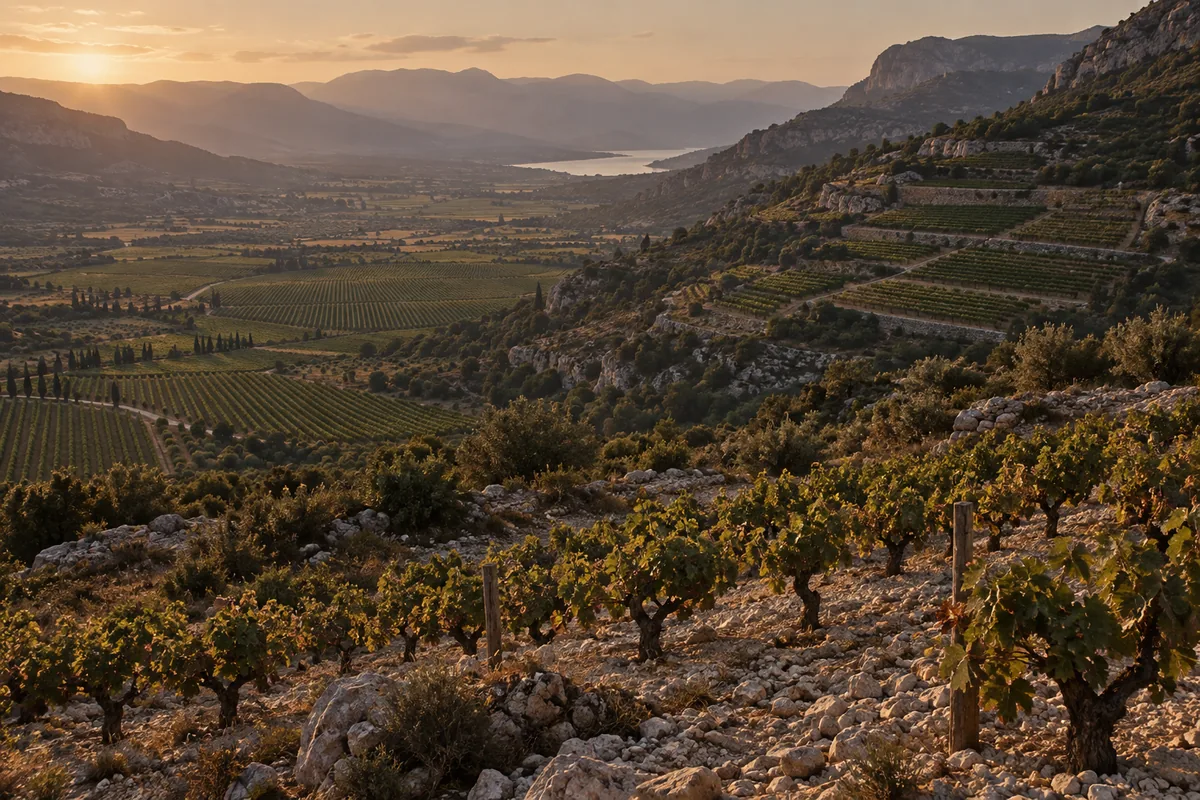
What trained panels have actually found in the glass
Descriptors for this grape circulate freely and are almost never sourced. A 2025 study makes it possible to do better.
Commercially available monovarietal wines from the 2018 vintage went to a trained panel working by frequency of attribute citation, with the volatile compounds identified and quantified separately by gas chromatography and mass spectrometry.
The attribute the panel named most often for Agiorgitiko was blackberry.
Alongside it came dried fruit, recorded specifically as prune and fig, together with floral and grassy notes.
Citation frequency is worth understanding before leaning on it. It records how often a taster named an attribute, not how intensely that attribute came through, so the profile below describes what is commonly present rather than what is guaranteed in any bottle.
- Blackberry. The most frequently cited attribute for the variety, and the single expectation a reader can carry with reasonable confidence.
- Dried fruit, as prune and fig. This is the part that separates the grape from the fresh red fruit description most pages default to.
- Floral and grassy notes. Cited in the same profile, and the reason the wine does not read as a simple jammy warm-climate red.
- Beta-damascenone, beta-ionone and ethyl butyrate. The compounds associated with the blackberry and dried fruit citations.
- (Z)-3-hexen-1-ol. Related to the herbaceous and earthy end of the profile, which makes that greenness a normal feature rather than a fault.
- Cherry, forest fruits and spices. Recorded independently in the official French variety catalogue, which adds that altitude shifts the balance between the fruity and the spicy end.

The same study ran Xinomavro through the same panel, and the contrast is instructive: tomato paste was the attribute most cited there.
Two Greek red varieties, one panel, one method, and profiles that do not overlap.
Anything on a back label that does not appear above is a producer's own description of a specific wine. That is not necessarily wrong, but it carries no evidence behind it.
Acidity, pH and the texture you will notice
Three of the four analysed bottles publish both total acidity and pH, and the pattern between them is the interesting part.
Total acidity sat in a narrow band of 5.5 to 5.7 grams per litre across a dry oaked red, an unoaked dry red and a semi-sweet sparkling rose.
pH ran from 3.4 to 3.6 across the same three.
- 5.5 to 5.7 g/L
- Total acidity across the three bottles publishing it, whatever their style.
- 3.4 to 3.6
- pH across the same three, which is where a red stops reading as sharp.
- 1.3 to 36 g/L
- Residual sugar across those same three, the one measurement that actually moved.

Acidity held steady while sugar moved by a factor of nearly thirty. Whatever separates these wines on the palate, it is mostly not acid.
A pH in the middle threes with acidity around 5.5 grams per litre is the analytical signature of a red that arrives round rather than tart.
That is worth knowing before the glass, because softness in a red is easy to read as a flaw when it is in fact a property of the grape and the site.
The 2006 water status work explains part of it. Deficit accelerates the breakdown of malic acid in the juice, so a hot dry site starts the winemaker with less acid to work with.
Tannin is a separate question, and none of these sheets measures it.
That absence is worth stating rather than filling. No published figure here supports a grip level for the variety, so this page does not offer one.
What the water status work does establish is that the skins carry more phenolic material when the vine ripens under an early deficit, and skin phenolics are where a red's structure begins.
At the table the same numbers set the boundary. A round red with moderate grip has less acid to cut through fat and less tannin to stand up to a heavily charred or heavily salted dish than a sharper, firmer variety would.
That is a constraint rather than a menu, and the specific matches belong with the pairing decision rather than with the grape.
What the oak adds, and what it hides
Oak is printed on labels far more often than it is explained, and for this variety there is a controlled answer.
A 2024 trial took Agiorgitiko and matured it with French oak chips across three toast levels, three doses and three ageing periods, then ran the results through mass spectrometry and a descriptive sensory panel.
Almost every oaked wine carried higher ester concentrations than the unoaked control.
That is the finding most likely to be mistaken for fruit. Oak did not only add wood notes, it lifted the fraction the drinker reads as fruitiness.
- Heavy toast
- Produced the smoky attribute, which is the note most often credited to the grape by mistake.
- Medium toast
- Associated with a barrel attribute, which the panel treated as distinct from smoke.
- Esters
- Higher than the unoaked control in almost every treatment, regardless of toast level.
Dose and ageing period were varied in the same trial, but no distinct sensory attribute was reported for either, so nothing here supports a claim about how much or how long.
Chips are also not barrels. The trial tested chips, and a barrel adds slow oxygen transfer that a chip in a tank does not.

The shelf offers a rougher version of the same comparison.
One estate bottles a Nemea red at 14.5% that spent twelve months in French oak, half of it new, followed by eight months in bottle, and an unoaked red at 13% off the same 420 metre calcareous site.
Vintage and classification differ between those two as well, so it is a comparison rather than an experiment. It is still closer to controlled than anything else a buyer can put on a table.
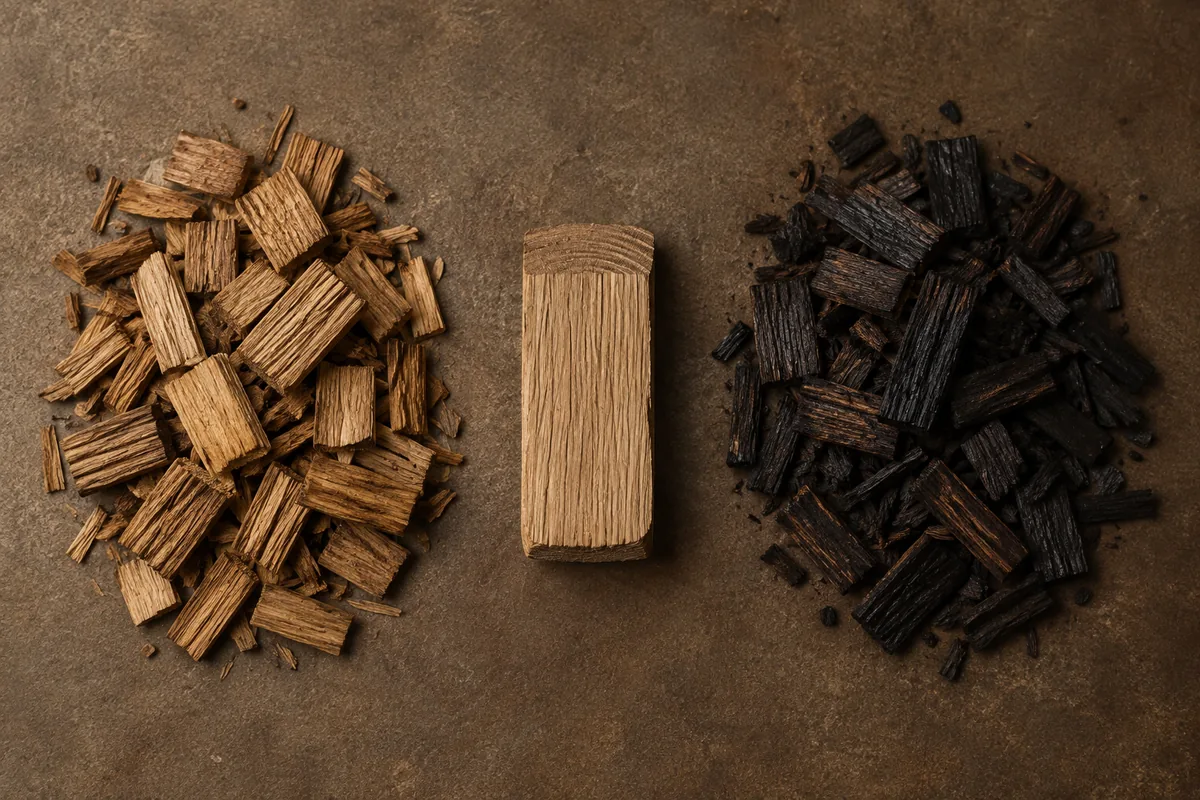
A vigorous vine, sensitive to rot in the wrong year
Vintage variation in this appellation has a specific cause, and it starts with how the vine behaves.
The official French catalogue records Agiorgitiko as vigorous, with semi-erect to horizontal bearing and a tendency to high yields that calls for trellising and short pruning.
It also records the vine as adapted to drought, to varied terroirs and to poor soils, which is what makes the dry farming behind the water deficit work viable rather than reckless.
- Vigorous, semi-erect to horizontal bearing. The growth habit that makes trellising necessary rather than optional.
- High yield tendency. Left alone the vine overcrops, so yield control is a live decision here rather than a formality.
- Drought adapted, tolerant of poor soils. The trait that lets a grower farm without irrigation and use water deficit deliberately.
- Sensitive to grey rot and to mites. Grey rot is Botrytis, and compact bunches give it the conditions it wants.
- Susceptible to wood disease, including esca. A slow vineyard problem that governs replanting, and therefore how old the vines behind a bottle can be.
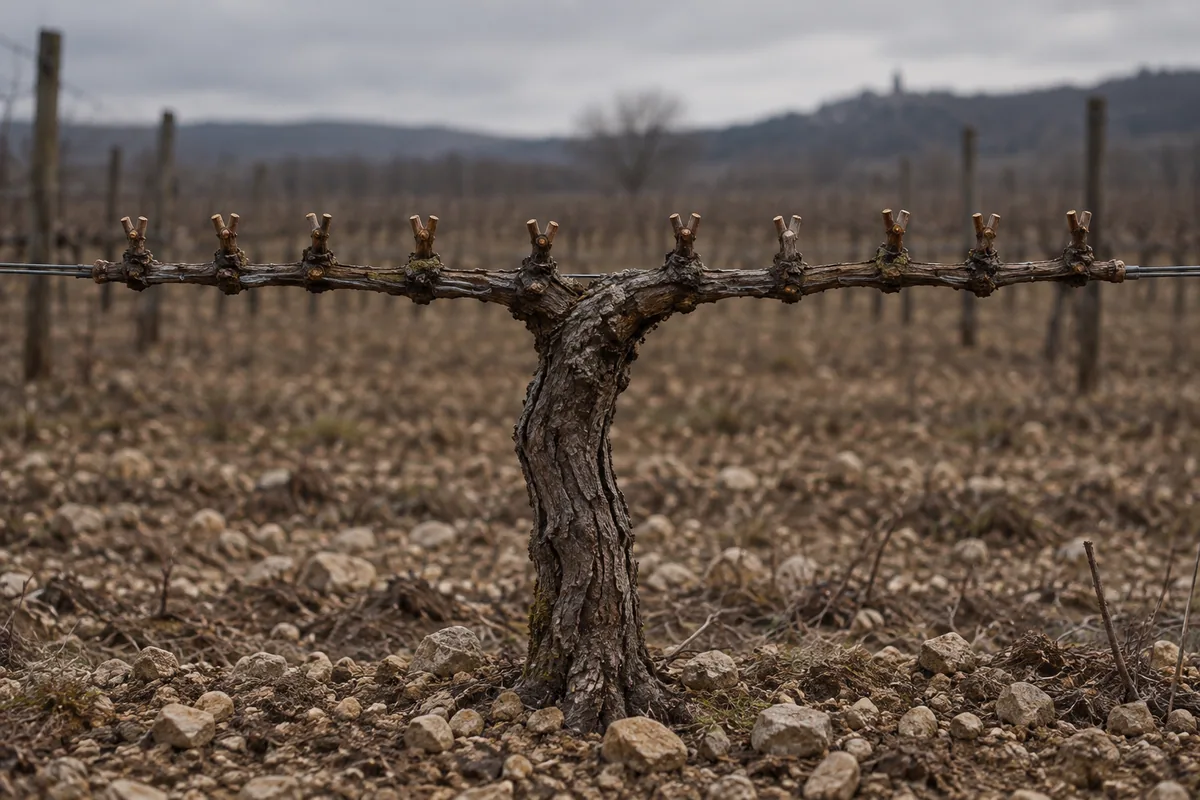
The rot sensitivity is not theoretical. A survey sampled grape and soil microbiota across three consecutive Nemea harvests and found a microbiome broadly shared across the zone's vineyards.
What shifted between years was which organisms dominated, and the shifts tracked the weather.
In the 2019 samples, Botrytis predominated.
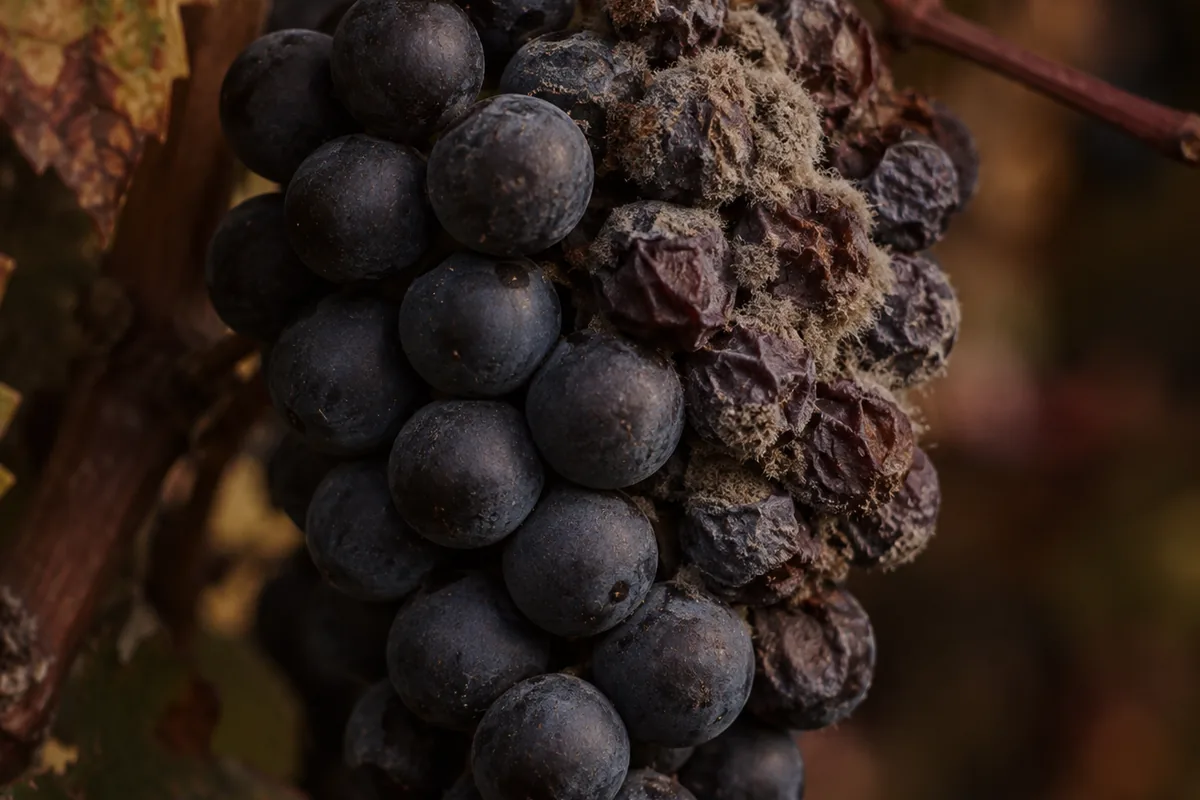
Put the two sources together and the vintage question answers itself: a variety the catalogue calls rot-sensitive, growing in bunches that trap moisture, in a zone where fungal dominance changes with the season.
Three harvests is a short series, and none of this rates one year against another. It does mean a difference between two vintages of the same wine has a cause in the vineyard rather than in the cellar.
Pressure runs the other way too. The 1997 and 1998 seasons behind the water status work were very hot and without summer rainfall, which is the drought end of the same range rather than the rot end.
Short pruning and canopy management are the levers a grower has against both problems, which is why vine age and yield claims on a back label are worth more attention here than on a low-vigour variety.
Saint George, Mavro, and the names that mislead
The passport record for this grape carries dozens of synonyms, among them Aghiorghitico, Mavro, Nemea, Mavroudi Nemeas, Blut des Herkules and St. George.
Saint George is a straight translation, since the Greek name refers to the saint, and an English-language label using it is pointing at the same grape.
Nemea as a synonym is the appellation name doing double duty, which is harmless as long as the reader knows the wine must be entirely this variety to carry it.
Mavro will not lead you back here. The passport records Mavro among the synonyms, but Mavro is separately the name of a distinct Cypriot variety.
On its own the word means dark, identifies nothing, and should never be treated as proof of what is in the bottle.
The official French catalogue is blunter still, stating that no synonym is officially recognised for this variety in France or in the other European Union countries.
A recorded synonym describes usage somewhere, at some point. It is not a labelling term you can rely on at a shelf.
Reading an Agiorgitiko label in the order that matters
Everything above collapses into a short procedure, and the order is what does the work.
- Classification and style words. Nemea or Peloponnese, dry or semi-sweet, still or sparkling. This is the only line that separated a 14.5% oaked red from a 10% sweet rose.
- Stated alcohol. It moved 4.5 percentage points across the published analyses and tracks both ripeness and site.
- Altitude or a single-site claim. The highest elevation tier separated analytically from the rest, so this is a real signal.
- Whether oak is named, and how. Toast level and vessel change the smoky and barrel character a panel could isolate.
- Vintage. Rot pressure and water availability shifted by year across the sampled harvests.
Read those label lines in that order and the expectation you carry to the till is a realistic one rather than a guess.
Producers publish something useful on the other side of the decision too.
The estate behind the oaked Nemea bottle in the table above states a ten year ageing potential for it.
That is a claim a producer makes about its own wine, which is a reasonable thing to weigh and a poor thing to generalise from. Serving temperature and cellar conditions are a separate decision, answered where service and storage are answered.
One last piece of arithmetic is worth carrying. A United States standard drink is 5 fluid ounces of table wine at 12% alcohol, containing 14 grams of pure alcohol.
Pour that same measure of a 14.5% Agiorgitiko and the glass carries roughly a fifth more alcohol than the reference it is usually compared against.
Common questions
- How is Agiorgitiko pronounced?
- One Greek producer prints the pronunciation on its own technical sheet as Ah-yor-yee-ti-ko, with the stress falling on the third syllable. English spellings vary widely because the Greek name is transliterated several different ways, which is why the variety catalogue number 102 is the more reliable identifier.
- Which grapes is Agiorgitiko descended from?
- No confirmed parentage is recorded. The international variety passport shows no pedigree confirmed by genetic markers and no full pedigree for the variety, so any family tree offered for it elsewhere is not supported by the catalogue record.
- Besides grey rot, what is the Agiorgitiko vine prone to?
- The official French catalogue records sensitivity to mites alongside grey rot, susceptibility to wood diseases including esca, and a slight susceptibility to potassium deficiency. Only the rot sensitivity tends to show in a given bottle, because the others act on the vineyard over years rather than on a single harvest.
Sources
-
Plantgrape, the official French vine catalogue: Agiorgitiko
Accessed 12 September 2026.
-
NIAAA, What Is a Standard Drink?
Accessed 13 September 2026.
-
Ferrocino and others, microbial terroir of Agiorgitiko in Nemea (2025)
Published 1 January 2025. Accessed 12 September 2026.
-
Koundouras and others, vineyard site and vine water status in Agiorgitiko (2006)
Published 16 June 2006. Accessed 12 September 2026.
-
Ligas and Kotseridis, French oak chip maturation of Agiorgitiko (2024)
Published 10 December 2024. Accessed 12 September 2026.
-
Nanou and others, aroma profiling of Agiorgitiko and Xinomavro (2025)
Published 1 January 2025. Accessed 12 September 2026.