
Compare
Bourbon vs Canadian whisky: which label guarantees what?
Bourbon and Canadian whisky are both grain whiskies bottled at not less than 40 percent alcohol by volume, and their standards fix almost opposite things. The bourbon standard fixes the mash and the barrel and sets no minimum time in wood, while the Canadian standard fixes three years in wood and a country and never names a grain, so each label guarantees what the other leaves open.
What does each label actually guarantee?
Both words are guarantees rather than descriptions. A reader who takes either one for a place name will misread the shelf.
What each guarantees is a short list, and the two lists barely overlap.
- Bourbon guarantees
- Not less than 51 % corn in the mash, distillation at 160 proof or less, storage in charred new oak filled at 125 proof or less, and bottling at not less than 40 % ABV.
- Bourbon does not guarantee
- Any time in wood. The standard sets no minimum at all.
- Canadian whisky guarantees
- Mashed, distilled and aged in Canada, not less than three years in small wood, and bottling at not less than 40 % ABV.
- Canadian whisky does not guarantee
- Any grain, any proportion of it, or any distillation strength. The standard names none of them.
Read those four lines together and the shape of the comparison is already there, because each standard fixes the thing the other leaves open.
The lists are shaped differently because the two rules were written to do different jobs.
Bourbon is a type inside a wider American class, so its requirements narrow that class on a few points and inherit the rest. The Canadian standard is a single section that has to define the drink outright, which is why it reaches for a country and a duration rather than for a mash.
Neither list describes any particular bottle. Both standards are floors, and a producer may go past either one without saying so.
Where do the two standards agree?
The two are closer than the argument about them suggests, and the shared ground is worth having first.
Both must reach the bottle at not less than 40 percent alcohol by volume, and both are made from a fermented grain mash rather than from fruit or cane.
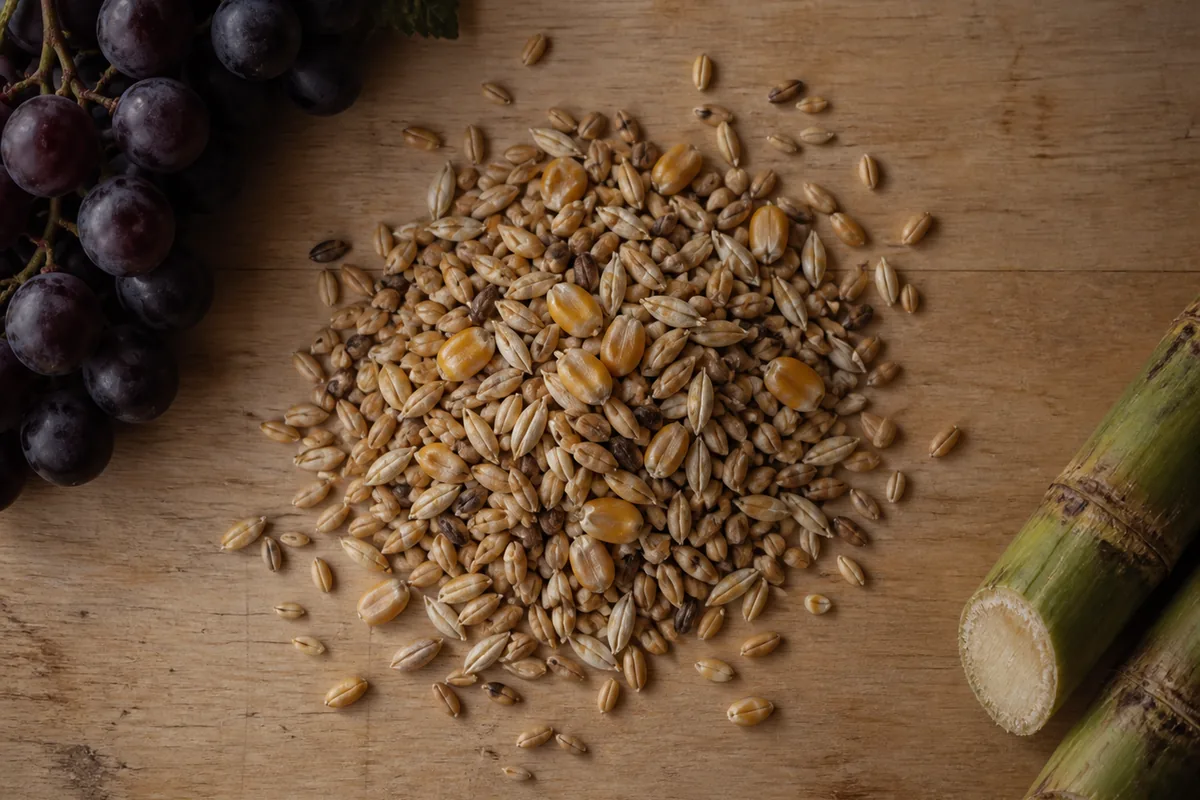
Both are also tied to a country. Bourbon may not be produced outside the United States, and a Canadian whisky must be mashed, distilled and aged in Canada, all three rather than any one of them.
And both spend time in wood, though only one of the two standards says how much. Sharing a floor is not sharing a practice, because neither standard says what a producer does above it.
Which one fixes what the whisky is made from?
The grain is the first thing most readers expect a whisky rule to fix.
Only one of these two does.
Bourbon requires a fermented mash of not less than 51 percent corn. The Canadian standard asks for a mash of cereal grain or cereal grain products and stops there, so no minimum proportion of any grain is set anywhere in it.
| Input rule | Bourbon | Canadian whisky |
|---|---|---|
| Grain | Not less than 51 % corn | Cereal grain. No grain named, no proportion set |
| Distillation strength | 160 proof or less | No ceiling |
| Neutral spirits | Not permitted | Not excluded in those words |
| Bottling strength | Not less than 40 % ABV | Not less than 40 % ABV |
The distillation row works the same way as the grain row. Bourbon must come off the still at 160 degrees of proof or less, and the Canadian standard sets no ceiling at all.
None of that means a Canadian producer works without a recipe. It means the recipe is the producer's rather than the rule's, and the label is not required to report it.
Which one fixes the barrel, and which fixes the years?
Both standards have a barrel rule, and they are not rules about the same thing.
A barrel has several separate properties: what wood it is, whether it was charred, whether it has held spirit before, how strong the spirit was going in, and how big it is.
Bourbon fixes four of those and says nothing about the fifth. It must be charred new oak, filled at 125 degrees of proof or less, and the standard states no cask size anywhere.
The Canadian standard fixes the one bourbon leaves out. Small wood means wood of no more than 700 litres, and it names neither a species, nor a char, nor a filling strength.
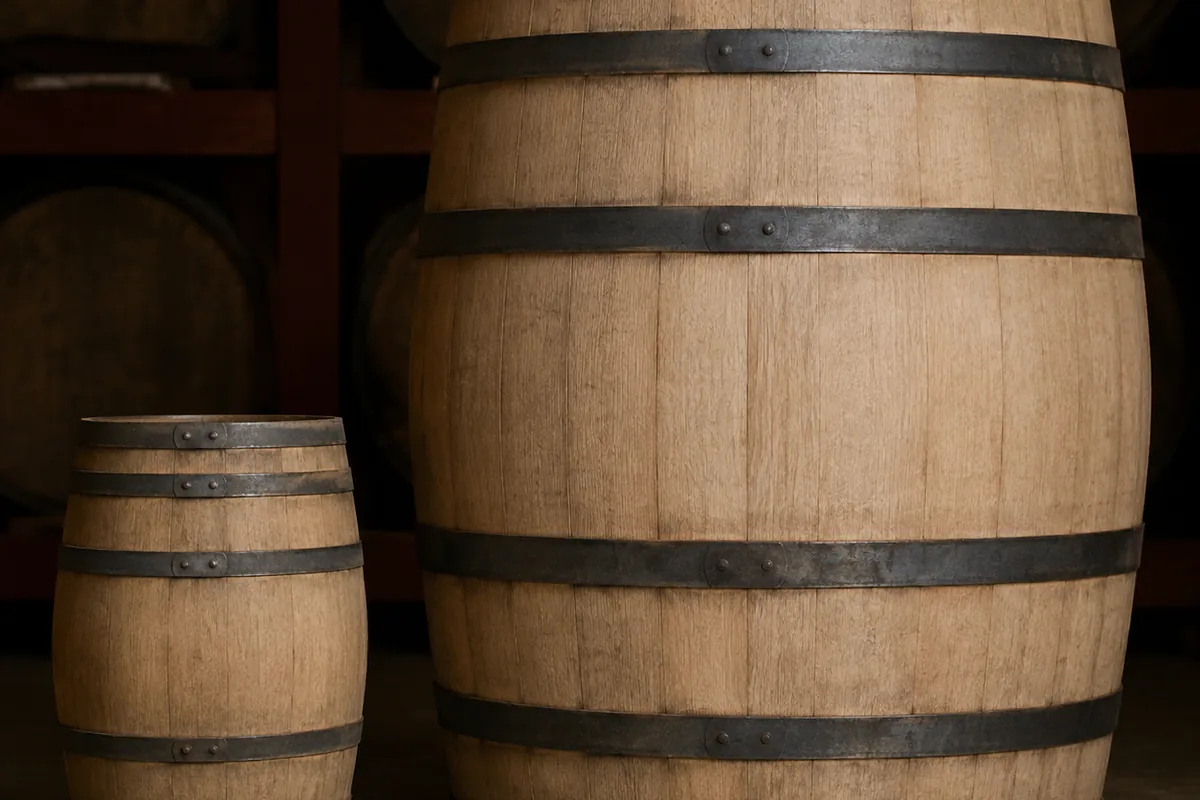
Time is the other half of the same split. A Canadian whisky must spend not less than three years in that small wood before it may carry the name.
Bourbon has no minimum at all, so a bourbon may be days old and still be a bourbon.
One word moves that. Straight and bonded bourbons carry time floors of their own, which the plain designation does not.
What may be added to each?
This is the column where the expectation reverses. The standard with more requirements everywhere else is the permissive one here.
Harmless colouring, flavouring and blending materials are not permitted in bourbon. The Canadian standard permits a Canadian whisky to contain flavouring.
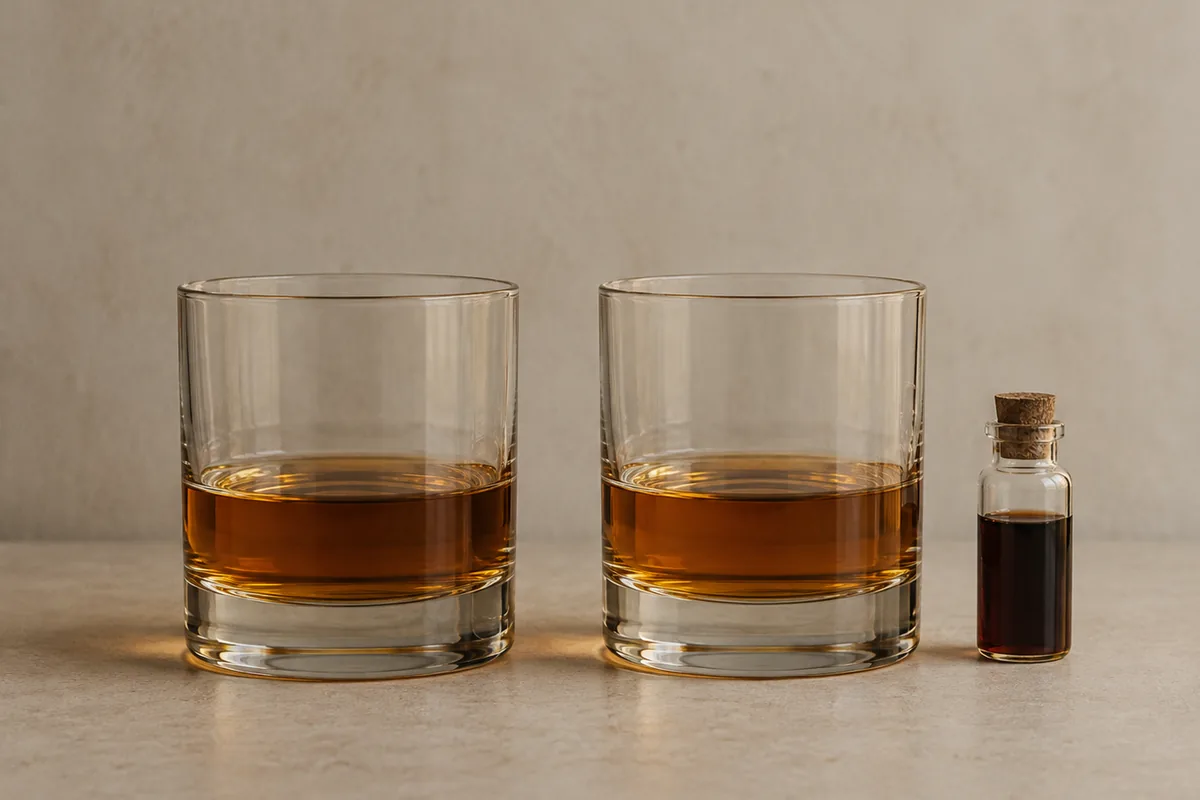
How much it may contain is settled in tax law rather than in the compositional standard, so the rule about what may go in and the rule about how much sit in different books.
Permitted is not the same as used, and nothing here says any particular bottle contains it. What a reader can rely on is narrower than that: neither label has to disclose it either way.
Does either standard say how it should taste?
Most comparisons of these two are settled on taste, which is the axis the rules reach least.
One of them does reach it. The Canadian standard requires the drink to possess the aroma, taste and character generally attributed to Canadian whisky.
The bourbon standard says nothing about aroma, taste or character at all.
The Canadian clause is a real requirement, but it fixes the character by pointing at the category rather than by naming a flavour. It gives a regulator something to hold and gives a reader nothing to check on a shelf.
Which one should you buy?
The choice follows from which of the two guarantees is worth more to you. Neither is the better rule, because they are not rules about the same thing.
- Choose bourbon when the recipe matters more than the age. You are buying a mash floor, a distillation ceiling, new charred oak and nothing added, and you are buying no promise at all about time.
- Choose Canadian whisky when the time matters more than the recipe. You are buying three years in wood and a country, and you are buying no promise about grain, distillation strength or additions.
- Read the label wherever the standard is silent. A producer may state an age, a mash bill or a cask type that neither rule required, and that statement is the only thing that closes the gap.
Where a standard says nothing, the label is doing the work rather than the rule, and what a label volunteers can change between releases.
An age statement on a bourbon is exactly that. It reports the youngest whisky in the bottle, which is the figure the bourbon standard itself never supplies.
There is one thing a silent bourbon label still tells you, and it comes from the labelling rules rather than from the standard of identity.
An American whisky aged less than four years must carry an age statement, so a bourbon with no age on it has had at least four years. A Canadian whisky with no age on it has had at least three.
Both silences carry a floor, in other words, and the floors are not the same height.
Common questions
- Is Canadian whisky aged longer than bourbon?
- By the standards, yes. A Canadian whisky must spend not less than three years in small wood, and the bourbon standard sets no minimum time in wood at all. That compares the rules rather than the bottles, because a particular bourbon may have spent far longer than three years in a barrel without the standard requiring any of it.
- Does Canadian whisky have to contain rye?
- No. The Canadian standard requires a mash of cereal grain or cereal grain products and names no individual grain, and it sets no minimum proportion of any grain anywhere. Bourbon is the one of the two that names a grain, at not less than 51 percent corn.
- Can colouring or flavouring be added to bourbon?
- No. Harmless colouring, flavouring and blending materials are not permitted in bourbon whisky. The Canadian standard permits a Canadian whisky to contain flavouring, with the quantity settled in tax law rather than in the compositional standard, and neither label is required to disclose what was or was not added.
Sources
-
27 CFR 5.74, Statements of age, storage, and percentage
Accessed 4 September 2026.
-
Canadian Food Compositional Standards, Volume 2 Alcoholic Beverages, section 2.1.3, the standard for Canadian Whisky, Canadian Rye Whisky or Rye Whisky
Accessed 10 September 2026.
-
Code of Federal Regulations, Title 27, sections 5.143 and 5.74
Accessed 5 September 2026.
-
Food and Drug Regulations, C.R.C., c. 870, sections B.02.002 and B.02.020
Accessed 6 September 2026.