
Tasting
How to taste whisky, and which parts of the method are documented
A tasting is a procedure for keeping everything except the whisky the same from one glass to the next. Most of the procedure is convention; two steps in it have been measured, and it is worth knowing which are which.
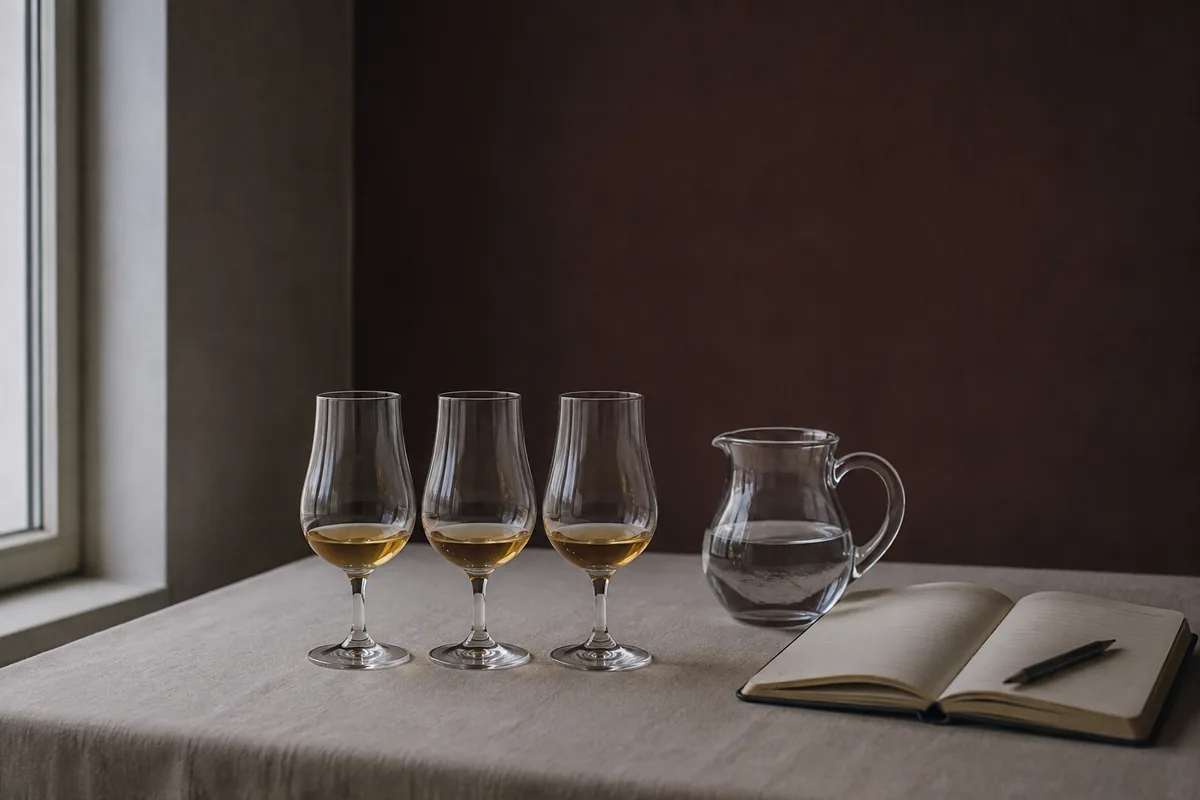
In what order should a whisky be assessed?
No law and no standard fixes the order of a tasting. What the usual order does is hold three things steady so that the only thing changing between two glasses is what is in them.
- The strength
- Water can go into a glass and cannot come back out, so the undiluted note has to be written first or not at all.
- The glass
- A glass carrying a smell of its own puts that smell into every note taken from it.
- The room
- The first opinion spoken aloud is the one a group converges on, so the note comes before the conversation.
The sequence itself is set out below the article, in six steps, and two things in it are worth saying here because they are the parts most often got the wrong way round.
The assessment belongs to the second sip rather than the first, which mostly registers alcohol. The water goes in last, after the note is written, because it is the one step that cannot be undone.
Only two of those steps have been studied. The rest are there to keep the glass, the strength and the company from adding anything of their own.
Is there a standard for a tasting glass, and does it cover whisky?
There is exactly one international standard for a tasting glass, and it is not about whisky.
ISO 3591:1977 specifies the characteristics of a glass for the sensory analysis of wines. It names no spirit, and no equivalent standard specifies a spirits tasting glass.
What it specifies is worth borrowing anyway, because the reasoning is about aroma rather than about wine. The standard describes the cup as an elongated egg on a stem resting on a base, with the opening of the cup narrower than the convex part so as to concentrate the bouquet.
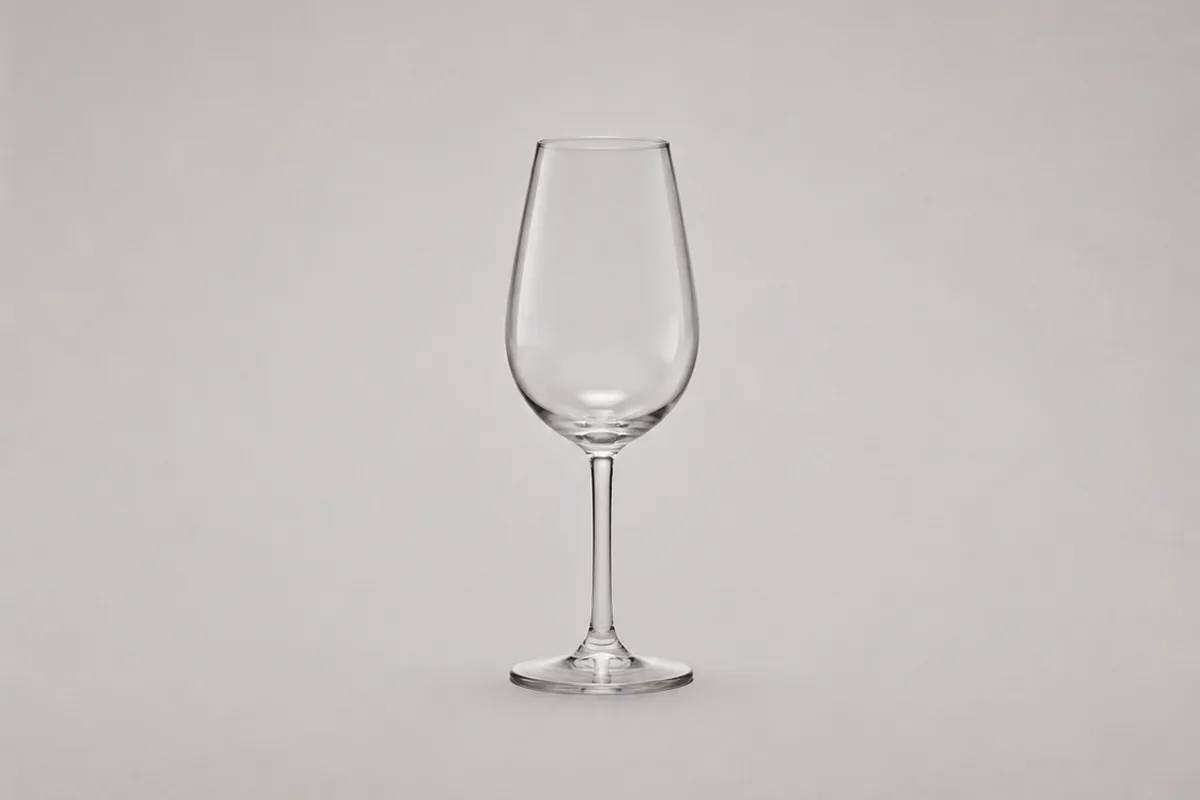
That single feature, and not any brand, is the part with a stated purpose.
| Requirement | What the standard says | Stated reason |
|---|---|---|
| Form | A cup like an elongated egg, on a stem, on a base, its opening narrower than the convex part | To concentrate the bouquet |
| Material | Colourless transparent glass, free of grooves and bubbles | None given; the colour requirement is set aside only for tests that mask the drink |
| Rim | Regular, smooth and rounded, without unnecessary thickening | None given |
| Scope | The sensory analysis of wines | Not applicable; no spirit is named |
A tumbler fails the first requirement and nothing else. Its opening is as wide as its body, so what leaves the whisky leaves the glass.
Why does a cask strength whisky smell different, not just stronger?
A cask strength whisky does not smell like a stronger version of the same whisky. It smells like a different one, because strength changes which molecules are in a position to leave the liquid at all.
Guaiacol is one of the compounds a whisky can smell of, smoky and medicinal.
In simulations of water and ethanol mixtures, it was found mainly at the boundary between the liquid and the air in mixtures containing up to 45 percent ethanol by volume. At 59 percent and above it was increasingly surrounded by ethanol and driven down into the body of the liquid.
Below about 45 percent, the compound sits where its aroma can leave the glass. At 59 percent and above, it is pulled down into the liquid instead.
That is a simulation of one compound, not a panel smelling a whisky, and its authors published a correction in 2018 narrowing one of the ranges they had reported. It says nothing about which whisky is better at which strength.
What it does explain is why a bottle at 50 percent presents differently from the same distillate reduced to 40, rather than merely more strongly.
Does adding water improve a whisky or only weaken it?
Adding water does two things at once, which is why the advice to add a drop has stood for a century without ever being settled. It lowers the strength and it dilutes the flavour, and those pull in opposite directions.
One sensory study pulled them apart. Two rums were each diluted twice: once with water, down to 20 percent alcohol by volume, and once with a 40 percent solution that thinned the flavour by the same amount while leaving the strength where it started.
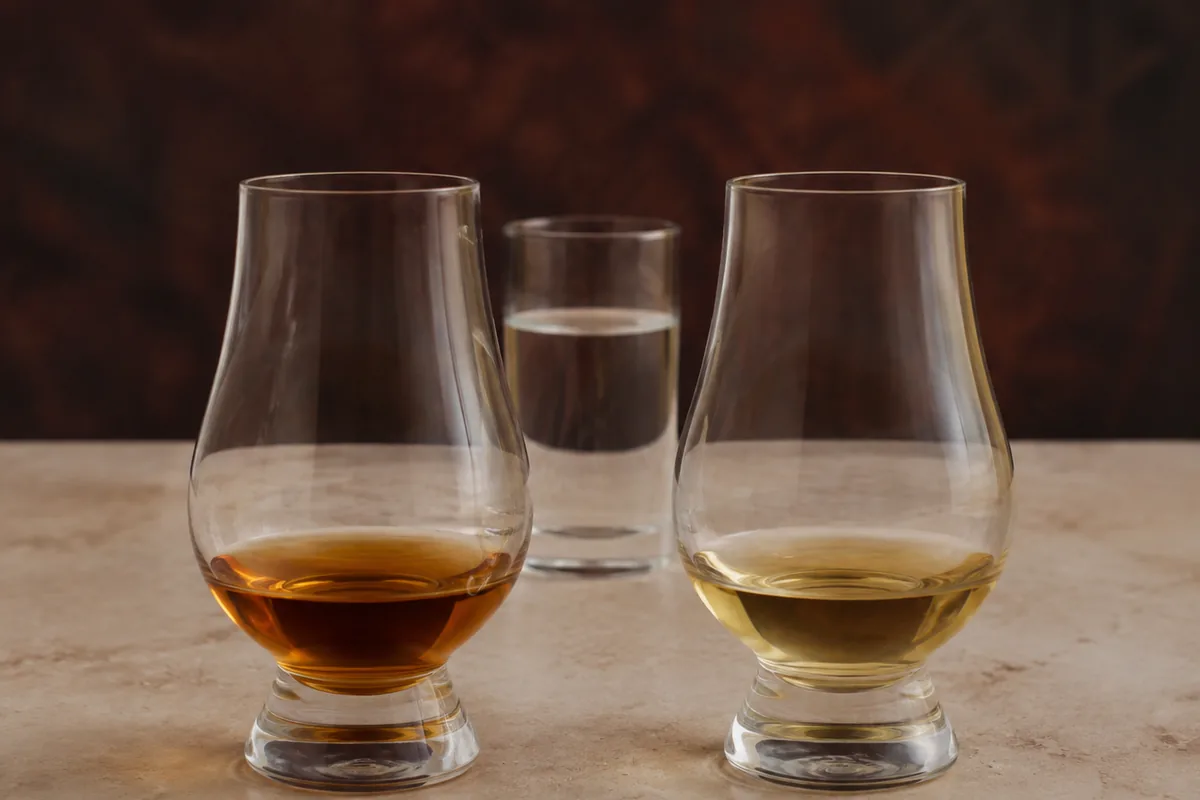
| Diluted with | What changed | What the panel reported |
|---|---|---|
| Water | Strength and flavour both fell | Profiles very similar to the original, intensities slightly lower |
| A 40 percent solution | Flavour fell, strength held | Profiles significantly different, rated lower on nearly every attribute |
The series that kept its strength lost the most, so water is not simply thinning a drink but taking away something that was holding the aroma down.
The study scored twenty-three attributes with a trained panel and reported intensity rather than preference, and it used rum. It tested no particular quantity of water, which is why no honest source will tell you how many drops.
Add a little, smell again, and stop when something you had is gone.
What can the colour of a whisky tell a taster?
The standard's clearest statement about colour is that it makes provision for removing it. For certain tests it calls for a glass deep enough in colour to mask the colour of the drink and thus eliminate the visual factor.
A standards body writing about sensory analysis thought the visual factor worth designing a glass to remove.
For a spirit the case is stronger still. Caramel colouring is permitted across many categories, so a dark rum and a pale one can have been treated identically, and a printed age is the only claim about time a label may make.
Masking is an allowance for certain tests rather than a rule for every tasting, and anyone without a coloured glass can use any opaque vessel, since the requirement asks only that the shade cannot be seen.
Which ordinary handling mistakes change what a taster smells?
Three of the commonest faults in a tasting are not faults in the whisky at all, because they come from the washing up. The standard's own recommendations name each one, so each can be prevented.
- Perfumed detergent. The recommendations note that the majority of commercial detergents are perfumed. A glass washed in one carries a smell that was never in the bottle.
- The drying towel. A towel can transmit the odour of the washing product into a glass that was otherwise clean. The recommendations call for rinsing the glass with the drink to be tasted before use.
- A hand on the cup. The glass is to be grasped by the stem only, and the cup not touched by the fingers or the nose, to avoid the influence of body warmth.
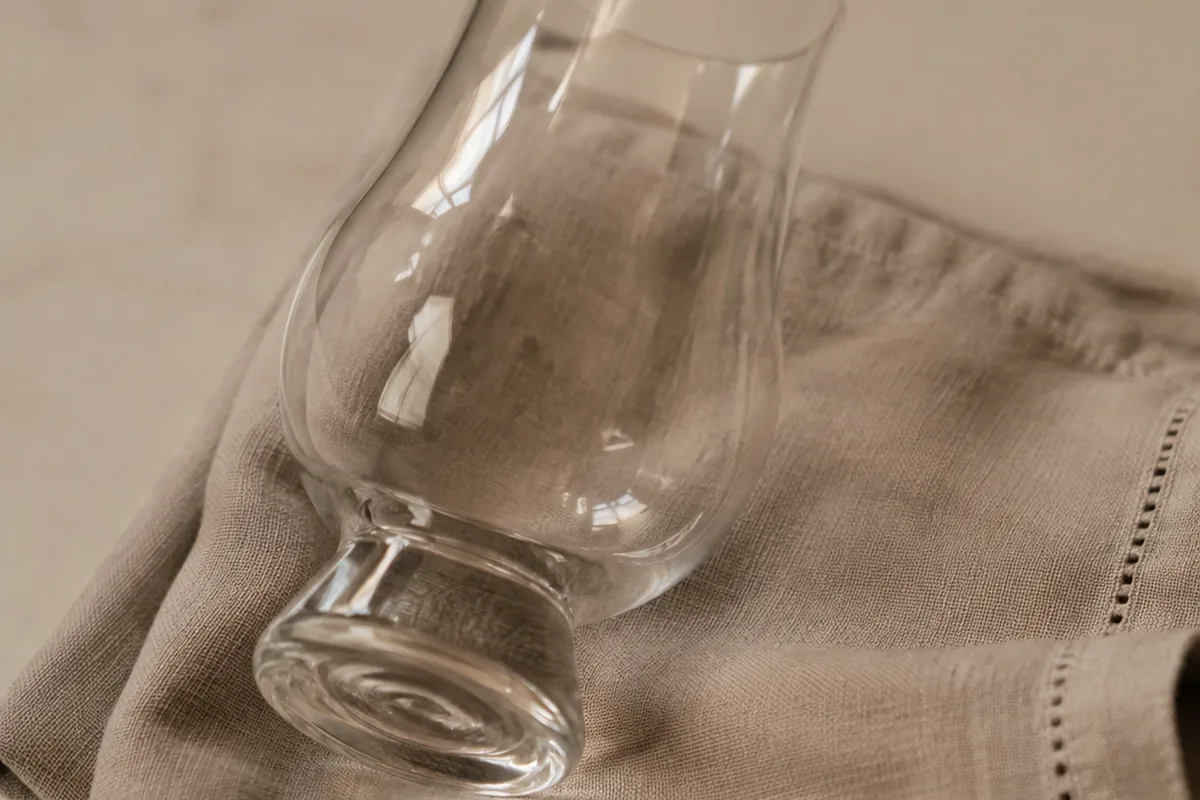
None of the three announces itself as a fault of the glass. The smell arrives with the whisky, and a taster with no reason to suspect the washing up writes it into the note as character.
These are recommendations in an annex rather than requirements the standard makes, and they were written for a wine tasting room. They cost nothing to follow, and each removes an aroma that came from somewhere other than the whisky.
Step by step
-
Pour a small measure
Twenty to twenty-five millilitres is enough. A large pour presents more alcohol vapour without presenting more aroma.
-
Look, and expect little
Note the shade, remembering that colouring is permitted in many categories and that the colour reports the least of anything in front of you.
-
Smell in short passes
Mouth slightly open, short sniffs rather than one long draw, moving away and returning.
-
Sip, and assess the second sip
A small sip coats the mouth. The first mostly registers alcohol, so the assessment belongs to the second.
-
Write the note
Write it before anyone speaks, and before any water goes in, because neither can be undone.
-
Add water a little at a time
Add, smell again, and stop when something you had before has gone. No source specifies a quantity.
Common questions
- Is there a standard whisky tasting glass?
- No. ISO 3591:1977 specifies a glass for the sensory analysis of wines and names no spirit, and no equivalent international standard covers a spirits glass. The feature it specifies, an opening narrower than the widest part of the cup, is there to concentrate the aroma and is worth looking for in any glass.
- How much water should I add to a whisky?
- No published source specifies a quantity. The study that examined dilution tested fixed dilutions rather than a recommended amount, so the practical approach is to add a little, smell again, and stop once something you could smell before has gone.
- Why does a cask strength whisky smell different rather than just stronger?
- In simulations of water and ethanol mixtures, an aroma compound sat at the boundary between liquid and air up to about 45 percent ethanol by volume, and was driven down into the liquid at 59 percent and above. Strength changes which molecules are in a position to leave the glass.
- Can I judge a whisky by its colour?
- Very little. Colouring is permitted in many categories, so shade and age are not connected in any dependable way, and the one sensory standard on tasting glasses makes provision for a glass deep enough in colour to remove the visual factor from an assessment altogether.
- Does the glass need washing a particular way?
- The standard's recommendations warn that most commercial detergents are perfumed and that drying towels can carry the odour of the washing product. They call for rinsing the glass with the drink to be tasted before use, and for holding the glass by the stem so body warmth does not reach the cup.
Sources
-
ISO 3591:1977, Sensory analysis, Apparatus, Wine-tasting glass
Accessed 5 September 2026.
-
Ickes and Cadwallader, Effect of ethanol on flavor perception of Rum, Food Science and Nutrition, 2018
Accessed 5 September 2026.
-
Karlsson and Friedman, Dilution of whisky, the molecular perspective, Scientific Reports, 2017, with the 2018 author correction
Accessed 5 September 2026.