
Spirits
What is black rum, and does the colour mean anything?
Black rum is a shade, not a grade. The federal rum standard names exactly one type of rum and it is a country rather than a colour, and three separate things set how dark any bottle ends up.
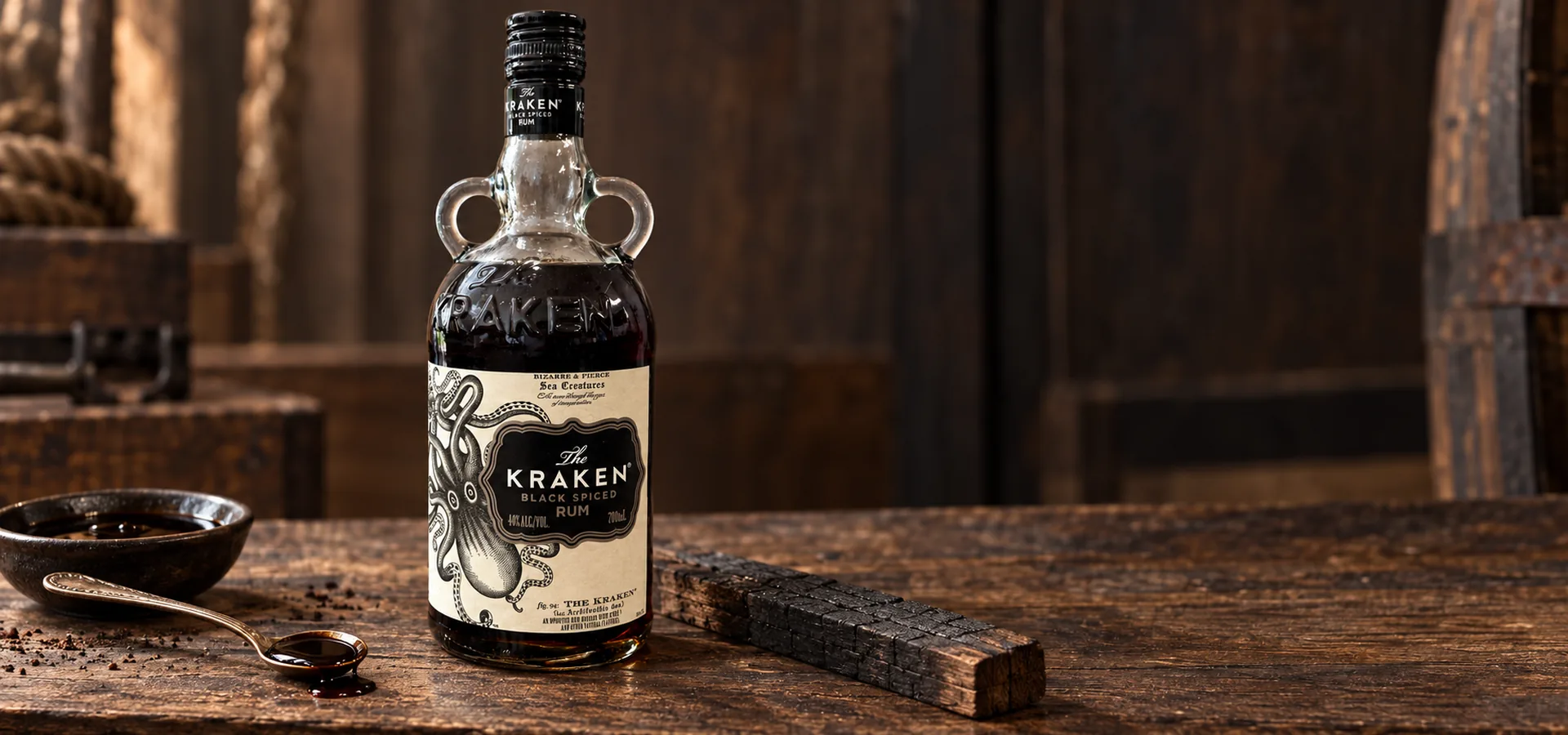
At a glance
- Legal category
- No colour grade in the standard; class rum at 27 CFR 5.147
- Minimum strength
- 40 percent ABV
- Also called
- Black strap rum
Is black rum a legal category?
Look for black rum in the federal standard and it is not there. What is there is a class called rum, and it is short.
Rum is distilled from the fermented juice of sugar cane, from cane syrup, from cane molasses, or from other cane by-products. It must come off the still at less than 95 percent alcohol by volume and reach the bottle at no less than 40 percent.
- Source material
- Sugar cane juice, cane syrup, cane molasses, or other sugar cane by-products. That is the whole permitted list.
- Maximum distillation strength
- Less than 95 percent alcohol by volume, which is the only ceiling the standard puts on the still.
- Minimum bottling strength
- 40 percent alcohol by volume. If proof and alcohol by volume are not interchangeable in your head, that is 80 proof.
- Named types
- One. It is a country of origin, not a colour.
Everything after that is trade description, and no colour word appears anywhere in the standard, so black, dark, gold and amber are all words a producer chose rather than grades anyone assigns.
The only type the standard names
The rum standard has a table of types, and the table has one row in it. That row is cachaça, defined as a distinctive product of Brazil made in Brazil under Brazilian law.
The paragraph that would hold a second type is marked reserved. It is an empty slot the regulation is holding open.
So the only subdivision of rum the standard takes seriously is a place, and where a rum may say it comes from is governed far more closely than what is in it. A colour never has.
What actually makes a rum dark?
If the standard fixes no colour, something else is setting it, and three separate things do, working independently of each other.
Time in the barrel
This is the one people assume is the whole story. A rum sold as dark is typically described as having spent over two years in charred oak, and oak does put colour into a spirit.
It is also the only one of the three that records anything about how long the rum sat anywhere.
The charcoal filter
Here is where the assumption breaks. White rum is commonly aged for one to two years as well, and then passed through charcoal filters that pull the colour back out.
So a pale rum and a dark rum can have spent comparable time in wood. The difference between them may be a filter, not a calendar.
That filtered spirit is usually the one that ends up in a mixed drink rather than a glass on its own, which is a choice about weight rather than about age, and a measured drink then has to be built around that weight rather than around the colour.
The caramel
The third cause arrives last and moves fastest. Caramel may be added after ageing to give a more vivid colour, and to adjust the rum to a predetermined colour standard.
Read that last phrase slowly. The shade is a target the blender aims at, set before the blend was made.
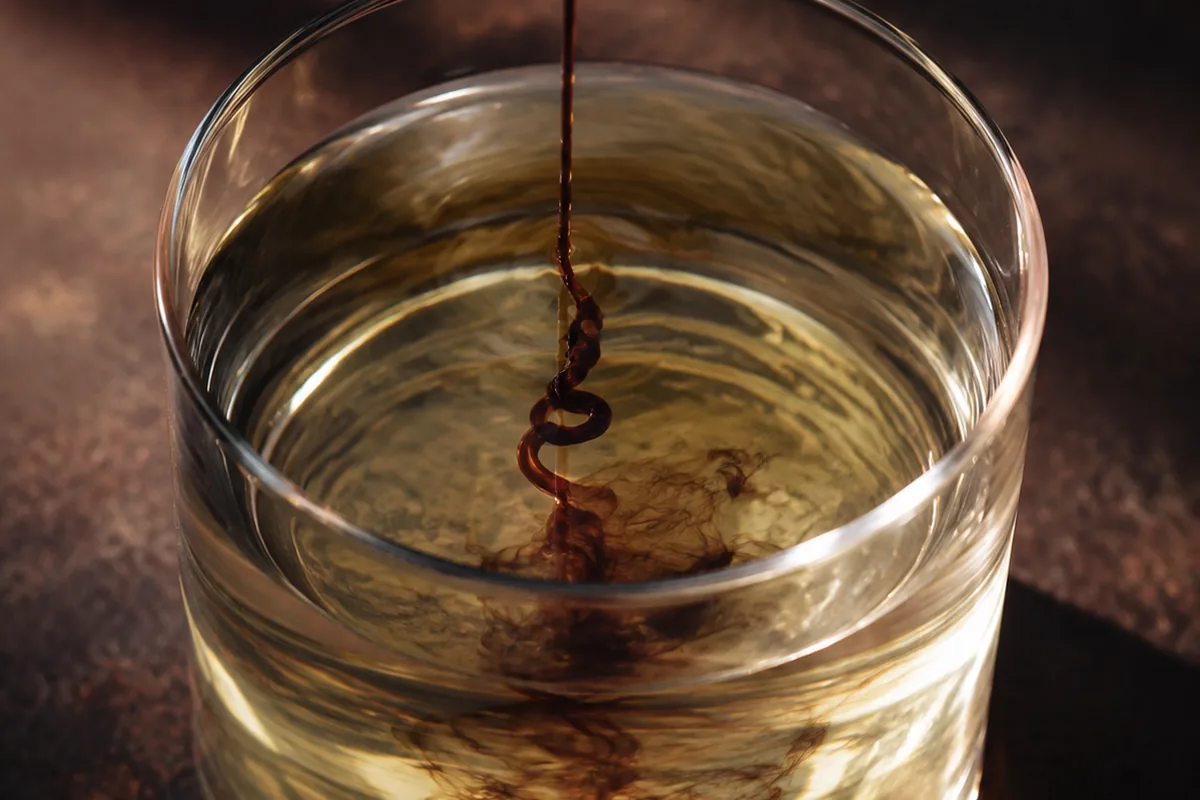
None of that makes caramel an adulteration. It is a normal blending tool used to keep a product consistent from batch to batch.
What it does mean is that two of the three things setting the colour happen after the barrel, so the shade cannot report what the barrel did.
Does a rum label have to say caramel was added?
The obvious next question is whether the bottle has to say so. For rum, in the United States, the answer is no.
The general rule is strict enough. A spirit carrying added materials that primarily contribute colour must say artificially coloured on the label, and where caramel is the only colouring used, a statement such as colored with caramel may appear instead.
Then comes the exemption, and it names rum outright.
| Product | What the colouring rule requires about caramel |
|---|---|
| Rum | No statement of any type is required |
| Brandy and Tequila | No statement of any type is required |
| American single malt whisky | A statement must appear if any amount is used |
| Any other spirit | The artificially coloured statement, or a caramel statement instead |
One regulation, one sentence apart. It obliges American single malt whisky to declare any amount of caramel colour, and exempts rum from saying anything at all.
The consequence for a reader is narrow and worth being precise about. Silence about caramel on a rum label is the ordinary legal position, so it is not evidence either way.
The exemption covers caramel specifically, so another colouring material would still trigger the artificially coloured statement, and what else a label must carry depends on where the bottle is sold.
What does the molasses give a rum, if not its colour?
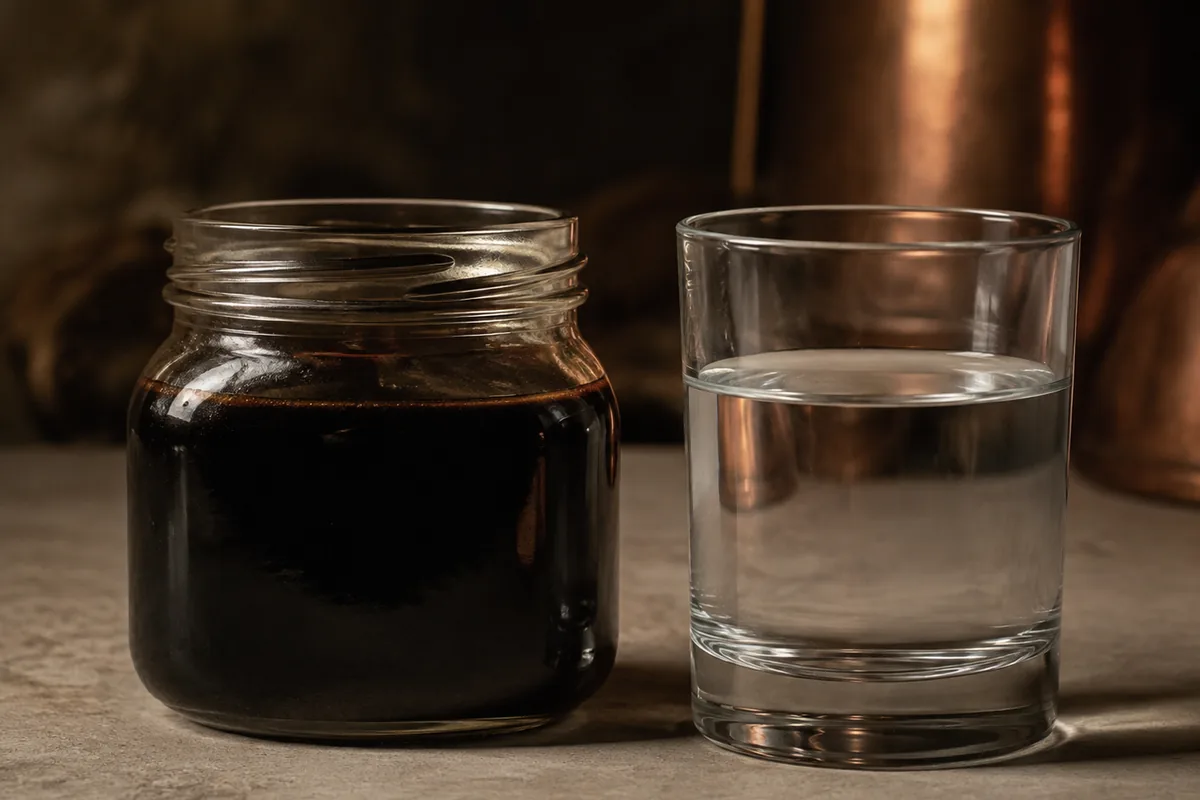
Molasses is nearly black. It is reasonable to assume some of that darkness travels into the bottle, and it does not.
What carries over
Blackstrap is what is left after repeated boiling and crystallisation have taken the sugar out. The extra processing is why it tastes more pronounced and slightly bitter than the earlier molasses.
What crosses the still is the congeners: every volatile component of the distillate apart from ethanol. They are the principal contributors to the character of a rum.
Pigment is not volatile and stays in the still, which is why a near black feedstock yields a spirit that runs off water clear.
The compounds that make it taste of rum
The heart of the run is where the useful congeners are. Among them are ethyl butanoate, ethyl acetate, isobutyl alcohol, 2,3-butanedione and beta damascenone.
Not everything in the heart is wanted. Isoamyl alcohol can come through with it and brings bitterness and a sharp odour, which is part of what a distiller is cutting against.
The part that is not the yeast
The more interesting source is the fermentation itself. Bacteria working alongside the yeast produce 2,3-butanediol, diacetyl and propionic acid, and those carry part of the characteristic flavour of rum.
Which is why a rum fermentation is not run sterile, because wiping the bacteria out completely may not be desirable and some of what a drinker recognises as rum is bacterial and kept on purpose.
Where the still comes in
The still decides how much of that congener load survives the trip. Batch distillation in pot stills is associated with heavier, stronger rums, and continuous column stills with lighter ones.
That heart cut condenses to somewhere between 60 and 94 percent alcohol by volume, depending on the unit it came off.
Everything after that is dilution and blending. So if you want a cue for weight, the still is a better one than the shade, and it is more likely to be printed on a label than a caramel dosage ever will be.
Fermentation length and where the cuts fall are the choices that build a heavy rum, and no part of the standard reaches them, and a rum this dark hides its aroma behind its colour, so assessing a spirit you cannot see through matters more here than the shade does.
How do you judge a dark rum on the shelf?
Everything above removes one cue and leaves the printed ones. The shade is the least informative thing on the shelf, and it is the thing most shoppers read first.
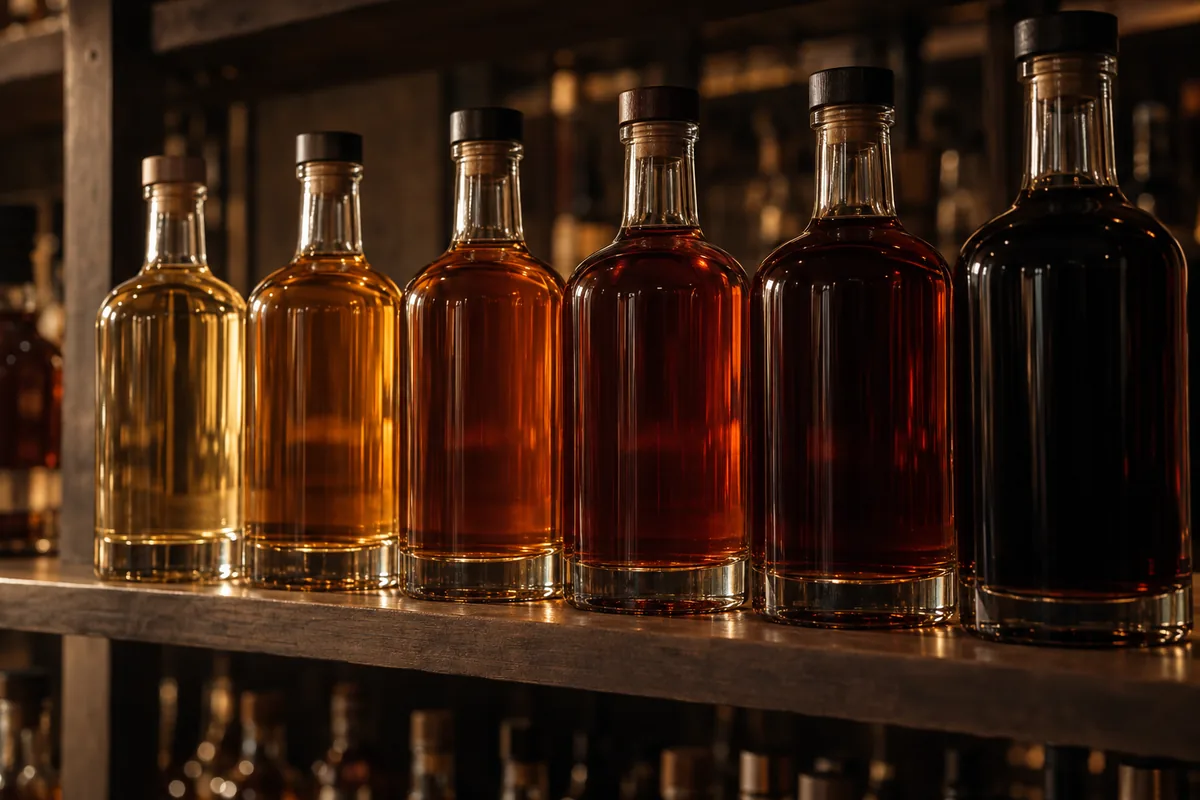
- The strength. The only figure the standard guarantees, at no less than 40 percent alcohol by volume.
- An age statement. The only wording that speaks to barrel time. The colour cannot.
- The origin. A place name such as cachaça carries the law of that place. A colour word carries nothing.
- The still, if it is named. Pot or column predicts the weight of a rum better than its shade does.
None of those is verified by anyone outside the producer. An unstated cask, an unstated still and an unstated caramel dose are all equally normal.
What the strength is telling you
The strength is worth a second look while you are there. Most rum sits between 37 and 40 percent alcohol by volume, and over proof bottlings run to 70 or 80 percent, which is a different drink in the same shaped bottle.
What the strength does carry is the arithmetic of the drink in front of you, and colour has no bearing at all on how much alcohol a measure carries, which is set by the strength alone.
Common questions
- Are black rum and dark rum the same?
- Producers use both terms inconsistently. Black rum usually signals the deepest colour, while dark rum can cover a broader range of barrel-coloured or caramel-adjusted rum. Neither term appears in the United States federal rum standard, so a label alone cannot guarantee a difference.
- Does a darker rum mean an older rum?
- No. Colour can be removed from an aged rum by charcoal filtering, and it can be added to any rum with caramel after ageing, so the shade does not establish barrel time.
- Can I tell by taste whether caramel colouring was added?
- This page will not claim you can. Caramel is used at low levels to adjust colour, United States labels need not disclose it in rum, and no source acceptable here publishes a reliable sensory test for it.
Sources
-
27 CFR 5.147, Rum, Electronic Code of Federal Regulations
Accessed 4 September 2026.
-
27 CFR 5.72, Coloring materials, Electronic Code of Federal Regulations
Accessed 4 September 2026.
-
Mangwanda, Johnson, Mani, Jackson, Chandra, McKeown, White, Naiker (2021), Processes, Challenges and Optimisation of Rum Production from Molasses, A Contemporary Review
Published 8 February 2021. Accessed 10 September 2026.
More in Spirits
-
 American single malt whisky
01
What is American single malt whisky, and what does it guarantee?
-
 Australian whisky
02
How is Australian whisky defined, and by which law?
-
 Blended American whiskey
03
What is blended American whiskey, and how much of it is whiskey?
-
 Blended Irish whiskey
04
Blended Irish whiskey: which word counts the distilleries?
-
 Blended Scotch
05
Blended Scotch: what is in it, and why does the recipe change?
-
 Blended grain Scotch
06
Blended grain Scotch: is the grain the cheap part of a blend?