
Spirits
Blended grain Scotch: is the grain the cheap part of a blend?
Blended grain Scotch is a blend of single grain Scotch whiskies from more than one distillery. Both words in the name are read wrongly: grain reports the cereals and the still rather than a cheap filler, and blended reports a distillery count rather than anything added, because nothing may be added to a Scotch but water and plain caramel colouring.
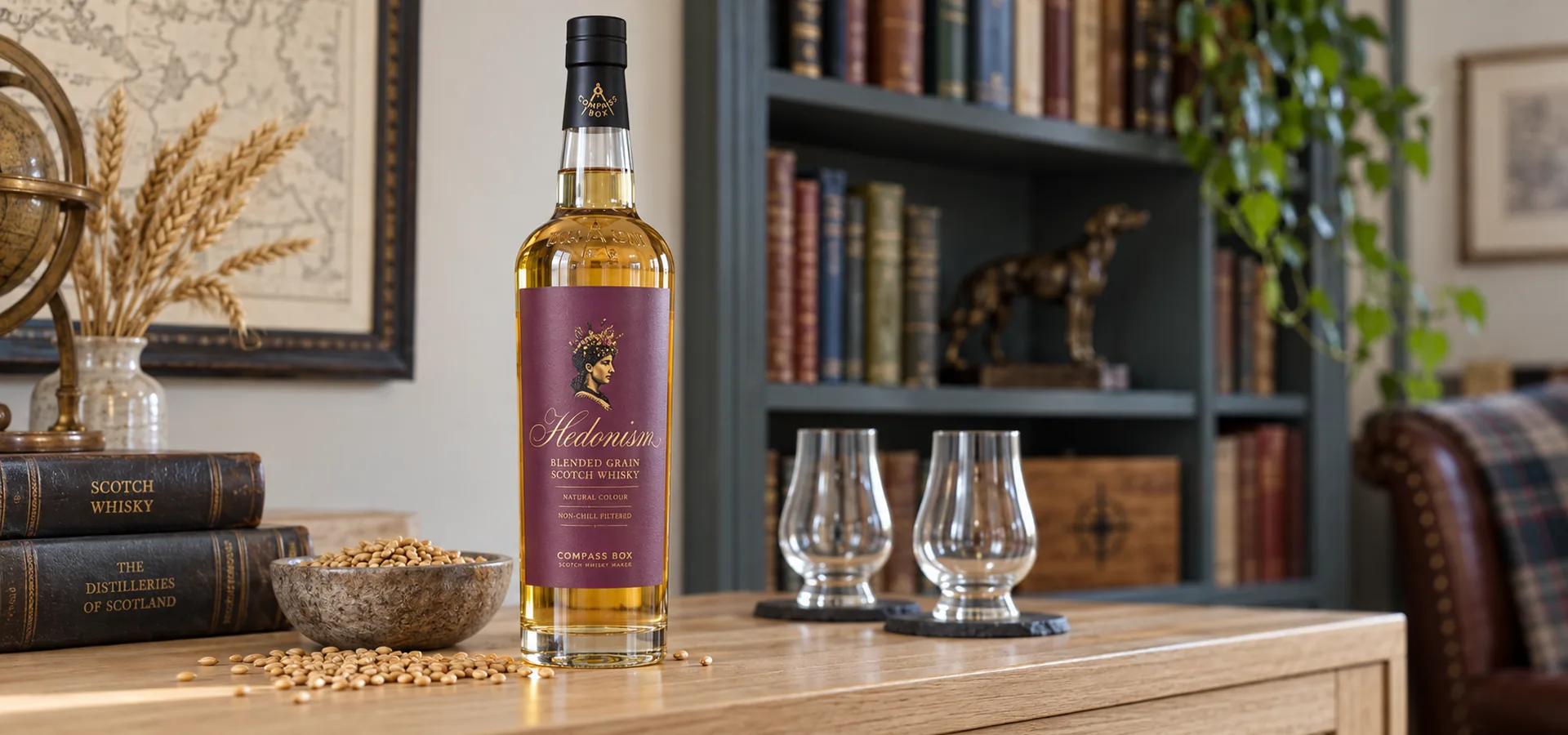
At a glance
- Legal category
- Blended Grain Scotch Whisky, Scotch Whisky Regulations 2009 regulation 3(2)
- Minimum strength
- 40 percent ABV
- Also called
- Blended Grain Scotch Whisky, Grain Scotch, Blended grain whisky
Is a blended grain Scotch cut with anything?
Nothing was cut into it. A blended grain Scotch is a blend of Scotch whiskies, so every drop in the bottle had already cleared the whole standard before any blending began.
Every component is already Scotch Whisky. Each one was distilled in Scotland, matured there for at least three years in oak, and carries nothing added but water and plain caramel colouring. Blending combined finished whiskies; it did not dilute them with anything else.
The conditions are worth reading in full, because they are stricter than most readers assume and they apply to grain whisky exactly as they apply to malt.
A Scotch must be distilled at a distillery in Scotland from water and malted barley, to which only whole grains of other cereals may be added. The mash, the conversion by the grain's own enzymes and the fermentation must all happen at that same distillery.
Maturation is fixed just as tightly. Oak casks of no more than 700 litres, in Scotland only, for not less than three years, and only in an excise warehouse or another place customs permits.
The short list of what may be added
This is where Scotch is unusually strict, because no substance may be added to a Scotch Whisky except water, plain caramel colouring, or both together.
That single sentence is what makes the category name trustworthy. It is also the sharpest difference from the American blending standard, where blending may legally introduce up to eighty percent neutral spirits.
Two floors close the list: a minimum of three years in wood and a minimum of 40 percent alcohol by volume. Both are floors rather than descriptions, so two blended grain Scotches that clear them can still be nothing alike.
What does the word grain mean in a Scotch category?
Grain is the word readers get wrong, and it is not a quality grade. It names the cereals that went into the mash.
Beyond water and malted barley, a grain Scotch may use whole grains of other malted or unmalted cereals, in practice usually wheat or maize, and malted barley is still underneath it because the regulation starts there before anything else is added.
The ceiling that keeps it whisky
Every Scotch must be distilled below 94.8 percent alcohol by volume, and the rule says why: so the distillate keeps an aroma and taste derived from its raw materials and its method.
That ceiling sits close to neutral strength. A grain Scotch may be light and is still required to carry flavour from its own production, rather than arriving as a blank spirit.
A spirit can be light without being empty, and the vocabulary for a light spirit is what tells the two apart in a glass.
The still is a legal difference, not a preference
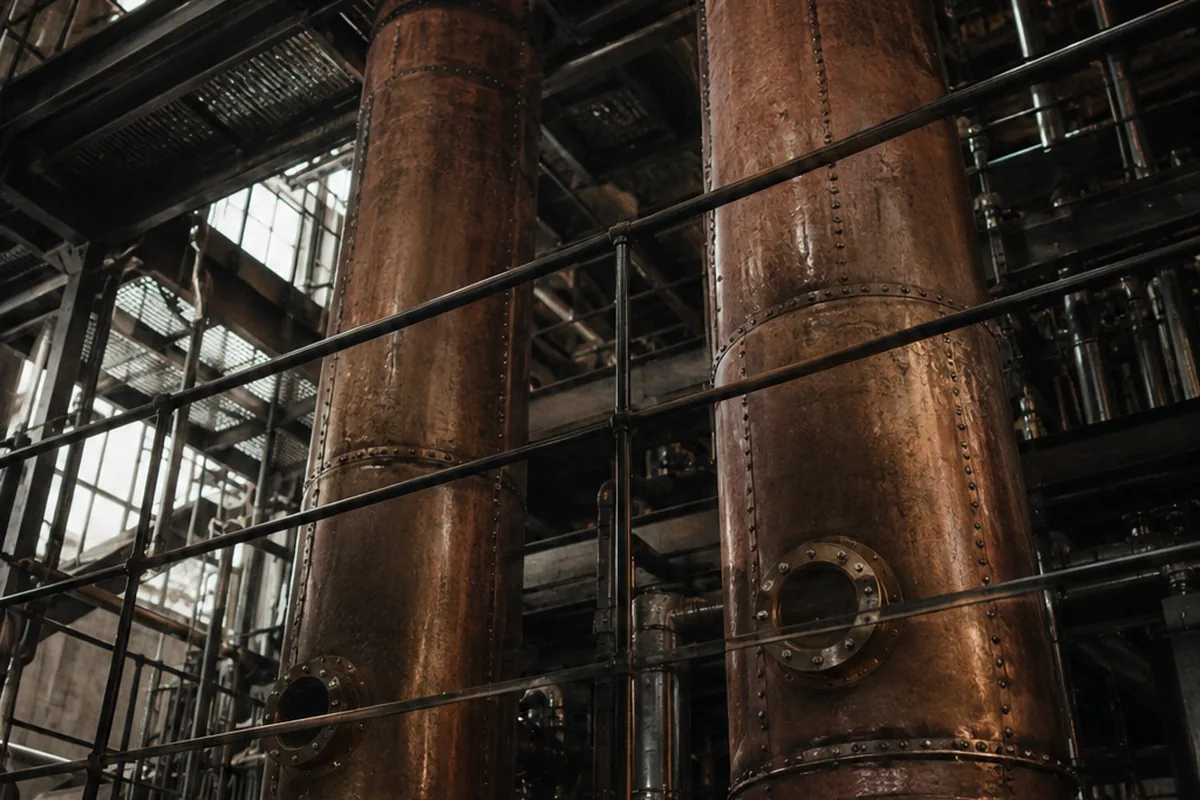
Single Malt Scotch Whisky must be distilled in pot stills. Grain Scotch is distilled continuously, in columns, and that difference is written into the categories rather than chosen by a distiller.
Where the words single and malt sit together they are not always doing the same work, as the American malt entry shows.
What a column actually does to a spirit as it runs is a process worth following separately. On the label the still matters only because the category name reports it.
How is Single Grain Scotch Whisky defined?
The definition is drafted in an unusual way, and noticing that explains most of the confusion around it.
Single Grain Scotch Whisky means a Scotch Whisky distilled at a single distillery except Single Malt Scotch Whisky or a Blended Scotch Whisky. It names no cereal of its own at all.
So a grain Scotch is defined by the two categories it is not. Each exclusion does a specific job.
- The Single Malt exclusion stops a pot still barley whisky from also counting as a grain one.
- The Blended Scotch exclusion stops a blend of malt and grain made at one distillery from also counting as Single Grain.
What single is counting
Single reports one distillery, and it does not report one cereal or one cask.
A Single Grain Scotch bottled from fifty casks of one distillery is correctly named, and so is one made from three cereals. A grain whisky distilled anywhere but Scotland is not Single Grain Scotch Whisky whatever else it does.
Which Scotch categories use the word blended, and what does each mean?
Readers expect one blended category and meet three. They separate cleanly once you know that each name is reporting two things: which whiskies went in, and how many distilleries they came from.
| Category | What goes in | Distilleries |
|---|---|---|
| Single Malt Scotch Whisky | Malted barley only, pot stills | One |
| Single Grain Scotch Whisky | Other cereals permitted; defined by exclusion | One |
| Blended Malt Scotch Whisky | Single Malts only | More than one |
| Blended Grain Scotch Whisky | Single Grains only | More than one |
| Blended Scotch Whisky | Single Malt with Single Grain | More than one |
Read down the last column and the pattern appears. In every name containing the word blended, blended means more than one distillery, never that something was added.
That is not how the word works everywhere, because in Ireland blended counts varieties instead, so a blend there can come from a single distillery.
Only one of those three mixes malt with grain, and it is the one that mixes malt with grain: Blended Scotch Whisky. That is also the category most bottles on a supermarket shelf belong to.
Why older writing disagrees
Before the 2009 regulation, any combination of Scotch whiskies counted as a Blended Scotch Whisky, including a blend of malts alone. The definition was then narrowed to malt with grain.
So an older book or article can describe these categories accurately for its own date and still mislead a reader standing in a shop today. Any single rule is only as current as the date it was last checked against the regulation itself.
Does the category have to appear on the bottle?
Knowing what the five names mean would be of limited use if producers could leave them off, and they cannot.
The regulation makes the category description compulsory, and it is unusually specific about how it must appear.
- On the front, and on the packaging. Every Scotch must carry its category on the front of the bottle and on any individual packaging.
- As prominent as anything else. The category description must be at least as prominent as any other description of the whisky on the label.
- Only a place may join it. The single permitted addition is the Scottish locality or region where the whisky was distilled, so "Single Malt Scotch Whisky" must otherwise appear in exactly that form.
This is why a Scotch label answers its own question in a way most spirits labels do not. The name is the sales description, and it has to be legible against everything the marketing department added around it.
What it does not report is the cask, the age or the quality.
One term is banned outright. Pure Malt may not be used on any Scotch Whisky, because it confused buyers about which category they were holding.
What does an age on a blended grain Scotch count?
The category is compulsory and an age is not, which makes the age statement the one figure on a Scotch label a producer chooses whether to give.
When it is given, the rule is strict. The only age that may be stated is the age of the youngest Scotch whisky in the product.
The regulation works it through with its own example: blend eight, twelve and fifteen year old whiskies and the only claim available is eight years old. Wording such as "aged 8 years" is fine, so long as the figure is in years.
A vintage year is the stricter claim
If a distillation or vintage year is used instead, only one year may be mentioned, and every drop in the product must have been distilled in it.
So a vintage admits no younger component at all, where an age statement only fixes a floor. The two look similar on a label and are not making the same promise.
A bottle with no age on it is therefore claiming nothing rather than hiding something, which is a different reading from the one most shoppers apply. What an age statement does and does not report is the whole of that difference.
Common questions
- Is blended grain Scotch cut with neutral spirits?
- No. Nothing may be added to a Scotch Whisky except water, plain caramel colouring, or both. Every component of a blended grain Scotch is itself Scotch whisky, matured at least three years in oak casks in Scotland.
- What does grain mean in a Scotch category?
- It names the cereals used. Beyond water and malted barley, a grain Scotch may use whole grains of other malted or unmalted cereals, and it is distilled continuously in column stills rather than the pot stills a single malt requires.
- What is the difference between blended grain and blended malt Scotch?
- Blended Grain Scotch Whisky is a blend of two or more single grain Scotch whiskies from more than one distillery. Blended Malt Scotch Whisky is the same arrangement using single malts. Neither mixes malt with grain.
- Which Scotch category mixes malt and grain?
- Blended Scotch Whisky, which is a blend of one or more single malt Scotch whiskies with one or more single grain Scotch whiskies. It is the category most supermarket Scotch belongs to.
- Does the category have to be printed on a Scotch bottle?
- Yes. Every Scotch Whisky must carry its category on the front of the bottle and on any individual packaging, as prominently as any other description. The only words that may be added are the Scottish locality or region of distillation.
- What does an age statement on a blended grain Scotch mean?
- It gives the age of the youngest Scotch whisky in the bottle. A blend of eight, twelve and fifteen year old whiskies may only be sold as eight years old.
Sources
-
Scotch Whisky Regulations 2009, regulation 3, as set out in the Scotch Whisky Association guidance for producers and bottlers
Accessed 4 September 2026.
-
The Scotch Whisky Regulations 2009 (SI 2009/2890), regulation 3
Accessed 4 September 2026.
-
The Scotch Whisky Regulations 2009 (SI 2009/2890), regulations 8 and 11
Accessed 4 September 2026.
More in Spirits
-
 American single malt whisky
01
What is American single malt whisky, and what does it guarantee?
-
 Australian whisky
02
How is Australian whisky defined, and by which law?
-
 Black rum
03
What is black rum, and does the colour mean anything?
-
 Blended American whiskey
04
What is blended American whiskey, and how much of it is whiskey?
-
 Blended Irish whiskey
05
Blended Irish whiskey: which word counts the distilleries?
-
 Blended Scotch
06
Blended Scotch: what is in it, and why does the recipe change?