
Spirits
What is single grain Scotch, and which grain is it?
Single grain Scotch is any Scotch distilled at one Scottish distillery that is neither a single malt nor a blend. The category names no cereal of its own, and what usually puts a whisky into it is the still rather than the grain.
At a glance
- Legal category
- Single Grain Scotch Whisky under regulation 3(2) of the Scotch Whisky Regulations 2009, sitting inside the same base standard as every other Scotch category.
- Minimum strength
- 40 percent ABV
- Also called
- Single grain Scotch whisky, Grain Scotch, Scottish grain whisky
What is a single grain Scotch made from?
Nothing in the name answers that. Single Grain Scotch Whisky is any Scotch distilled at a single distillery that is neither a single malt nor a blend.
The word grain is doing no work at all in that sentence.

- Distilleries behind it
- One
- Cereals permitted
- Malted barley plus whole grains of other cereals
- How the starch is converted
- By enzymes already in the mash, with none added
- What it may not be
- A single malt, or a blend
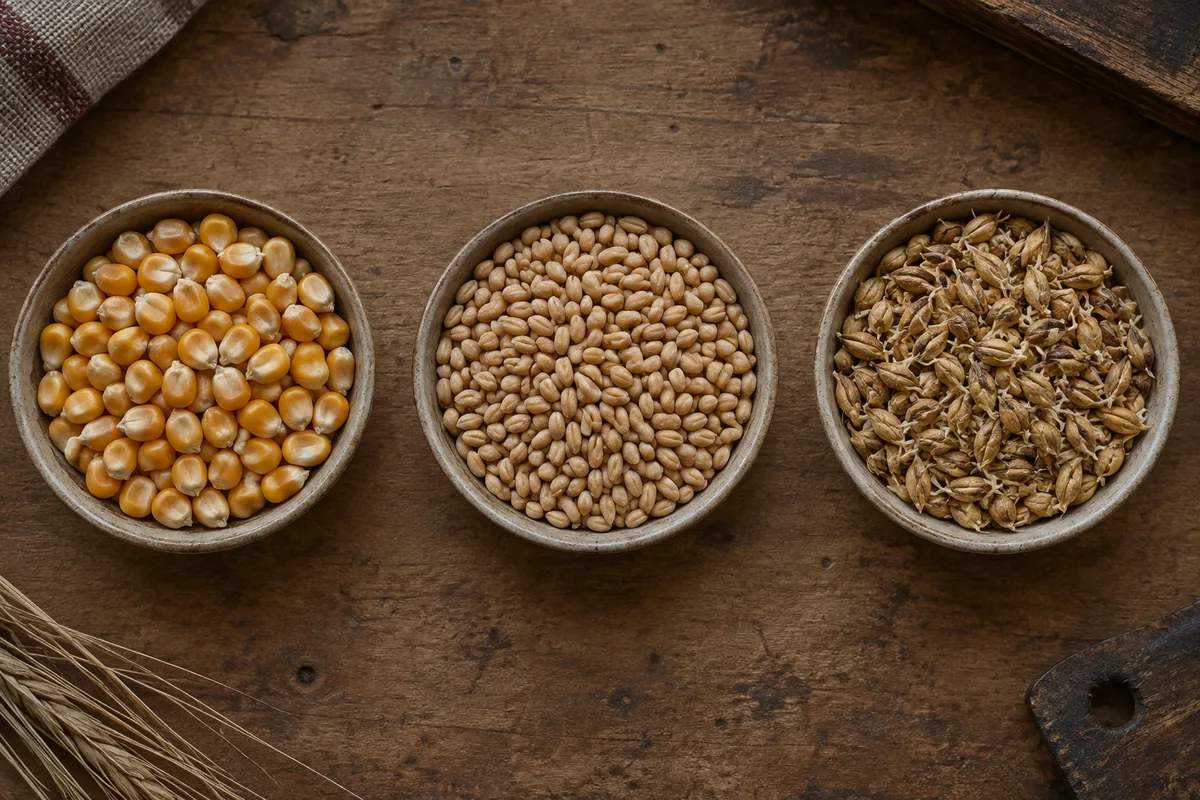
In practice the category has a composition. A single grain Scotch may be produced from water and malted barley, together with whole grains of other malted or unmalted cereals.
Maize and wheat are the cereals a Scotch grain distillery usually works with alongside the malted barley that supplies the enzymes.
That last clause is a rule rather than a habit.
Every Scotch must be converted into a fermentable substrate only by endogenous enzyme systems, so no enzyme may be added to a grain mash.
Malted barley is therefore not in the recipe for flavour. The regulation forbids the industrial alternative, and the malt is what carries the enzymes that turn maize starch into sugar.
Grain whisky made under other regimes is not held to that. The technical file for Irish whiskey, for one, allows other natural enzymes at the brewing and fermentation stage.
A malted barley whisky can be a single grain
The single malt definition has three conditions and the third is the one nobody quotes.
Single Malt Scotch Whisky must be distilled at a single distillery from water and malted barley without other cereals and in pot stills. Take any one of those away and the whisky is not a single malt.
Now remove only the third.
The still decides the category, not the cereal. A Scotch made from only malted barley and distilled in a column still fails the pot still condition, so it is a single grain.
Nothing in the grain category asks about cereals at all. It takes whatever the malt definition and the blend definition leave behind.
Most single grain Scotch is made from mixed cereals, so the malted barley case is a consequence of the drafting rather than the usual product. It is also produced and sold, which is what makes it worth knowing.
A reader who wants to know what is in the bottle has to look past the category to the distillery and the producer's own description.
Continuous distillation, and the 94.8 percent ceiling
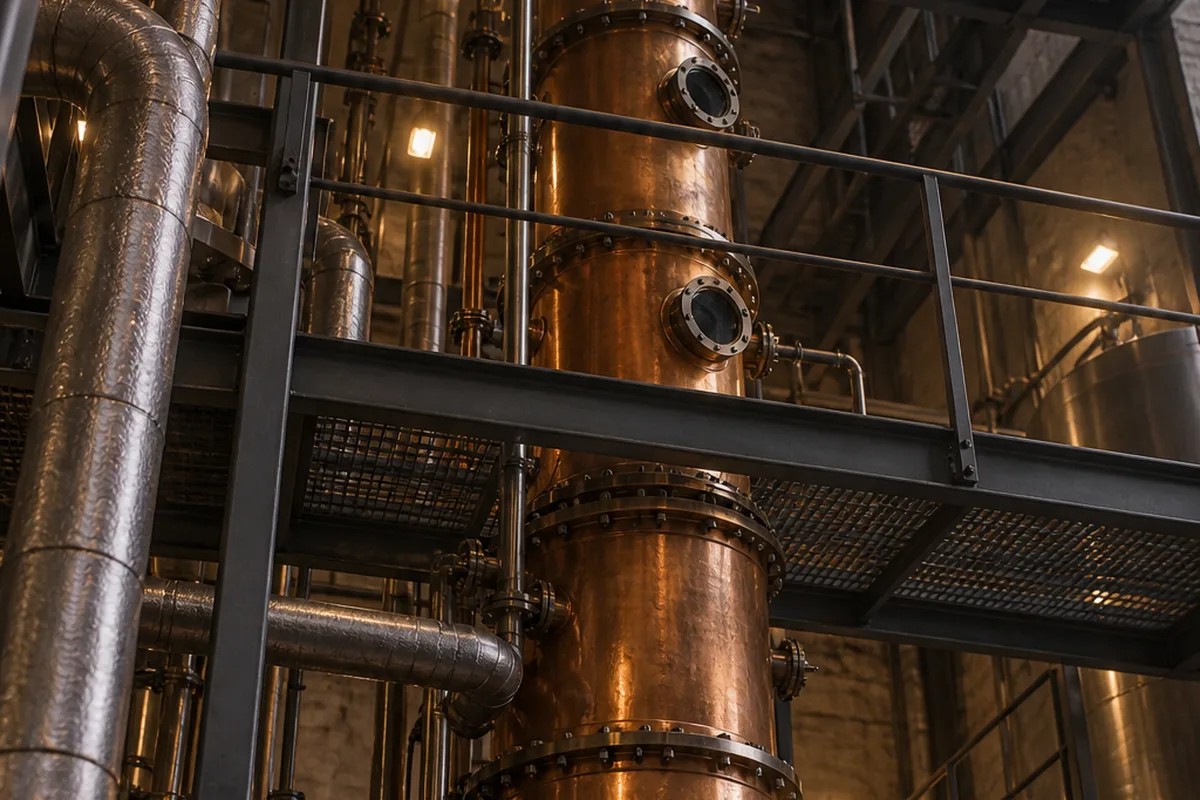
The column still behind a single grain Scotch runs continuously, with wash entering and spirit leaving while the still stays in operation.
A pot still is charged, run down and emptied instead. Each batch of Scotch is a separate event with its own cut points.
| What you are asking | Batch, in pot stills | Continuous, in a column |
|---|---|---|
| How the still runs | Filled, run and emptied, one charge at a time | Wash in and spirit out without stopping |
| What ends a run | The charge is exhausted | A shutdown, not the liquid |
| Where the strength lands | Well below the ceiling | Close to it |
| What reaches the cask | A heavier congener load | A lighter one |
A ceiling exists because a still of that kind could otherwise run past the point where whisky stops being whisky.
Every Scotch must be distilled at an alcoholic strength of less than 94.8 percent so the distillate keeps an aroma and taste from its raw materials and its production. The number is not a rounding: it is the boundary between a spirit that still reports its mash and one that does not.
A grain Scotch comes off close to that ceiling. It carries fewer congeners into the cask than a pot still spirit does.
Fewer is not none, and the regulation is what guarantees that.
What happens inside the column
The word continuous describes a path rather than a speed, and the path is worth following once.
A continuous flow of wash passes down through a series of perforated plates inside the distilling column. Gravity does that part.
- Wash down the plates. Fermented wash enters near the top and works downward through perforated trays.
- Steam up through the apertures. Steam applied at the base of a grain column drives vapour up through apertures in each plate, stripping alcohol and congeners out of the wash.
- Condensed at the top. The alcohol laden vapour is cooled and collected where the column is coolest.
- A second column. The first stage vapour is then distilled again, and this is where the character is actually set.
Wash falling and steam rising in the same vessel is the whole trick. Each plate is a small separation, and stacking a great many of them is what lets one pass do the work of several batch runs.
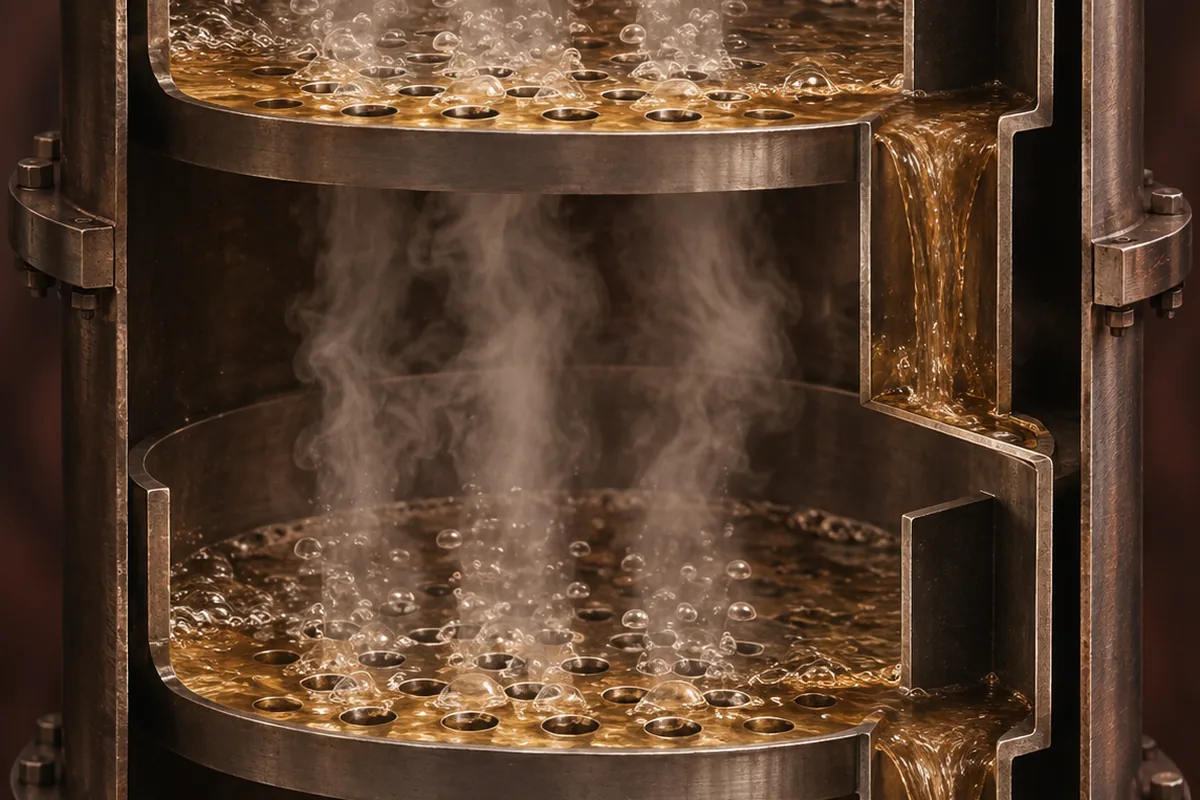
The alcohol laden vapour is condensed at the top, and the first stage vapour is then distilled again through a secondary column.
Now the part that decides what the whisky is like.
The draw off point on the final column and the volume of side streams removed let one grain still produce spirit from very light to more heavily flavoured. Move the draw point and the spirit changes without a single fitting being replaced.
That is why grain whisky from one site is not one product. A column is an adjustable instrument, and the distiller's decisions on it matter as much as the cereals underneath.
Column designs differ, so the two column arrangement described here is common rather than universal. Some plants run three, with an extractive column between the other two.
The line between grain whisky and neutral spirit
A suspicion follows grain whisky around: that it is vodka with a cask stage bolted on.
The regulation answers it with a number rather than an argument.
A single grain Scotch must come off the still below 94.8 percent, so a strength above that line cannot be Scotch at all. The ceiling is not decorative and it is not near the working strength by accident.
The cereals do not separate them, the strength does. A grain distillery and a neutral spirit plant can start from the same cereals and diverge at the draw off point.
Distilling a grain spirit above that line strips the congeners that carry aroma and taste from the raw materials. That is the purpose of a neutral spirit and it is exactly what the Scotch definition forbids.
Two details keep the line honest.
The 94.8 percent ceiling on a grain Scotch is a production limit rather than a bottling strength, so it applies before any cask or water. A whisky bottled at 40 percent still had to clear it years earlier.
And the guarantee is one directional. The ceiling guarantees that some character survives in a grain Scotch and says nothing about how much of it.
Most of it is never sold under its own name
Grain whisky has somewhere to go, and it is not the shelf.
Blended Scotch Whisky is a blend of one or more single malts with one or more single grains, so grain whisky has a standing industrial destination. Filling for that destination is the reason the distilleries exist at the scale they do.
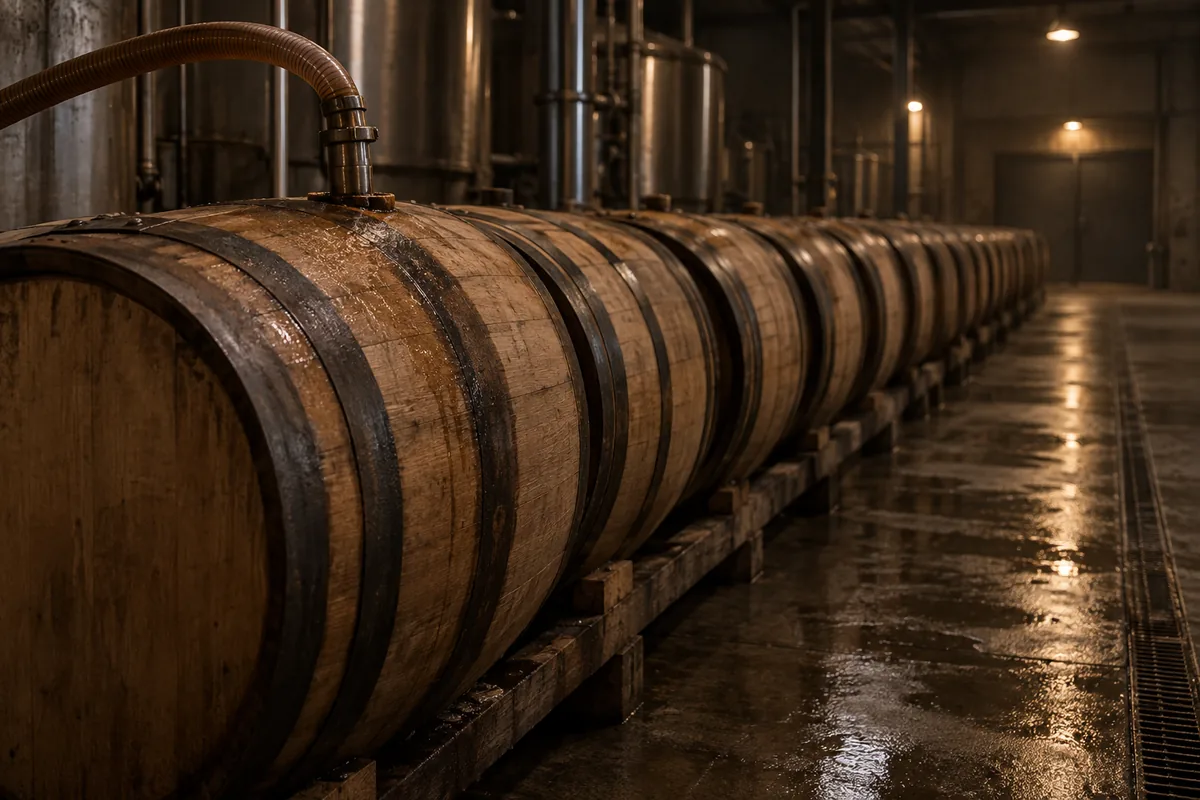
A single grain Scotch release is stock held back from blending rather than a separate production run.
Scotland has only a handful of grain distilleries, and each works at a scale a malt distillery does not approach. One of them can out-produce a great many malt sites at once, which is why the stock behind these releases is deep and old.
Two or more single grains blended together are a blended grain Scotch, which is a fifth category again rather than a variant of this one.
That picture is changing at the edges. A few producers now fill and release grain whisky deliberately, so the blending destination is a tendency rather than a rule.
Long maturation on a light spirit
A grain spirit enters the cask with fewer congeners. Wood derived aroma therefore meets less competition from the distillate.
The cask is working on a quieter starting point. It has correspondingly more room.
| What you are asking | A pot still malt spirit | A light grain spirit |
|---|---|---|
| What the spirit brings | A heavy congener load of its own | Much less, and less that competes |
| What the wood can add | A layer beside the distillate | Most of what the drinker will notice |
| What a very long fill risks | Wood covering a character that was there | Tannin arriving where little else pushes back |
That explains a pattern on the shelf. Single grain Scotch frequently carries ages that would be unusual on a malt, because the stock was already sitting in warehouses for blending.
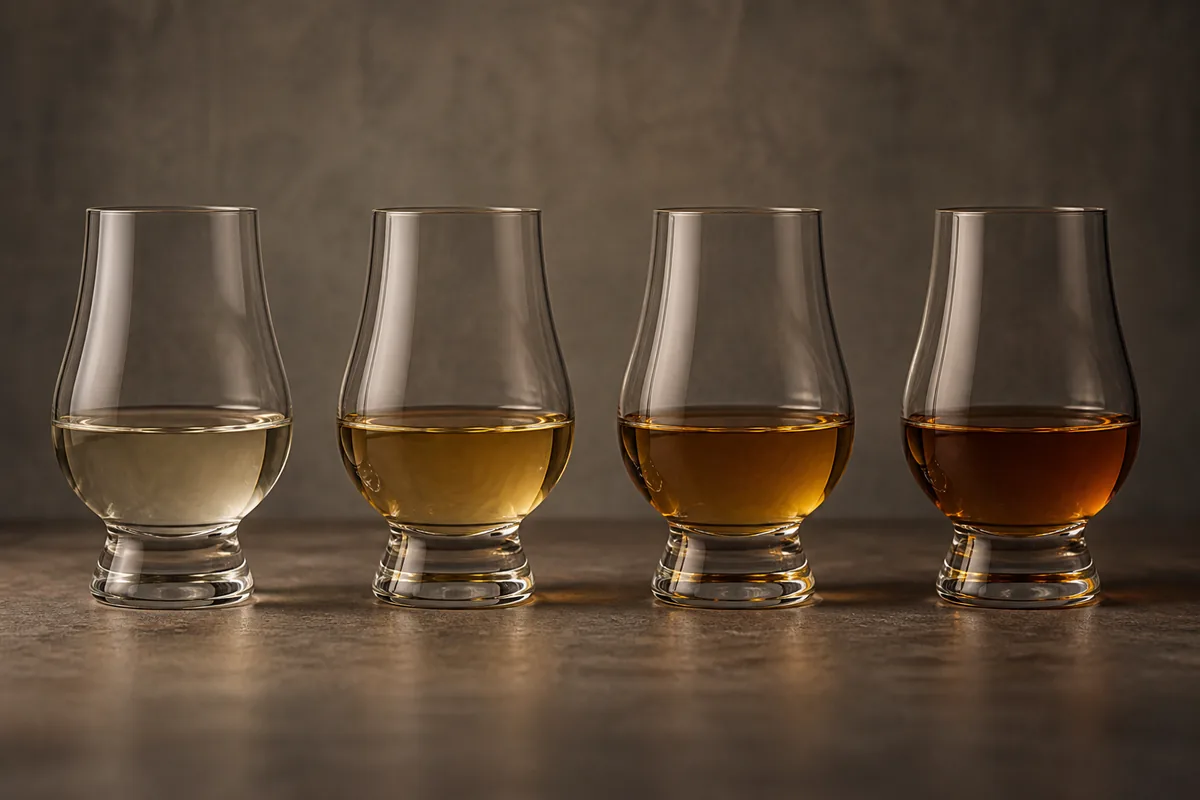
Long maturation on a light grain spirit produces a whisky whose character reports the cask more than the mash.
That is worth reading as a description rather than as praise. A light spirit can also be overwhelmed, so a very long maturation in an active cask can leave a grain Scotch tannic rather than complex.
An age on one of these bottles is a fact about the warehouse. It is not a promise about the glass.
The distillery name on a grain bottle
Because so few sites make it, the distillery name is the most useful thing on one of these labels. The regulation protects it accordingly.
It is illegal to use the name of a listed Scotch distillery as a brand name unless the whisky was wholly distilled there.
A second provision goes further than the list. A specific provision makes it illegal to label a Single Grain Scotch Whisky in a way likely to deceive the public as to the identity of the distiller.
That wording is worth noticing. The provision names single malt and single grain together, so the two categories carry the same protection, and grain whisky is not treated as the category where a vaguer name would do.
- What a distillery name asserts
- The whisky was wholly distilled there
- Which categories are named
- Single malt and single grain, together
- Who applies the test
- The brand owner, not a registry
With so few grain distilleries in Scotland, a distillery name is the most identifying thing a single grain Scotch label can carry. Knowing the site tells you the cereals, the column arrangement and the warehouse in one word.
The enforcement is quieter than it sounds. The deception test on a single grain Scotch label is applied by the brand owner rather than by a filing, so compliance is a judgement.
How do you read a single grain Scotch label?
Some of the words on the front were required and some were chosen, and the bottle does not distinguish them.
- The category description. Every Scotch must carry its category on the front of the bottle, so Single Grain Scotch Whisky is a required sales description rather than a marketing choice.
- A region or locality name. The only word that may be added to a Scotch category description is the name of the Scottish region or locality where the whisky was distilled.
- An age statement. The figure reports the youngest whisky in the bottle, which on a single grain release is often a high number.
- The distillery name. With so few grain distilleries in Scotland, the name narrows a single grain Scotch further than the category does.
The order runs from least informative to most, which is the reverse of the order the label prints them in.
A cereal named on the front of a single grain Scotch is a producer's description rather than a regulated statement of the mash. It may be accurate and nothing compels it to be complete.
The distillery name is the one that settles things, because a reader who knows the site knows the cereals, the columns and the warehouse behind the bottle. Everything else on the front is a category every Scotch has to declare.
The requirements every single grain Scotch still meets
The lightness invites a suspicion that the standard is lighter too. Every Scotch category satisfies the same standard, and these are the numbers behind it.
- Maximum cask size
- 700 litres
- Minimum maturation
- 3 years, in Scotland
- Minimum strength
- 40 % ABV at bottling
- Permitted additions
- Water and plain caramel colouring
A single grain Scotch must be matured only in Scotland in oak casks of a capacity not exceeding 700 litres.
A single grain Scotch must be matured for not less than three years and bottled at not less than 40 percent alcohol by volume. The three year floor is invisible on a thirty year old bottling and it still applies to it.
Nothing may be added to a single grain Scotch except water, plain caramel colouring, or water and plain caramel colouring.
That last rule is the one worth holding onto. A light Scotch is light because of how it was distilled, not because anything was done to it afterwards.
Grain whisky made outside Scotland answers to its own rules on cereals and on added enzymes, so none of this transfers to a grain whiskey made anywhere else.
At the glass, a light spirit asks for less water
Water behaves differently here.
A single grain Scotch carries less congener load, so water moves it further and faster than it moves a pot still whisky.

Start with less than you would use on a malt and add it in stages, because what comes out cannot be put back. Work through the nose first, since the wood-led aromas these whiskies carry are the part dilution reaches soonest.
- Standard drink, United States
- 14 g of pure alcohol
- One drink at 40 % ABV
- About 44 ml
- One drink at 57 % ABV
- About 31 ml
- What the category changes
- Nothing in this column
A standard drink in the United States is 14 grams of pure alcohol, whichever Scotch category the whisky belongs to. Fourteen grams of alcohol is roughly 44 ml of a Scotch bottled at 40 percent alcohol by volume.
The same 14 grams is about 31 ml of a single grain Scotch bottled at 57 percent, and cask strength releases are common in this category.
The alcohol in a measure of single grain Scotch is set by the stated strength and the size of the pour, not by the category. A light spirit is not a weak one.
No Scotch category, dilution or age can establish that anybody is fit to drive.
Common questions
- Does single grain Scotch have to contain a grain other than barley?
- No. The category is defined by what it is not rather than by a cereal, so a Scotch made entirely from malted barley falls into it whenever the distillation was not carried out in pot stills.
- Is grain whisky lower quality than malt whisky?
- The regulation recognises no grade. Both categories sit inside the same standard on maturation, strength and additions, and the difference is in how the spirit is distilled rather than in what it is permitted to be.
- Why are so many single grain Scotch bottlings very old?
- Grain whisky is filled mainly as blending stock, so mature parcels accumulate in warehouses. A single grain release usually comes from that stock rather than from a run laid down for bottling on its own.
- What is the difference between single grain and blended grain Scotch?
- A single grain Scotch is distilled at one distillery. A blended grain Scotch is a blend of two or more single grain Scotches from different distilleries, so the word single is counting sites in both cases.
Sources
-
Irish Whiskey technical file, sections 2 and 4, Department of Agriculture, Food and the Marine
Accessed 4 September 2026.
-
NIAAA, What Is a Standard Drink?
Accessed 13 September 2026.
-
Scotch Whisky Association, Guidance for Bottlers and Producers 2025
Published 2025. Accessed 7 September 2026.
-
The Scotch Whisky Regulations 2009 (SI 2009/2890), regulation 3
Accessed 4 September 2026.
More in Spirits
-
 American single malt whisky
01
What is American single malt whisky, and what does it guarantee?
-
 Australian whisky
02
How is Australian whisky defined, and by which law?
-
 Black rum
03
What is black rum, and does the colour mean anything?
-
 Blended American whiskey
04
What is blended American whiskey, and how much of it is whiskey?
-
 Blended Irish whiskey
05
Blended Irish whiskey: which word counts the distilleries?
-
 Blended Scotch
06
Blended Scotch: what is in it, and why does the recipe change?