
Spirits
What is blended American whiskey, and how much of it is whiskey?
Blended American whiskey is not one federal class but several, and the one that permits the most neutral spirits permits four fifths of the bottle to be neutral spirits. The figure that settles any single bottle is printed on its label: the percentage of neutral spirits and the commodity they were distilled from.
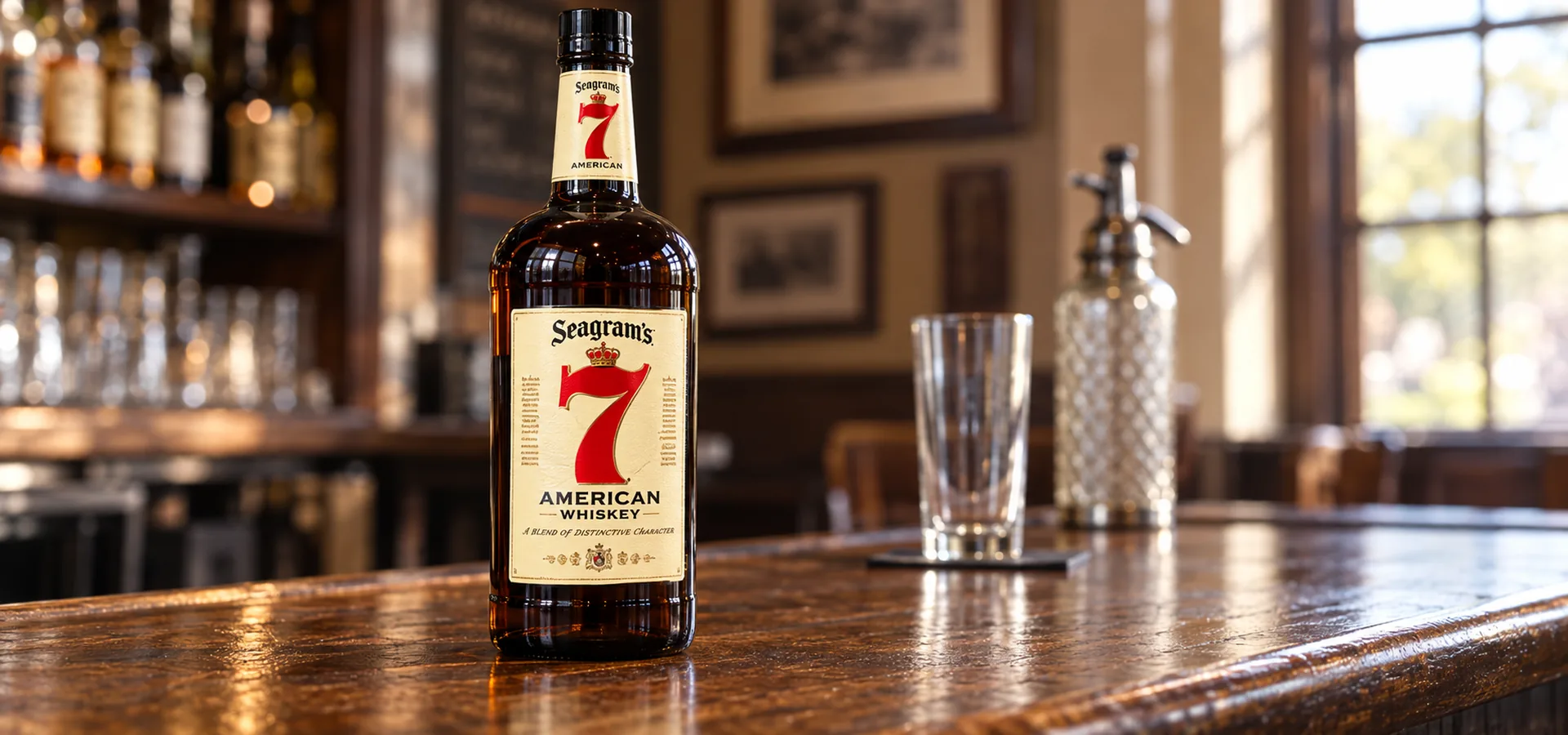
At a glance
- Legal category
- Class whisky at 27 CFR 5.143; designation Blended Whisky, Table 1 to paragraph (c)
- Minimum strength
- 40 percent ABV
- Also called
- Blended whisky, Whisky a blend, American blended whiskey
Is blended American whiskey a single federal class?
- Legal class
- Whisky, at 27 CFR 5.143. Blended American whiskey is not itself a designation.
- Designation to look for
- Blended Whisky, printed on a label as Blended Whisky or whisky — a blend.
- Minimum straight whisky
- 20 percent on a proof gallon basis.
- Maximum neutral spirits
- 80 percent on a proof gallon basis.
- Minimum strength
- 40 percent ABV, the floor the class whisky sets.
- Required on the label
- The percentage of neutral spirits and the commodity they were distilled from.
Start with what the word whiskey guarantees on its own, because the word beside it moves everything else.
The class whisky is defined at 27 CFR 5.143(a). It is a distillate from a fermented mash of any grain, distilled below 95 percent ABV, stored in oak barrels, and bottled at not less than 40 percent ABV.
That is a real floor, and it is a low one. It fixes the raw material, a distillation ceiling and a bottling strength, and says nothing about how much of the bottle has to be whisky rather than something else.
The phrase is not in the regulation
Look for blended American whiskey in the whisky standards and it is not there, because no composition rule attaches to those three words as a group.
What the regulation carries instead is a designation. Table 1 to 27 CFR 5.143(c) lists it as entry (10), Blended Whisky, which a label may also print as whisky — a blend.
Several separate entries in that table contain the word blended. That is the first thing worth knowing: the word is shared, and what it permits is not.
Table 1 is also where the tightly drawn designations live. American single malt whiskey earns its own entry by meeting conditions a blend never has to.
How little straight whisky may a blended whisky contain?
Blended Whisky requires at least 20 percent straight whisky on a proof gallon basis, and the rest may be whisky or neutral spirits, alone or in combination.
The neutral spirits column for that entry gives the other half of the arithmetic: a maximum of 80 percent on a proof gallon basis.
What neutral spirits actually are
Neutral spirits are distilled at or above 95 percent ABV, which is above the ceiling the class whisky sets for itself.
They are not an obscure industrial input. The same regulation designates neutral spirits, treated with small amounts of sugar and citric acid, as vodka.
So the material that may fill four fifths of a Blended Whisky is the material sold in its own right one shelf over. That is not a defect and it is not concealed, but it is rarely what a buyer pictures.
Proof gallon, neutral spirits and straight whisky each carry an exact meaning in that rule, and not one of the three means what it sounds like.
Why a proof gallon basis is not the same as volume
A proof gallon measures alcohol rather than liquid. The twenty percent floor therefore counts the alcohol the straight whisky contributes, not the space it takes up in the bottle.
Twenty percent is also a floor and not a typical figure. A blender may use far more straight whisky than the minimum, and nothing obliges them to say so.
How do the four blended designations differ from each other?
Sharing the word blended does not mean sharing a composition. Two of these designations sit three words apart on a shelf and eighty percentage points apart in what they permit.
| Designation | Straight whisky floor | Neutral spirits ceiling | Colouring and flavouring |
|---|---|---|---|
| Blended Whisky | 20 percent | 80 percent | Permitted |
| Blended Bourbon Whisky | 51 percent straight bourbon | 49 percent | Permitted |
| Blend of Straight Whiskies | Straight whiskies only | None, except as part of a flavour | Permitted |
| Blended Straight Bourbon Whiskies | Straight bourbon only, from more than one state | None, except as part of a flavour | Permitted |
| Spirit Whisky | 5 percent whisky, straight component below 20 percent | 95 percent | Permitted |
The pair to hold on to is the first and the third.
Blended Whisky may be four fifths neutral spirits. A Blend of Straight Whiskies may contain none at all beyond a flavour carrier.
Two of them report geography, not composition
Blended Straight Bourbon Whiskies covers straight whiskies of one named type produced in different states, or in the same state where colouring, flavouring or blending material is present.
There the word blended reports where the whiskies came from. It is doing a completely different job from the same word in entry (10).
What a designation does not tell you
A designation fixes what is permitted, not what a particular blender used. A Blended Whisky may legally contain no neutral spirits at all and still carry that name.
So the table above bounds the answer without giving it, and for the bottle in your hand the answer is printed elsewhere.
Which statement on the label reports the neutral spirits content?
This is the part most worth carrying to a shop. Where neutral spirits were used in blending or other processing, 27 CFR 5.71 requires the percentage and the commodity on the label.
It may appear in any of several interchangeable forms, which is why it is easy to skim past.
- ___% neutral spirits distilled from ___, naming grain, cane products or fruit.
- ___% neutral spirits (vodka) distilled from ___, with the vodka designation shown in brackets.
- ___% grain neutral spirits, with the commodity moved in front.
- ___% grain spirits, used where those neutral spirits were stored in oak.
Read the number, not the adjective. The designation gives a range and this statement gives the figure for that bottle.
Where the requirement stops
The requirement does not reach everything. Cordials and liqueurs, flavoured neutral spirits including flavoured vodka, and distilled spirits specialty products sit outside it.
Gin made by continuous distillation and pure neutral spirits carry only the commodity statement, without a percentage.
The statement also reports one side of the bottle only. It gives the proportion of neutral spirits and says nothing about which straight whiskies make up the rest, or how they were distilled, which is a question about how they were made.
What does an age statement on a blend count, and when must one appear?
An age is the second figure a blend may have to print, and the rule behind it is a threshold rather than a requirement.
Under 27 CFR 5.74, an age statement and a percentage of types of whisky statement are required for whisky aged less than 4 years, including a blend containing any whisky aged less than 4 years. At 4 years and above the statement becomes optional.
Because the statement is compulsory only below four years, its absence carries information. A blend with no age on it holds nothing under four years old, so silence here is a floor rather than a gap.
Which whisky the stated age describes
Where an age is stated for a blended whisky without neutral spirits, the label shows the age of the youngest whisky in the product. It is not an average and not the age of the oldest component.
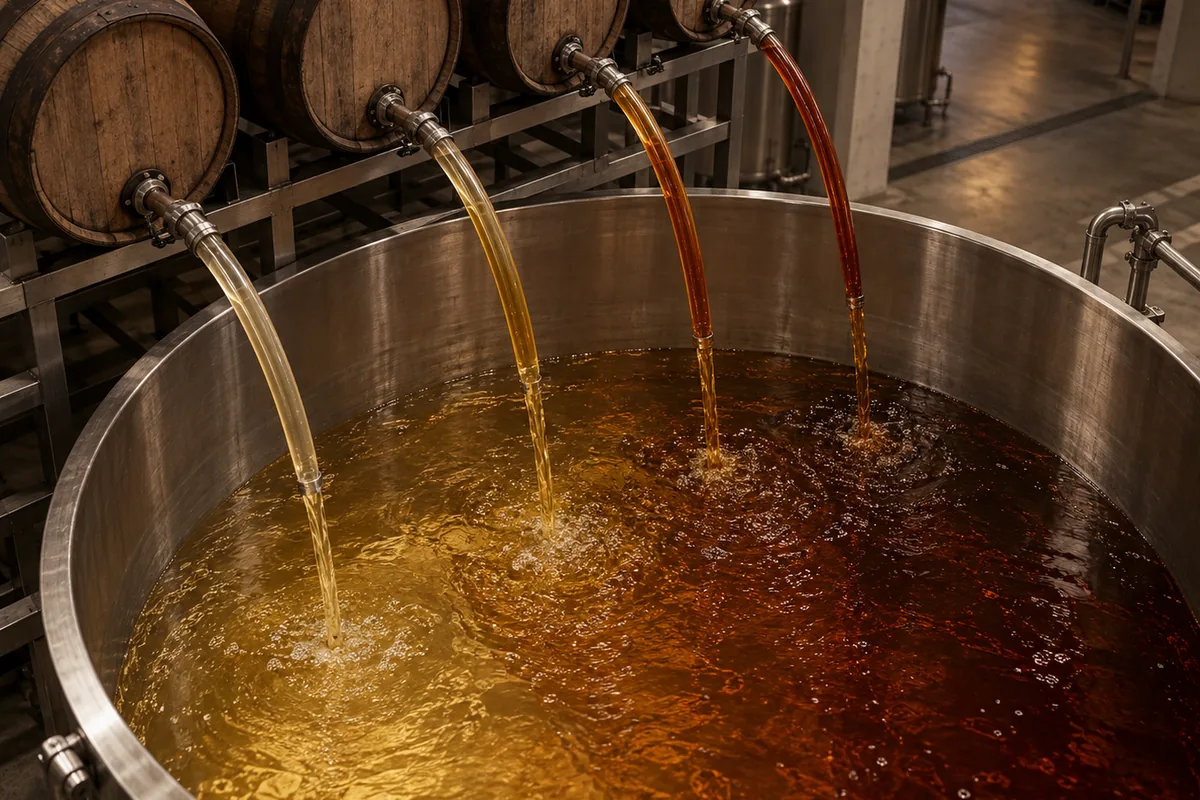
Where a blend does contain neutral spirits and a straight whisky under four years old, the label states the percentage by volume and the age of each such whisky, adjacent to the neutral spirits disclosure.
All of that is United States federal labelling. A blend sold outside the United States answers to a different standard entirely, and which authority sets it, and when that was last checked, is the part that changes.
None of that reports how much of the blend is straight whisky. Age and proportion are two separate readings, and only one of them is the neutral spirits statement's job.
What may be added to a blend after the whiskies are combined?
One column of that table reads the same all the way down, because harmless colouring, flavouring and blending materials are permitted for every blended designation.
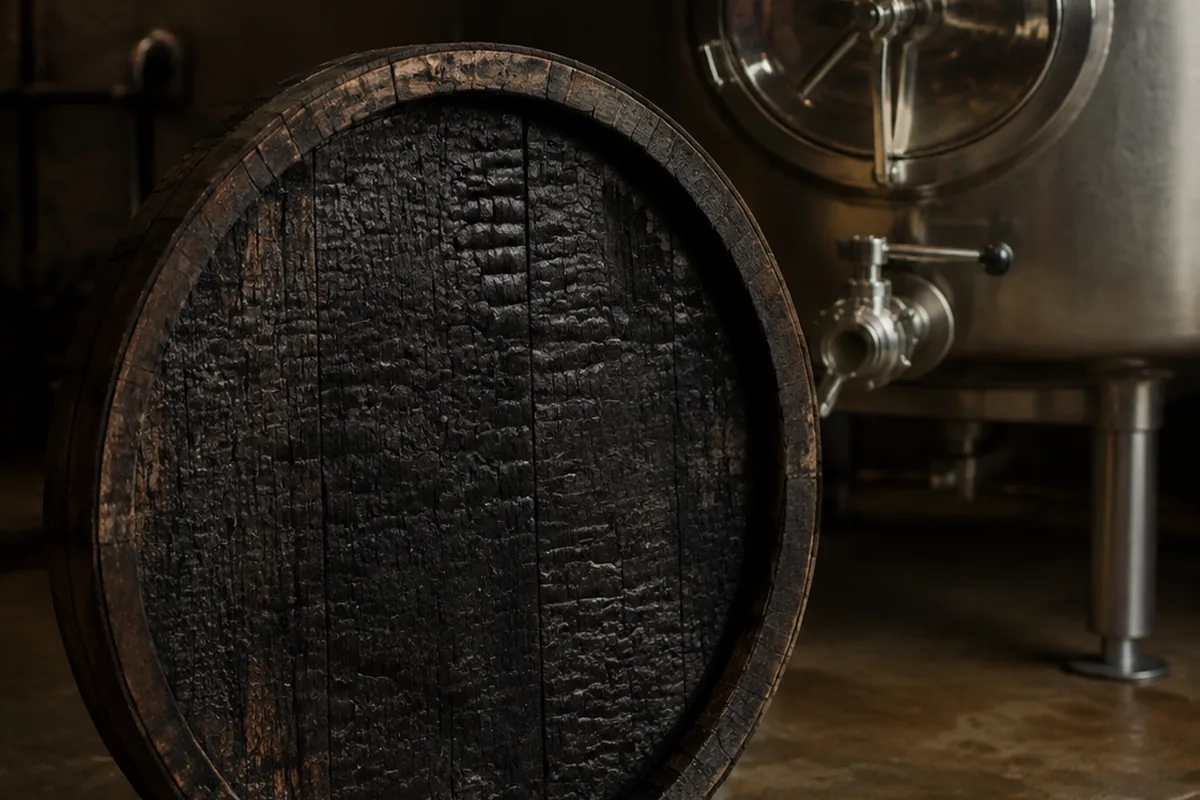
Those materials sit under the 2.5 percent limitation at 27 CFR 5.155. Caramel colouring carries its own disclosure rules at 27 CFR 5.72, which differ by class rather than applying uniformly — the same allowance that makes colour an unreliable cue in black rum.
The contrast that makes the rule visible
Straight whisky permits no neutral spirits and no colouring or flavouring materials at all, and bourbon whisky prohibits them on the same terms.
So the straight whisky inside a blend could not have carried added colouring. The blend built from it may.
Read the percentage, not the word. The designation tells you what a bottle is allowed to be. The neutral spirits statement tells you what this one is. Only one of those two is specific to the bottle you are holding.
None of this settles whether a given bottle is worth buying, which is a question about the whisky rather than about the words. What it settles is how much of the bottle is whisky at all, and the arithmetic for a poured measure of it sits with the strength calculators.
Common questions
- Is blended American whiskey a legal class?
- No. The class is whisky, at 27 CFR 5.143. The phrase blended American whiskey appears nowhere in the whisky standards. The designation a label actually carries is Blended Whisky, which may also be printed as whisky a blend.
- How much of a blended whiskey has to be whiskey?
- Blended Whisky requires at least 20 percent straight whisky on a proof gallon basis. The remaining 80 percent may be whisky or neutral spirits, alone or in combination.
- What is the difference between blended whisky and a blend of straight whiskies?
- Blended Whisky permits up to 80 percent neutral spirits. A Blend of Straight Whiskies permits none, except as part of a flavour. The names are three words apart and the permitted compositions are eighty percentage points apart.
- Does the label say how much neutral spirits are in the bottle?
- Yes. Where neutral spirits were used in blending, 27 CFR 5.71 requires the percentage and the commodity they were distilled from, in a form such as a stated percentage of neutral spirits distilled from grain.
- Why do some blended whiskeys carry no age statement?
- Under 27 CFR 5.74 an age statement is required only where a whisky in the blend is under 4 years old. At 4 years and above it is optional, so a blend carrying no age statement holds nothing younger than four years.
Sources
-
27 CFR 5.143, Whisky, Code of Federal Regulations 2024 edition
Accessed 4 September 2026.
-
27 CFR 5.71, Neutral spirits and name of commodity
Accessed 4 September 2026.
-
27 CFR 5.74, Statements of age, storage, and percentage
Accessed 4 September 2026.
More in Spirits
-
 American single malt whisky
01
What is American single malt whisky, and what does it guarantee?
-
 Australian whisky
02
How is Australian whisky defined, and by which law?
-
 Black rum
03
What is black rum, and does the colour mean anything?
-
 Blended Irish whiskey
04
Blended Irish whiskey: which word counts the distilleries?
-
 Blended Scotch
05
Blended Scotch: what is in it, and why does the recipe change?
-
 Blended grain Scotch
06
Blended grain Scotch: is the grain the cheap part of a blend?