
Spirits
What Is Indian Whisky, and What Can It Contain?
Indian whisky is a broad national category that can include cereal distillate, neutral or rectified spirit constructions, and specifically defined single malt or single grain whisky. The named type on the label tells you more than the country alone.
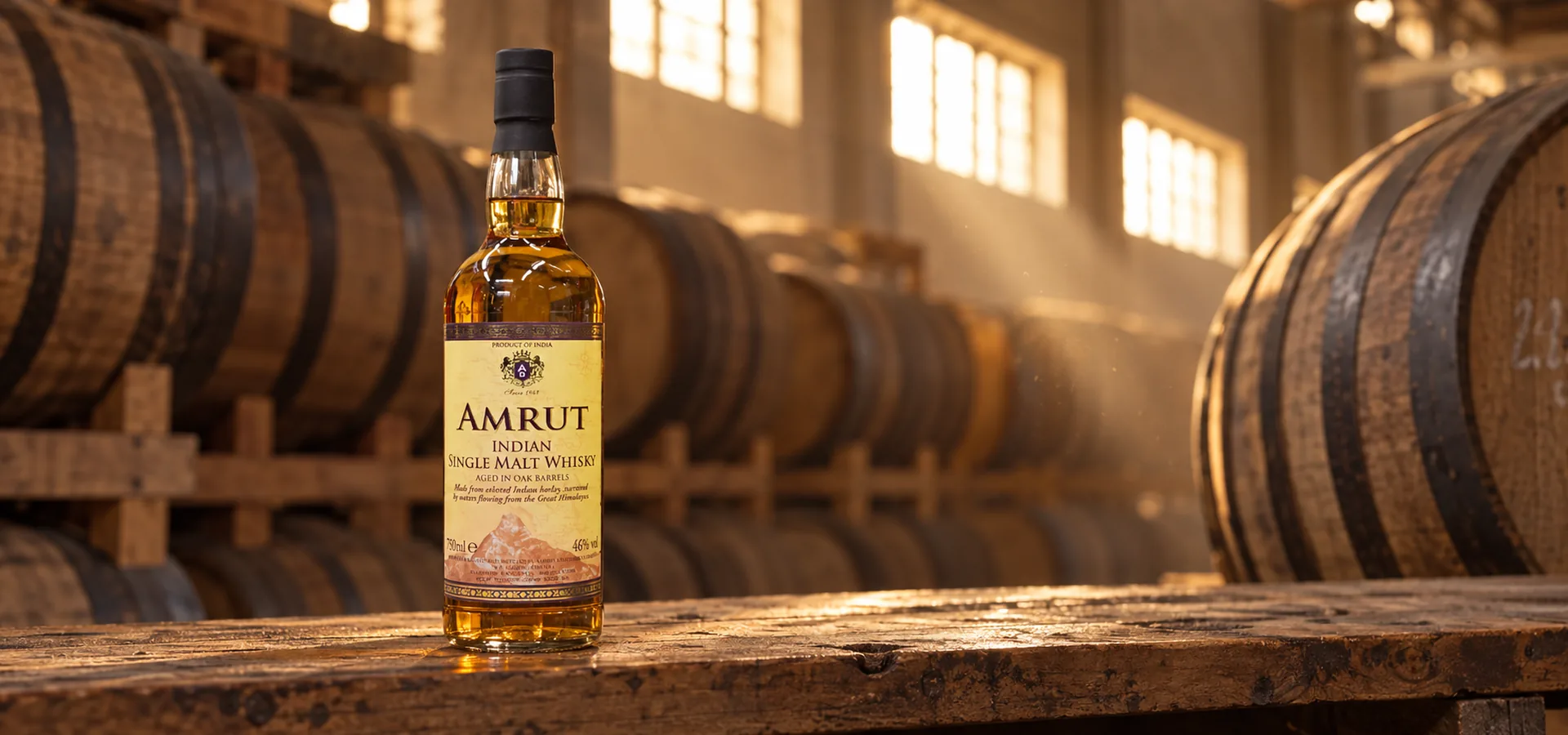
At a glance
- Legal category
- Whisky under Food Safety and Standards (Alcoholic Beverages) Regulations, 2018, as amended
- Typical strength
- 36 to 50 percent ABV
- Also called
- Indian whiskey
- Category range
- Single malt, single grain, and specified blended forms can differ substantially
- Indian blend floor
- Named blended malt or grain categories can use a 2% minimum whisky component
- Climate meaning
- Warm maturation can accelerate extraction and evaporation without a fixed age conversion
What can Indian whisky legally contain?
Indian whisky is not one recipe.
The current Food Safety and Standards Authority of India whisky rules describe a broad whisky standard and then distinguish single malt, single grain, and blended malt or grain forms.
The broad definition can include distillate from a fermented extract of malted cereals. It can also accommodate neutral grain spirit, rectified grain spirit, neutral agricultural spirit, or mixtures in specified constructions.
- Whisky
- The umbrella standard permits more than one kind of cereal or neutral-spirit construction.
- Single malt or single grain
- These branches define the grain input and require production at one distillery.
- Blended malt or grain
- These may combine at least 2 percent barley malt or grain whisky with neutral or rectified spirit.
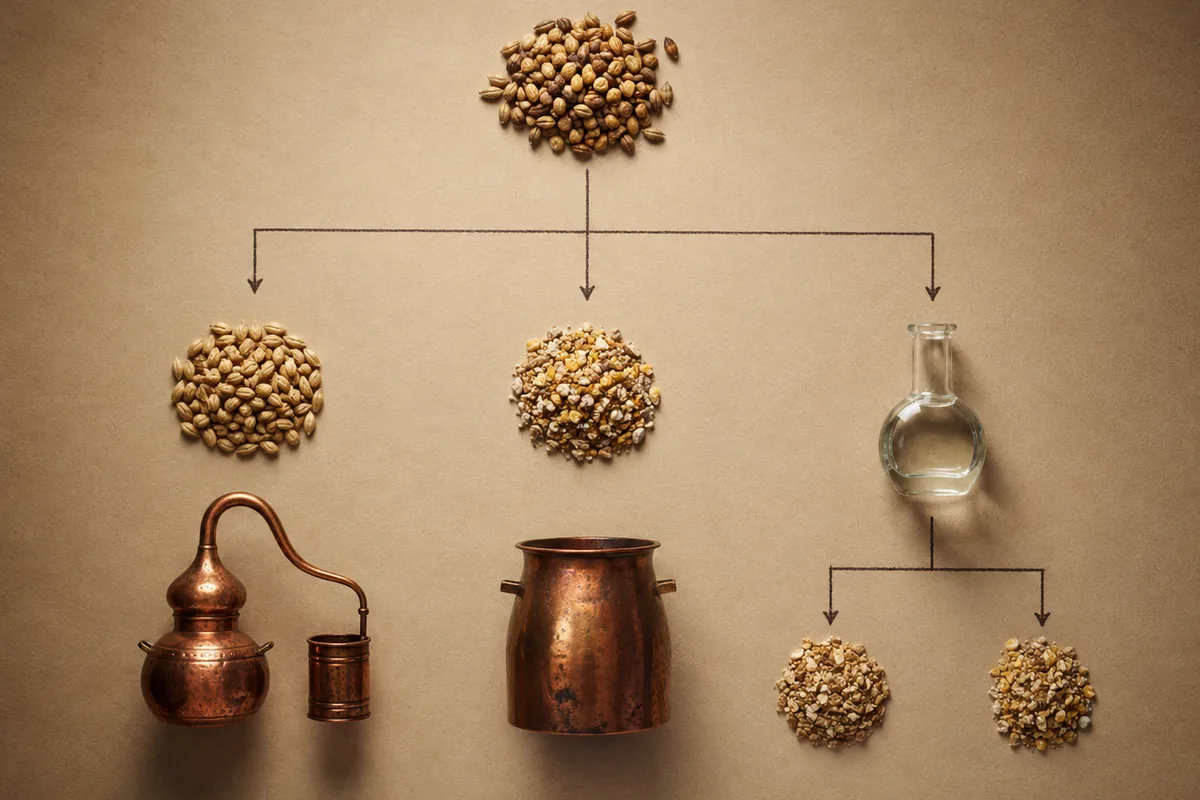
This architecture makes the sales description the first useful fact on the bottle. Country of origin cannot by itself tell you whether the spirit is all malted barley, another grain distillate, or a blend containing neutral spirit.
FSSAI's consolidated compendium is a practical current reference, but it states that original Gazette notifications and amendments prevail if there is an error or overlap.
That source limit matters because alcohol standards can change. This entry uses the version dated 1 December 2025 and records the access date rather than presenting a summary as timeless law.
The named type carries more information than Indian whisky alone: the umbrella wording allows multiple constructions, while single malt, single grain, and blended forms narrow the materials and production facts in different ways.
The current definition covers fermented extract from malted cereal grains such as corn, rye, or barley plus listed neutral or rectified spirits and mixtures, explaining why country and category cannot collapse into one recipe.
| Question at the bottle | Evidence to find | What not to infer |
|---|---|---|
| Which construction | Single malt, single grain, blended malt or grain, or broader whisky wording | That every Indian whisky shares one base |
| Which strength | The printed ABV; the cited table gives 36 to 50 percent for the whisky columns | Strength from colour, price, or smoothness |
| Which agricultural source | A specific grain or neutral-spirit disclosure | Molasses or grain when the source is unstated |
| Which maturation | Age, cask, and warehouse facts when supplied | A Scotch maturation rule transferred to an Indian category |
The consolidated table lists the relevant whisky columns at 36 to 50 percent alcohol by volume, so the bottle's printed ABV is still needed to locate the product within that range.
FSSAI labelling rules prohibit health claims and require the statutory health and drink-driving warnings described in the compendium. Those warnings are part of reading the bottle, not evidence about the grain, cask, age, or flavour.
Imported products can face destination-market rules, making it necessary to always name the jurisdiction before judging a domestic Indian or export whisky label.
The immediate decision is simple: read past the country name to the precise type and ABV. If the bottle supplies no further composition detail, leave the neutral-spirit source and component proportions unresolved.
Which rules define Indian single malt?
Indian single malt whisky must be made from malted barley, distilled in pot stills, and produced at a single distillery.
Those requirements have applied under the amended standard since 1 March 2024.
The word single refers to the distillery, not one cask or one production batch. A producer can combine qualifying casks from that distillery and still remain within the single malt definition.
| Named type | Grain or spirit base | Distillery and still requirement |
|---|---|---|
| Single malt whisky | Malted barley | Pot stills at one distillery |
| Single grain whisky | Malted or unmalted grain | One distillery; excludes single malt and the blended categories |
| Blended malt or grain whisky | At least 2 percent barley malt or grain whisky with neutral or rectified spirit | A blend rather than a single-distillery guarantee |
Single malt fixes grain and still type, but it does not by itself reveal a cask type, a stated age, a warehouse climate, or the finished flavour. Those remain bottle-level facts.
It also should not be treated as a local spelling of Scotland's single malt. Scotch carries its own Scottish geography, maturation, cask-capacity, and bottling requirements; a direct choice between the two would need a dedicated comparison rather than a borrowed definition.
Single grain may use malted or unmalted grain at one distillery, with the current definition expressly excluding single malt and the blended malt or grain categories.
Single does not mean one grain in every case: in these names it identifies a single distillery, while malt or grain identifies the relevant material and production branch.
- Single malt
- Malted barley, pot still distillation, and production at one distillery.
- Single grain
- Malted or unmalted grain at one distillery, excluding the named malt and blended branches.
- Blended malt or grain
- At least 2 percent barley malt or grain whisky combined with neutral or rectified spirit under the cited text.
- Broader whisky
- A wider umbrella that should not be used to infer the guarantees carried by a narrower type.
A single malt label does not promise one cask, one batch, natural colour, age, or flavour. Multiple qualifying casks from the same distillery can contribute.
The pot still requirement does not prescribe one still shape, size, heating method, condenser, cut regime, or distillation count in the summary used here; those production choices matter for character but need a producer disclosure or a dedicated technical source.
An age in years on the bottle should be read as time, not translated into a Scottish equivalent. If the bottle carries no age, its Indian single malt identity still establishes materials, still type, and distillery, while maturation time remains undisclosed.
Claims such as craft, premium, reserve, or award-winning do not extend the legal definition. Without retained tasting or product-access evidence, they also cannot support a sitewide quality ranking.
The most useful single malt comparison therefore holds category constant and asks about ABV, age, cask history, peat, and production details. The definition narrows the field, while those bottle facts explain the remaining variation.
Why the molasses answer is sometimes, not always
Some Indian whisky has historically used extra neutral alcohol derived from molasses, especially in broad blended constructions.
That history is real, but applying it to every Indian whisky erases the cereal, grain, and single malt branches in the current standard.
Academic work on Indian whisky describes both the long use of molasses-derived neutral spirit and a shift toward grain extra neutral alcohol in parts of the market. Premium blends may combine Indian or imported malt components with neutral spirit, while Indian single malt has a malted-barley requirement.
A permitted ingredient is not a universal ingredient. Indian whisky may contain neutral agricultural spirit is supportable; saying every Indian whisky is made from molasses is too broad.
The label may still leave the agricultural origin of a neutral component unclear; in that case, the honest result is unknown rather than an inference from price, colour, bottle shape, or national origin.
This is also a legal-language problem across borders. A spirit sold as whisky under one country's rules may not fit another country's whisky standard, so classification should always name the jurisdiction being used.
Colour cannot settle the question either. Caramel, oak contact, cask history, blending, and filtration all affect appearance, while none identifies whether a neutral spirit began from molasses or grain.
Historical literature describes extra-neutral-alcohol constructions, blends with Indian or Scotch malt components, and malted-barley single malts, explaining both the stereotype and why it fails as a universal rule.
Neutral spirit is distilled to reduce the distinctive congeners of its agricultural source, although production and residual composition can still vary. Once it enters a blend, the named malt or grain component, flavouring where permitted, colour, water, and final strength can have more obvious sensory effects than a guessed feedstock.
| Evidence available | Safe conclusion | Conclusion to reject |
|---|---|---|
| Single malt whisky | The current malted-barley, pot-still, single-distillery definition applies | That neutral molasses spirit is part of the bottle |
| Blended malt or grain whisky | A qualifying whisky portion meets neutral or rectified spirit | The agricultural source or exact share beyond the stated minimum |
| Whisky with no composition detail | The broad Indian standard applies | That the base must be molasses, grain, or all malt |
| Producer source disclosure | The named source can be used for that bottle | That the disclosure describes the whole national category |
Price is weak evidence because tax, packaging, distribution, marketing, age, cask cost, and brand position all affect it. A low or high price cannot identify molasses, grain, malt content, or legal classification.
Flavour cannot reverse-engineer the answer either. Caramel, vanilla, cereal, fruit, or rum-like associations may suggest questions to ask, but sensory perception cannot quantify a hidden component or replace composition evidence.
Cross-border disagreements often apply one jurisdiction's definition to another, so state both standards instead of treating a different domestic category as evidence of fraud.
Unknown is a valid result when the label and producer do not identify the neutral spirit source. It is more accurate than assigning molasses from a national stereotype or grain from a modern-looking bottle.
What does India's climate change in the cask?
Warmer storage can increase the rate at which some compounds move between oak and spirit, and it can increase evaporation.
That makes climate important, but it does not create a fixed conversion between Indian and Scottish years.
Humidity, warehouse airflow, cask size, wood treatment, previous fills, spirit strength, and temperature cycles all change maturation. Three times faster is a slogan, not a scientific ageing equation.
- Read the age statement literally It reports time for that whisky and does not need translation into another country's climate.
- Look for cask and warehouse facts Wood history and storage conditions explain extraction more directly than latitude alone.
- Check alcohol by volume Strength changes concentration, texture, dilution, and alcohol in a measured serving.
Warm-climate extraction can produce assertive oak character in a younger chronological whisky, but stronger extraction is not the same as balanced maturation. Oxidation, evaporation, spirit chemistry, and integration proceed together rather than on one universal clock.
Use aroma, taste, texture, and finish to assess the bottle in front of you, working through them in the same tasting order every time so two whiskies can be compared. For serving, temperature and dilution should respond to the actual strength rather than the Indian label alone.
No age statement, climate claim, dilution, or elapsed time can show that someone is unimpaired or safe to drive.
Temperature changes extraction, oxidation, reaction rates, and evaporation, while humidity, airflow, cask permeability, and warehouse conditions complicate every simple climate rule.
Cask size and prior use set another layer because smaller vessels have more wood surface relative to liquid and active wood can release compounds faster. Fast extraction can create deep colour or firm tannin before other maturation changes reach the balance a producer wants.
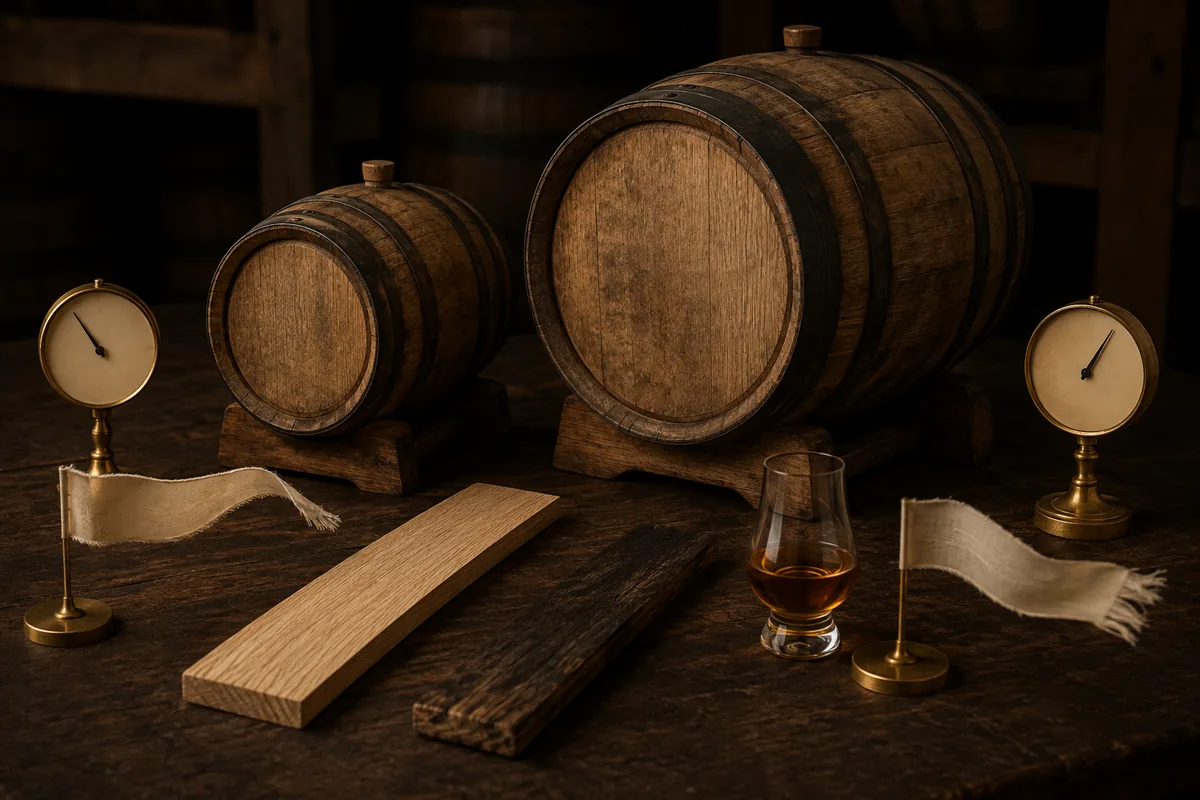
Evaporation is selective and variable, which means the liquid volume and ABV can change in different directions under different conditions. A headline about the angel's share does not describe every warehouse, cask, or year.
India also contains multiple climates and production locations, so national origin cannot supply one warehouse temperature or humidity profile. Producer-specific maturation information is stronger evidence than latitude or a general statement about heat.
Climate may help explain assertive oak at a young chronological age but cannot prove maturity, integration, quality, or a universal years-in-Scotland equivalent.
- Extraction
- Wood compounds can move into spirit faster under warmer conditions, depending on cask activity and surface contact.
- Evaporation
- Temperature, humidity, airflow, and cask properties affect both loss rate and the changing alcohol-water balance.
- Transformation
- Oxidation and chemical reactions continue alongside extraction rather than following one identical clock.
- Integration
- A strong oak signal does not by itself show that aroma, texture, alcohol, and finish have reached balance.
Indian whisky flavour remains as diverse as its legal constructions. A single malt can show cereal, fruit, oak, spice, smoke, or wine-cask influence, while a broader blend may emphasise a lighter neutral base, malt components, sweetness, colour, and blending choices.
For a controlled tasting, compare similar ABVs or add measured water and record it; the repeatable Indian whisky tasting procedure keeps heat, serving temperature, and climate expectations separate from observed aroma and texture.
Food pairing should follow the tasted profile: fruit and gentle cereal can suit lighter dishes, while assertive oak, smoke, or dried-fruit cask character needs comparable intensity or a deliberate contrast. Country alone does not decide the plate.
How should you serve and store it?
Store the opened bottle upright, tightly closed, and away from direct heat and sunlight; whisky does not continue cask maturation in glass, and increasing headspace may gradually flatten or shift aroma.
Check ABV and measure the serving because the legal range covers materially different alcohol concentrations. Food, water, coffee, a cold shower, perceived smoothness, or time since the last drink cannot establish that a person is safe to drive.
The final reading order is category, composition detail, ABV, age and cask evidence, then a controlled sensory assessment. That sequence respects what Indian whisky can legally contain without treating its widest permission as the recipe of every bottle.
How do India's whisky categories fit together?
Indian whisky is an umbrella description, so the category line on the bottle matters more than the country name alone.
Indian rules distinguish whisky, single malt whisky, single grain whisky, and specified blended forms, while products sold abroad must also satisfy the destination market's rules.
A bottle made in India can belong to different production families. One may be malt whisky distilled at a single distillery, another may combine whisky with neutral or rectified spirit under an Indian blend category, and another may be formulated specifically for export.
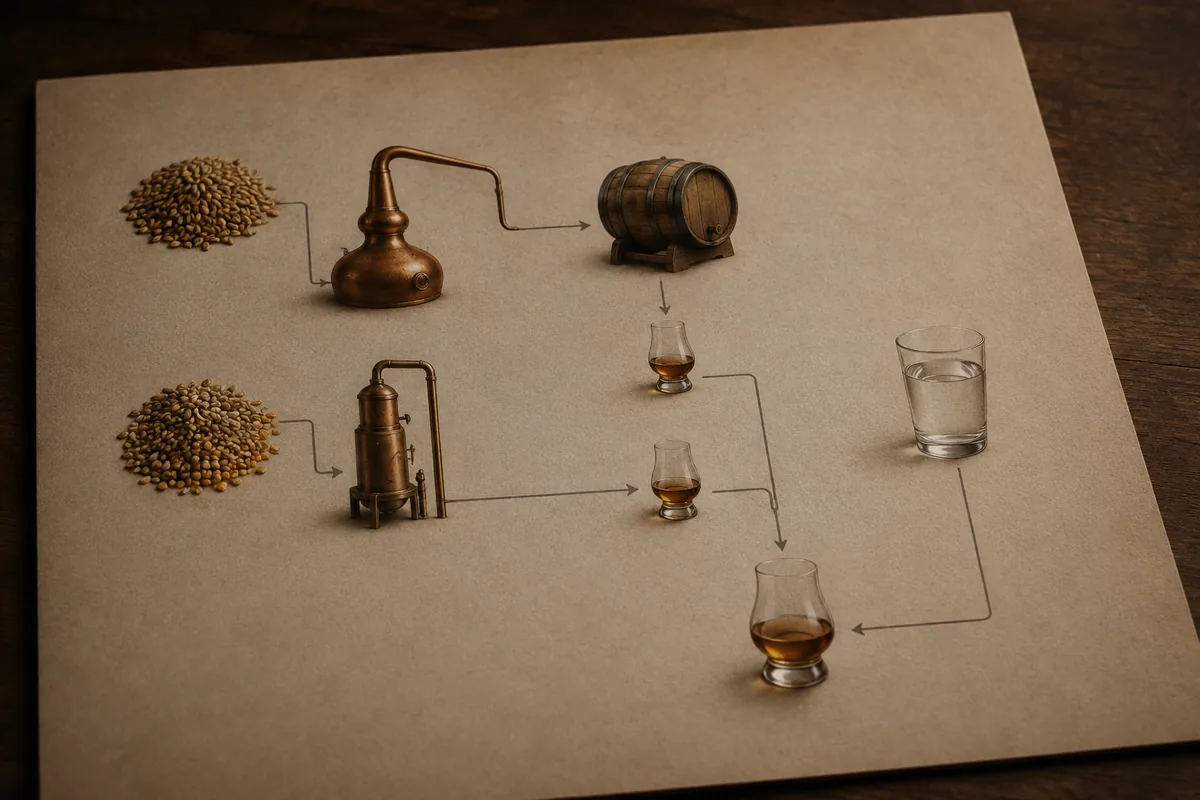
| Label path | Core distinction | Question still to ask |
|---|---|---|
| Single malt whisky | Malt whisky from one distillery under the applicable Indian standard | Which barley, stills, casks, age, and strength? |
| Single grain whisky | Grain whisky from one distillery under its category definition | Which cereals and distillation system? |
| Blended malt or grain whisky | A specified whisky component may be combined with neutral or rectified spirit under Indian rules | What proportion and spirit base are disclosed? |
| Export-labelled whisky | Must meet the rules of the destination market as well as lawful Indian production | Which jurisdiction controls the label in front of you? |
The Indian blended malt and blended grain definitions deserve careful reading because the regulations specify a minimum whisky proportion rather than promising that the entire liquid is malt or grain whisky. The consolidated FSSAI text sets that minimum at 2 percent for the named whisky component in those blend categories.
That legal floor does not reveal the actual proportion in a particular bottle.
A producer may use more, but only a precise disclosure or reliable technical source can establish how much.
Which raw materials can Indian whisky use?
Barley is central to Indian single malt, while other Indian whisky categories can use different cereals and permitted spirit bases. Molasses enters the discussion because India has a large sugar industry and some domestic whisky-style blends historically used neutral spirit associated with molasses.
Distillation separates volatile compounds from the fermented material, so the brown colour of molasses does not simply become brown whisky. Grain, molasses-derived neutral spirit, malt whisky, cask extraction, permitted colour adjustment, and blending perform separate jobs.
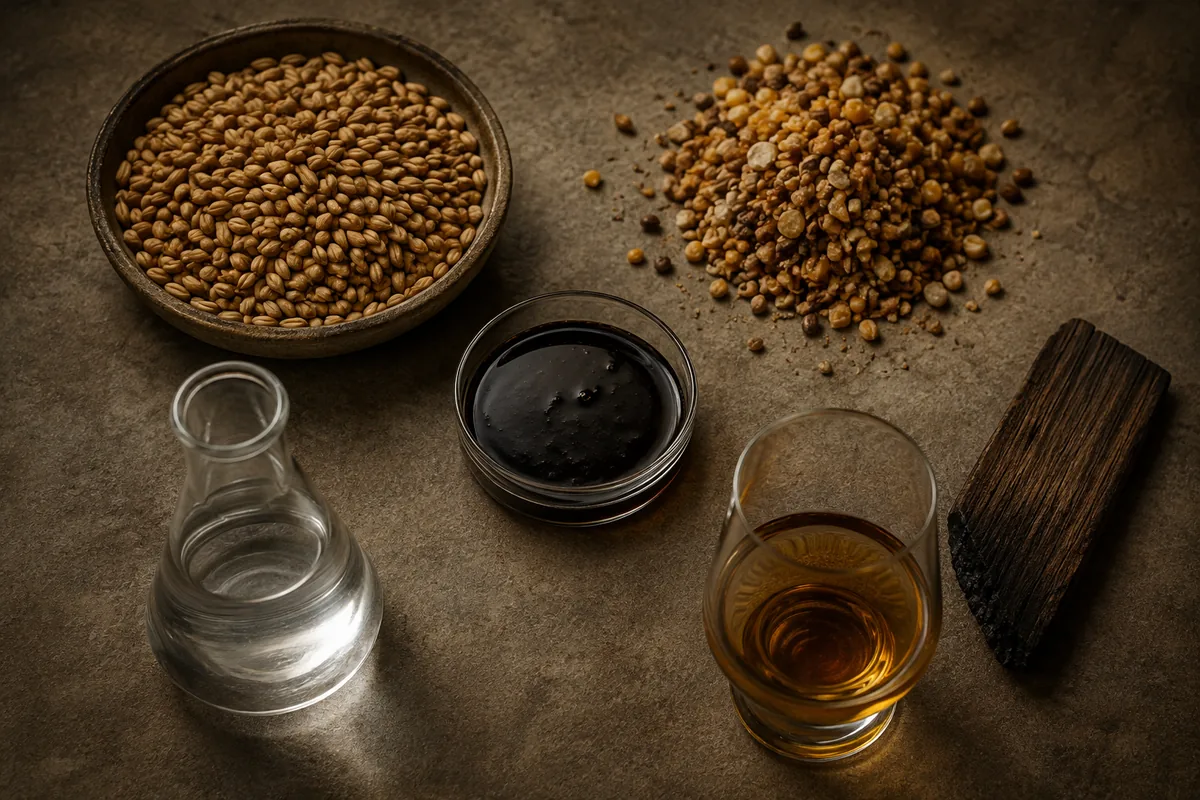
Neutral or rectified spirit is distilled to a high level of purity and contributes less raw-material character than a flavourful pot-distilled malt component.
Its presence, proportion, and source therefore change how much a label can tell you about cereal flavour and maturation.
Water matters at mashing, fermentation, cooling, and reduction before bottling, but romantic claims about a water source rarely predict flavour by themselves. Treatment, mineral composition, process use, and the much stronger effects of fermentation, distillation, casks, and blending need equal attention.
The phrase Indian whisky does not prove a molasses base. Check the named category and any ingredient or production disclosure before deciding which raw materials are present.
How are Indian malt whiskies fermented and distilled?
Malted barley is milled and mixed with water so enzymes can convert starch into fermentable sugars. The extracted liquid then ferments with yeast, producing alcohol and aroma precursors before distillation.
Fermentation time, temperature, yeast, wort composition, vessel practice, and controlled microbial activity can shift fruit, cereal, floral, sulphury, and heavier notes.
Hot ambient conditions may affect cooling needs, but the distillery controls the actual process rather than simply accepting the outdoor temperature.
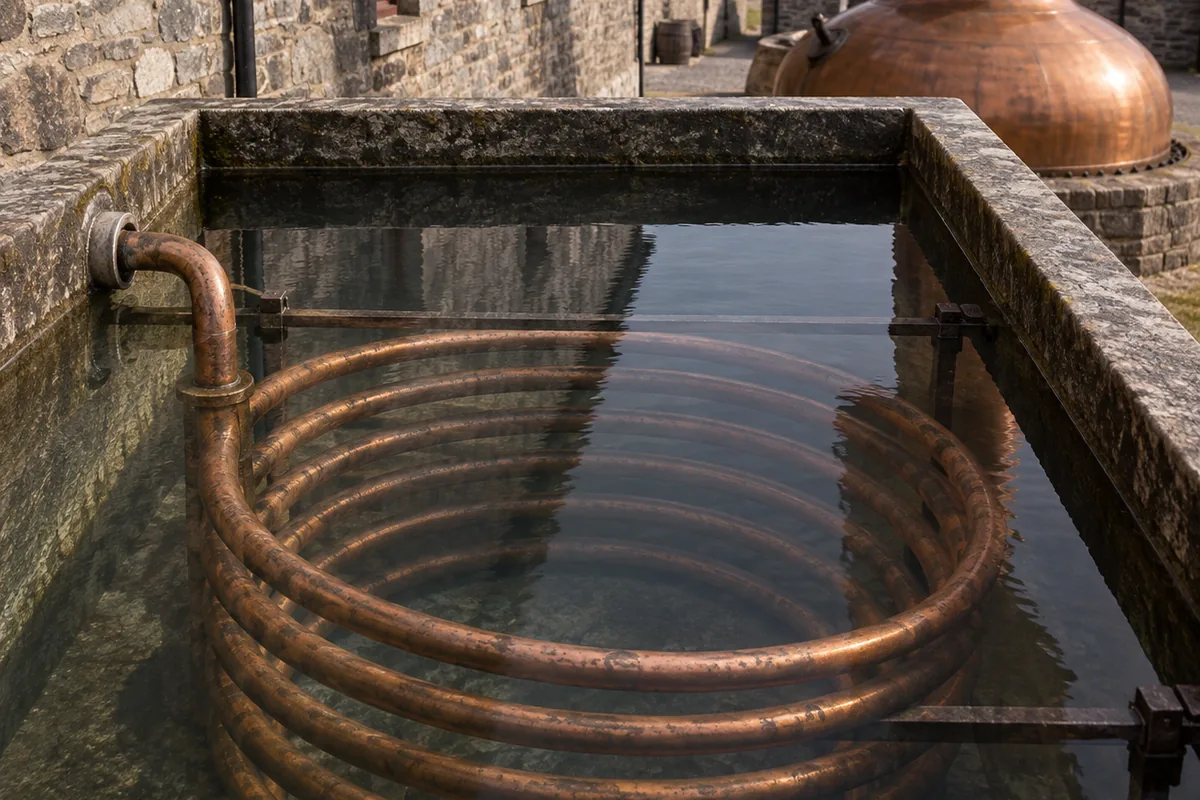
Pot still geometry, charge, heating, reflux, copper contact, and cut points shape which compounds reach the new make. Two Indian single malts can therefore share barley and country yet leave the still with different weights and aroma profiles.
| Stage | Key variables | Possible effect |
|---|---|---|
| Mashing | Mill, water, temperature, extraction | Fermentable sugar and wort composition |
| Fermentation | Yeast, time, temperature, acidity | Fruit, cereal, floral, ester, and heavier precursors |
| Distillation | Still shape, reflux, copper, cuts | New-make weight, texture, and congener balance |
| Reduction | Barrel-entry and bottling strength choices | Extraction balance and final sensory concentration |
This process belongs most directly to malt whisky. A blend using neutral or rectified spirit follows a different production route for that component, so one process description cannot be applied to every Indian whisky.
Does rapid maturation mean Indian whisky is older in flavour?
Warm warehouses can accelerate extraction and evaporation compared with a cool Scottish warehouse, but climate does not turn one calendar year into a fixed number of years elsewhere.
Heat, daily temperature movement, humidity, warehouse construction, cask size, oak history, fill strength, and spirit character change the result together.
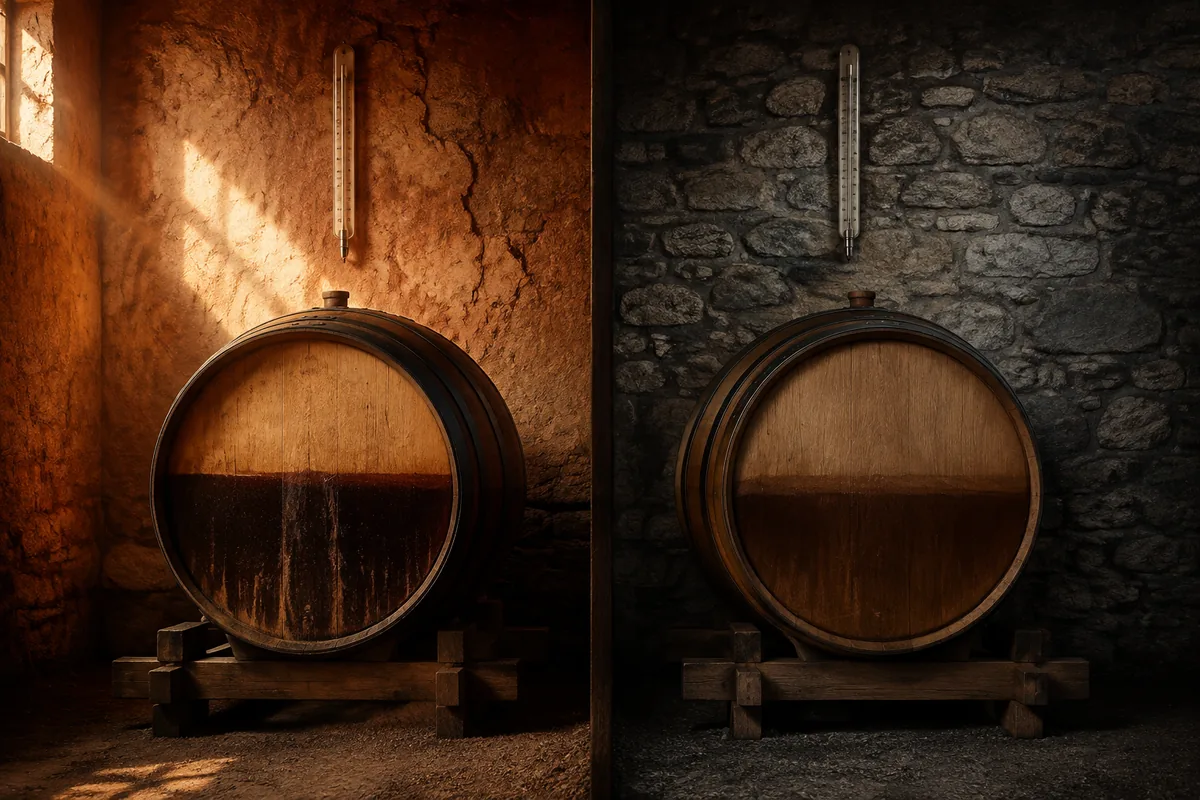
Higher temperature often increases movement between spirit and wood and can raise maturation losses. Depending on humidity and warehouse conditions, alcohol and water do not evaporate at identical rates, so cask strength may move differently from one site to another.
An active cask can add colour, vanilla, spice, tannin, and dried-fruit notes quickly. If extraction outruns integration, the whisky can become woody or drying before it gains the balance that a simple age comparison implies.
- Calendar age
- The elapsed maturation time and the basis for a lawful age statement.
- Climate load
- Heat and temperature movement that can accelerate extraction and evaporation.
- Cask activity
- Oak species, seasoning, previous fill, toast, char, and size.
- No conversion ratio
- There is no defensible rule that one Indian year equals a fixed number of Scottish years.
Compare age statements as factual time information, then read cask and warehouse disclosures where available.
Judge sensory maturity in the glass rather than replacing it with latitude.
How should you read an Indian whisky label?
Read the category name first, then the producer and distillery, country and market of sale, ABV, age statement if any, raw-material wording, blend description, cask claim, and any colouring or flavouring disclosure required in that market.
- Locate the exact category: Indian whisky, single malt, single grain, blended malt, and blended grain do not describe identical liquids.
- Identify the jurisdiction: a domestic Indian label and an export label may answer to different definitions.
- Read composition literally: separate a disclosed proportion from broad words such as premium, reserve, or select.
- Check age correctly: use a stated age as regulated time information and leave an unstated age unknown.
- Record the ABV: strength changes both sensory intensity and alcohol per measured serving.
Geographical imagery, imported-sounding names, dark glass, and amber liquid cannot establish the cereal source or the percentage of mature whisky in a blend. Those design cues should never outrank the mandatory category line.
For a bottle exported to the United States, European Union, United Kingdom, or another market, check the destination's official classification and label rules. A product lawful under one Indian category may need different wording or composition to use whisky terminology elsewhere.
What does Indian whisky usually taste like?
There is no single Indian whisky flavour.
Single malts may show cereal, orchard fruit, tropical fruit, floral notes, spice, oak, dried fruit, smoke, or combinations of them, while lighter blends can place neutral spirit, flavouring rules, caramel, and a smaller whisky component in a different balance.
Warm maturation can intensify wood extraction and concentration, but it does not require a heavy style. Refill casks, shorter maturation, distillery character, dilution, blending, and finishing can keep an expression lighter or shift it toward fruit rather than tannin.
| Sensory cue | Possible contributor | What it cannot prove |
|---|---|---|
| Cereal or biscuit | Malted grain, wort, fermentation, distillation | A specific barley variety or all-malt composition |
| Tropical or orchard fruit | Fermentation esters, distillation, cask interaction | A precise fermentation schedule |
| Vanilla, coconut, toast | Oak species, heat treatment, previous fill | Calendar age from intensity alone |
| Dark colour and dried fruit | Active seasoned cask, blending, or permitted colour adjustment | Long maturation or quality |
Producer notes offer hypotheses for tasting, not guaranteed perceptions. Use a clean glass and neutral setting, then compare what you actually smell and taste with the disclosed production facts.
How should Indian whisky be served?
For sensory comparison, begin with a measured pour in a clean tulip-shaped glass at moderate room temperature.
Smell above the rim if alcohol vapour feels sharp, then add a recorded amount of water gradually.
Water changes concentration and volatility, so it may reveal fruit or cereal while muting another aroma. A fixed instruction such as three drops cannot work equally for every ABV, glass, and pour volume.
- Single malt comparison: hold glass, volume, temperature, and water addition steady between samples.
- High-strength bottling: measure before dilution and allow time after adding water.
- Light blend: chilled water or a long mixed serve may suit the intended profile.
- Cocktail use: adjust for actual sweetness, whisky intensity, and proof rather than substituting by country alone.
Ice chills and dilutes over time, reducing some aroma intensity while changing texture and alcohol heat. That is a valid service choice when it fits the reader's goal, not evidence about whisky quality.
Which foods pair with Indian whisky?
Indian food covers too many regions and techniques to function as one pairing category.
Match the whisky's proof, fruit, smoke, oak, sweetness, and tannin with the specific dish's heat, fat, acidity, sweetness, and char.
| Whisky cue | Food direction | Risk to manage |
|---|---|---|
| Fruit and floral | Grilled paneer, mild kebab, fresh cheese, or fruit with restrained spice | Heavy chilli can bury delicate aroma |
| Malt and vanilla | Roast nuts, tandoor bread, browned dairy, or roast poultry | Excess sweetness can flatten cereal detail |
| Rich cask and dried fruit | Aged cheese, slow-cooked meat, date, fig, or dark chocolate | Stacked tannin and bitterness can become drying |
| Peat or char | Smoked meat, charred vegetables, or savoury grilled dishes | Smoke plus high proof can dominate the meal |
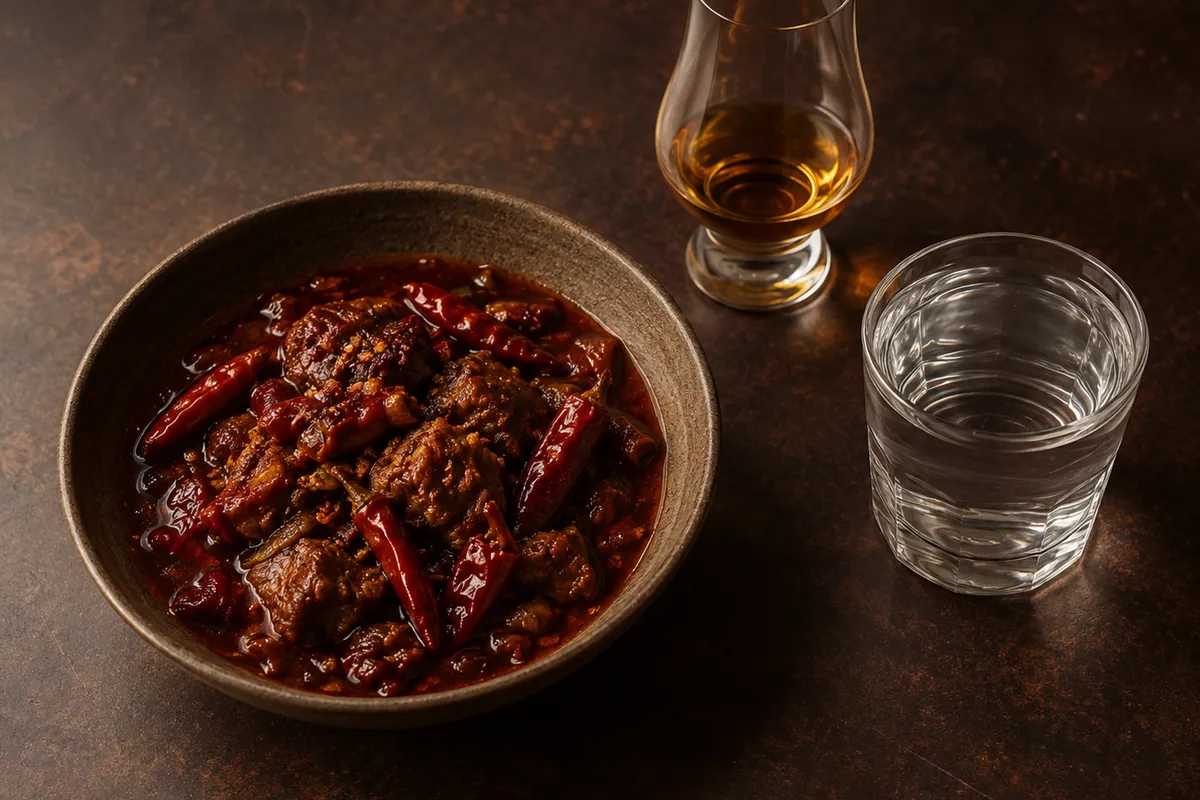
Capsaicin can intensify the burn of alcohol, so very hot dishes often work better with a smaller pour, dilution, or an alcohol-free drink. Food does not cancel alcohol or establish a safe time to drive.
How should an opened bottle be stored?
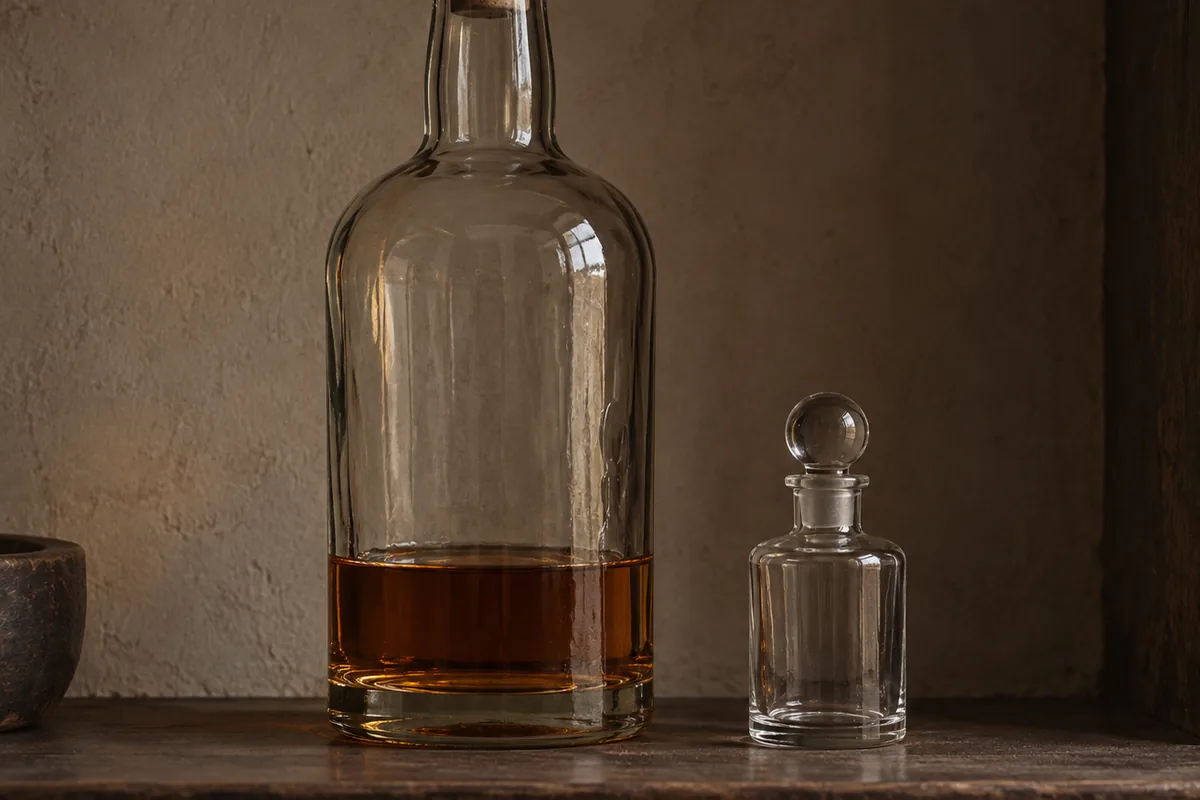
Store Indian whisky upright with its closure tight, away from sunlight and repeated heat cycles. A hot room can accelerate changes around the closure and evaporation, but the whisky no longer matures through wood once it is in glass.
Headspace grows as the bottle empties, and each opening introduces fresh air.
A clean, clearly labelled smaller bottle with a compatible seal can protect a small remainder without creating an undocumented blend.
- Choose a stable cupboard: avoid windows, ovens, vehicle storage, and roof spaces.
- Inspect the closure: replace a failing compatible stopper without contaminating the liquid.
- Keep identity intact: do not top up the bottle with another whisky.
- Use concrete discard signs: foreign material, an unknown refill, active pressure, or a distinctly abnormal odour requires caution.
Refrigeration is usually unnecessary for an intact bottle of whisky. Stable, dark storage and a sound seal matter more than keeping the liquid cold.
How does ABV change the responsible-use decision?
Country, category, age, and smoothness do not state how much alcohol is in a serving. Pour volume and ABV determine alcohol quantity, and the same glass can contain very different amounts when a high-strength single malt replaces a 40 percent blend.
At 40 percent ABV, about 44 millilitres or 1.5 fluid ounces of Indian whisky is roughly one United States standard drink.
Higher ABV reaches that amount in a smaller pour, while a mixed drink can contain more than one standard drink through multiple measured ingredients.
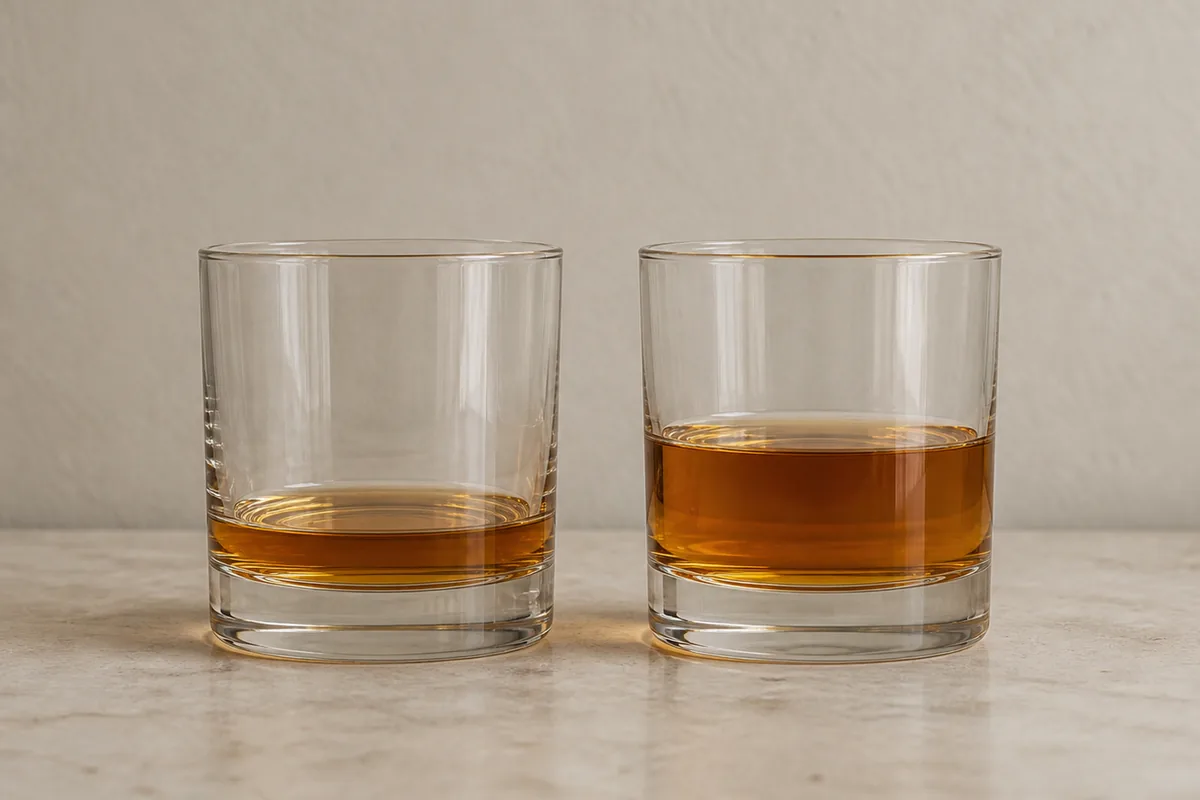
Measure every alcoholic ingredient. Water, ice, food, coffee, sweetness, or a smooth texture cannot establish that someone is unimpaired or safe to drive.
Pregnancy, interacting medicines, health conditions worsened by alcohol, legal-age restrictions, and driving or other safety-critical work change the appropriate choice. An alcohol-free drink avoids an uncertainty that the label and tasting notes cannot resolve.
The accurate answer to what Indian whisky is depends on the bottle: identify its category and market, then examine raw materials, production, blend composition, maturation, ABV, and disclosed facts. The national label is a starting point, not a recipe or flavour guarantee.
Common questions
- Is all Indian whisky made from molasses?
- No. Some broad blends have historically used molasses-derived neutral spirit, but Indian single malt must use malted barley and single grain whisky uses malted or unmalted grain.
- What makes an Indian whisky single malt?
- The FSSAI standard requires malted barley, pot-still distillation and production at a single distillery. The term does not by itself guarantee one cask, age or flavour.
- Does Indian whisky mature three times faster than Scotch?
- No fixed conversion is defensible. Heat can speed some oak extraction and evaporation, but humidity, warehouse, cask, spirit strength and temperature cycles also change the result.
Sources
-
Espitia-López, Malpica-Sánchez, Escalona-Buendía, Verde-Calvo (2024), Innovation and Development in Whisky Production Around the World
Published 2024. Accessed 10 September 2026.
-
FSSAI Product Standards, Alcoholic Beverages Regulations
Accessed 6 September 2026.
-
FSSAI, Compendium of Food Safety and Standards (Alcoholic Beverages) Regulations, Version V
Published 1 December 2025. Accessed 6 September 2026.
-
Maitin (2022), Indian whiskies
Published 2022. Accessed 10 September 2026.
-
Tarko, Krankowski, Duda-Chodak (2023), The Impact of Compounds Extracted from Wood on the Quality of Alcoholic Beverages
Published 2023. Accessed 10 September 2026.
More in Spirits
-
 American single malt whisky
01
What is American single malt whisky, and what does it guarantee?
-
 Australian whisky
02
How is Australian whisky defined, and by which law?
-
 Black rum
03
What is black rum, and does the colour mean anything?
-
 Blended American whiskey
04
What is blended American whiskey, and how much of it is whiskey?
-
 Blended Irish whiskey
05
Blended Irish whiskey: which word counts the distilleries?
-
 Blended Scotch
06
Blended Scotch: what is in it, and why does the recipe change?