
Spirits
Campbeltown whisky: what does that word on the label actually claim?
Campbeltown is not one of Scotland's whisky regions.
The specification for Scotch Whisky lists two protected localities and three protected regions, and Campbeltown is a locality, defined as the South Kintyre ward of Argyll and Bute Council as that ward stood under an electoral order made in 2006.
A bottle may carry the name only where the whisky was distilled inside that ward, and the name claims nothing at all about how the whisky tastes.
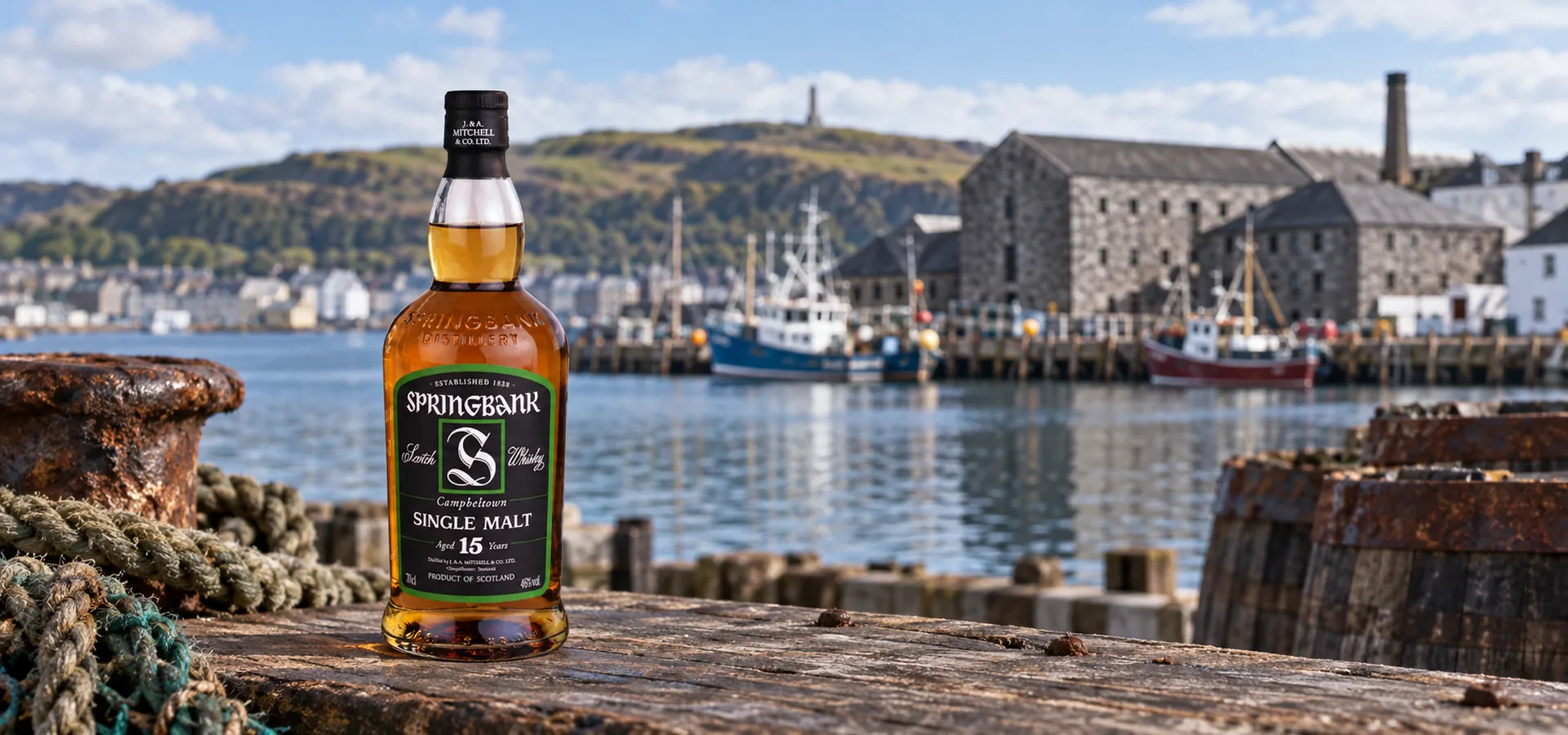
At a glance
- Legal category
- Campbeltown, a protected locality of the Scotch Whisky geographical indication, Scotch Whisky Technical File June 2019
- Minimum strength
- 40 percent ABV
- Also called
- Campbeltown Scotch, Campbeltown single malt
Is Campbeltown a whisky region?
Campbeltown is a locality, not a region. The Scotch Whisky specification names two classes of protected place inside the indication. The protected localities are Campbeltown and Islay. The protected regions are Highland, Lowland and Speyside.
Almost everything written about Scotch calls all five of these regions. The document that defines them does not.
The distinction is worth holding, because the five are not built alike.
What the two classes do and do not change
Both classes get the same labelling rule, which comes later on this page.
So the class is about how a place is named in the specification rather than about what a bottle may do with it. What it does change is precision.
The two localities are drawn tightly and two of the three regions are not. That difference is the subject of most of what follows.
Where exactly is the Campbeltown boundary?
Here is the definition, and it is shorter than most people expect.
Campbeltown comprises the South Kintyre ward of the Argyll and Bute Council, as that ward is constituted in the Argyll and Bute (Electoral Arrangements) Order 2006.
What each half of that fixes
The first half names a local government boundary. South Kintyre is a council ward, drawn so that people can elect councillors.
The second half pins it to a date. Not the ward as it stands today, but the ward as it was constituted in a named order of 2006.
So a later boundary review does not move the whisky boundary by itself, because the specification points at one version of one ward and stops there.
What the definition never mentions
Distilling. Barley, water, stills, casks, tradition, coastline: none of it appears.
The boundary was drawn for elections and then borrowed. Which is why the question of whether a distillery sits inside Campbeltown has an exact answer, and the answer has nothing to do with whisky.
Are the five protected places defined the same way?
Set the five definitions side by side and there is no common method at all. Four different kinds of boundary are doing the work.
| Name | Class | How it is defined |
|---|---|---|
| Campbeltown | Locality | One council electoral ward, named to a 2006 order |
| Islay | Locality | The Isle of Islay in Argyll |
| Highland | Region | Scotland north of the Highland and Lowland dividing line |
| Lowland | Region | Scotland south of that same line |
| Speyside | Region | Nine named council wards, from two 2006 orders |
Islay is geography, the Isle of Islay in Argyll and nothing further, while Speyside is administration at scale, comprising nine named wards of Moray Council together with the Badenoch and Strathspey ward of Highland Council, from two orders of 2006.
Highland and Lowland are neither. Each is defined as the part of Scotland on one side of the line dividing them.
The two that point at themselves
Read the Highland and Lowland definitions again. Each is defined as one side of the line dividing them, and the specification never says where that line runs.
So the two largest names on a Scotch label rest on a boundary the definitions assume rather than state. Campbeltown, the smallest, is the one drawn to a ward and an order.
Where the document does name that line
The definitions leave it undrawn, and another part of the same specification does not.
Describing the geology of Scotland, it says the country is divided into Highland and Lowland areas by the Highland Boundary Fault, and that the Highlands and Islands north and west of the fault make up about 60 percent of the land mass.
That is a geological description rather than the legal boundary the definitions point at. But it does mean the document that declines to draw the line elsewhere names what divides the two areas.
Boundaries are one thing and places are another. Where those five actually sit, and what has happened in them, is a different kind of account.
What does the word Campbeltown on a label claim?
The rule attaching to all five names is the same, and it turns on one thing.
- For a whisky
- It must be Scotch Whisky distilled in that locality or region.
- For a whisky-based drink
- The only whisky in the drink must be Scotch distilled there.
- Similar names
- Caught as well, where the presentation as a whole may create confusion.
- What it reports
- Where the whisky was distilled. Not where it matured, not where it was bottled.
Why the mixed drink rule is stricter
A whisky-based drink has to clear a higher bar than a whisky does. Every drop of whisky in it must come from that locality.
One component from elsewhere and the name is unavailable, however small that component is.
How far the protection reaches
A name merely similar to a protected locality is caught too. The presentation as a whole may make the public think of the real one.
That is a rule about impressions rather than about spelling.
The provisions that sit around it
The locality rule is one of a set, and the others reach further than place names.
- The place name. A locality or region name requires the whisky to be Scotch distilled in that place.
- The presentation as a whole. A Scotch must not be labelled, packaged, advertised or promoted in any way that, having regard to the presentation as a whole, creates a likelihood that the public may think it was distilled at any distillery or place other than the one it was actually distilled at.
- The distillery name. It may not be used as a brand name, or as part of one, or positioned prominently as though it were, unless the whisky was wholly distilled at that distillery.
- The distiller. For a single malt or single grain, the presentation must not suggest the whisky was distilled by anyone other than the person who distilled it, or the owner or operator of the distillery where it was.
Read together, the four rules protect the same thing from four directions. A place name, a similar name, a distillery name, and the impression the whole label leaves.
Locality, region, presentation and distillery are each doing exact work in those rules, and each is a term of art before it is a description.
The rule that lets a place name sit immediately before a category name is set out on the blended malt page, and what a grain whisky has to be is the condition sitting underneath all five.
Does Campbeltown on the label tell you how it tastes?
The labelling rule asks where a whisky was distilled. It asks nothing about aroma, flavour or character, and it promises nothing about them either.
What the specification does say about place
It is careful, and it is not silent. A single malt is described as having a recognisable flavour and aroma dependent on the distillery it was distilled in and the region of Scotland that distillery is located in.
So place is not irrelevant to character, but simply absent from the legal claim, which is a different statement.
The claim the whole indication rests on
The specification goes further than that, and it has to. A geographical indication only exists where origin and character are connected.
It states that the indication identifies a drink originating in an area where the quality, reputation or other characteristics are essentially attributable to its geographical origin. It then sets out the natural factors it says demonstrate that link.
Geology comes first, and water with it: the water that reaches each distillery varies according to the local rocks and countryside it flows through. Climate follows, then peat, used historically to fire stills and to dry barley.
None of that is undone by anything on this page, and what it does not do is turn a locality name into a description of a flavour, because the rule that governs the name asks one thing only, and it is a question about geography rather than about taste.
What this page will not tell you
How a Campbeltown whisky tastes. No source we read carries a tasting characteristic for the locality as a whole, so none is stated here.
With the place name barred from doing the work, a note built from the glass alone is the only account of a Campbeltown whisky that survives.
What a blend of single whiskies does to character is treated on the blended Scotch page.
Common questions
- Is Campbeltown a Scotch whisky region?
- No. The Scotch Whisky specification names Campbeltown and Islay as protected localities, and Highland, Lowland and Speyside as protected regions. Campbeltown is a locality.
- What is the boundary of Campbeltown for whisky?
- The South Kintyre ward of Argyll and Bute Council, as that ward is constituted in the Argyll and Bute (Electoral Arrangements) Order 2006. It is a local government electoral boundary fixed to a named order.
- When may a bottle say Campbeltown?
- Only where the whisky is Scotch Whisky distilled in that locality. For a whisky-based drink the rule is stricter: the only whisky in the drink must be Scotch distilled there.
- Does Campbeltown on a label describe a flavour?
- No. The rule turns on where the whisky was distilled and states nothing about aroma or flavour. The specification attributes the character of a single whisky to the distillery processes and the maturation.
- How are the other Scotch places defined?
- Four different ways. Islay is an island, Speyside is a list of nine named council wards, and Highland and Lowland are each one side of a dividing line the specification never draws.
Sources
More in Spirits
-
 American single malt whisky
01
What is American single malt whisky, and what does it guarantee?
-
 Australian whisky
02
How is Australian whisky defined, and by which law?
-
 Black rum
03
What is black rum, and does the colour mean anything?
-
 Blended American whiskey
04
What is blended American whiskey, and how much of it is whiskey?
-
 Blended Irish whiskey
05
Blended Irish whiskey: which word counts the distilleries?
-
 Blended Scotch
06
Blended Scotch: what is in it, and why does the recipe change?