
Spirits
High Rye Bourbon: What It Means and Whether a Cutoff Exists
High-rye bourbon is bourbon made with a comparatively rye-heavy mash bill, but United States law sets no percentage at which the phrase begins. Corn must still form at least 51 percent of the mash, and only a disclosed mash bill can quantify the rye.
At a glance
- Legal category
- Bourbon whisky, 27 CFR 5.143; high rye is not separately defined
- Minimum strength
- 40 percent ABV
- Also called
- High rye bourbon, High-rye bourbon whiskey
- High rye cutoff
- No federal percentage defines the producer term
- Grain boundary
- At least 51% corn; rye occupies part of the remaining mash
- Required wood
- New charred oak, with no universal char level or ageing outcome
Which rye percentage counts as high rye?
There is no federal high-rye cutoff.
The phrase is an unregulated producer description applied to bourbon with more rye than that producer, writer, or market considers conventional.
That relative wording explains why guides publish different thresholds. A number repeated across retailer pages does not become a legal standard, and it cannot settle what another producer means.
- At least 51% corn
- The legal mash requirement that every bourbon, including high-rye bourbon, must meet.
- No high-rye cutoff
- Federal standards never define the phrase or require a minimum percentage of rye.
- Disclosed mash bill
- The only direct evidence for the exact rye share in a particular bottling.
A producer may use high rye to distinguish one recipe from its own lower-rye bourbon even when another producer would not use the phrase for the same percentage. Without a mash bill, the claim communicates direction rather than quantity.
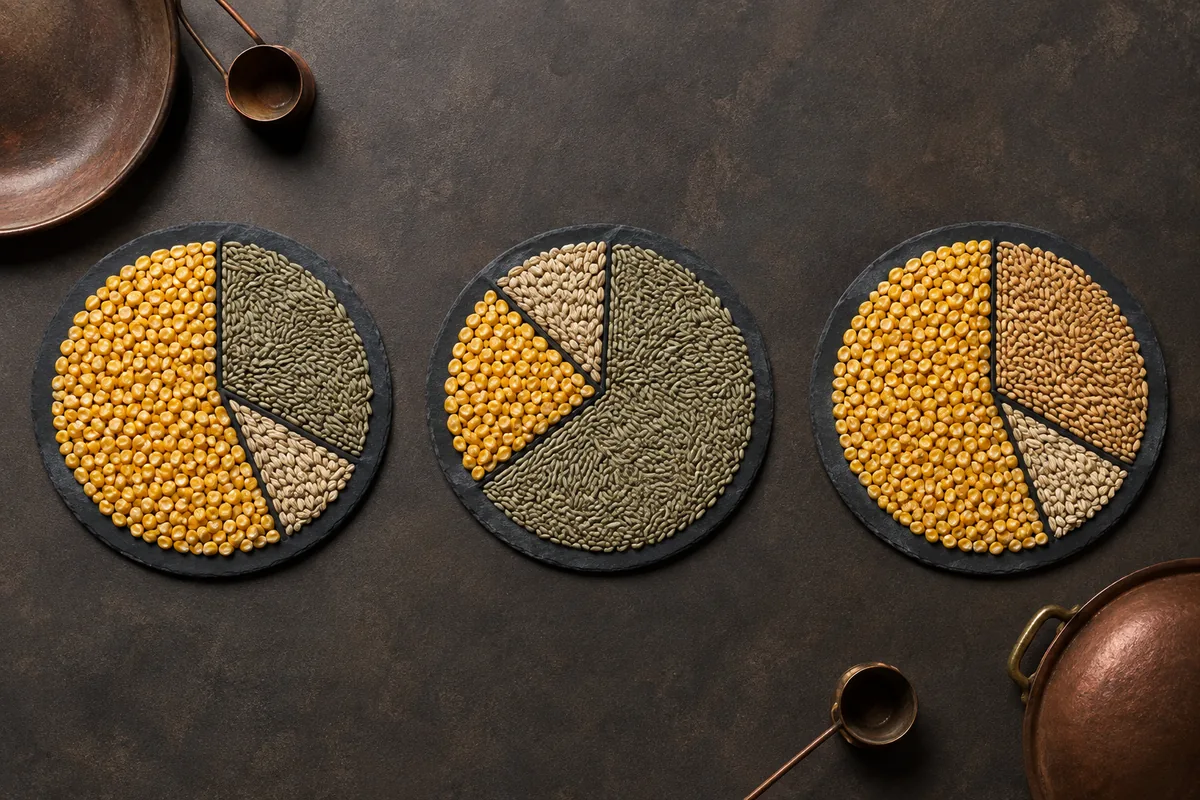
This is also why high-rye bourbon and the category that puts rye in the majority are not synonyms. The first remains corn-majority bourbon; the second must contain at least 51 percent rye under the United States standard.
High rye is comparative language, so a distillery can use it for the rye-heavier member of its own range even when another uses the same words for a different percentage.
No federal rule turns 15, 20, 25, or another rye percentage into the threshold, and repetition across shops can create a convention but not a legal cutoff.
| Statement | What it establishes | What remains open |
|---|---|---|
| High-rye bourbon | The producer presents rye as comparatively prominent within a bourbon mash | The exact rye percentage unless disclosed |
| 21% rye mash bill | A quantitative recipe fact for that whiskey | Whether another producer would call 21 percent high rye |
| Rye whiskey | At least 51 percent rye under the US identity standard | A universal spicy flavour |
| Wheated bourbon | Wheat is used as a significant flavouring grain in a corn-majority bourbon | An official wheat cutoff, because wheated is also informal |
A disclosed mash bill is stronger evidence than the adjective because it lets you compare actual grain shares. Even then, percentages describe inputs rather than the sensory result in the glass.
Check whether the percentage covers the whole fermentable mash and names the other grains, since rye can rise by displacing malted barley or another flavouring grain.
A bottle can also carry the phrase without printing a mash bill; in that case, the direction is known, not the amount, and the honest comparison stops there.
What does a disclosed mash bill prove?
The mathematical ceiling for rye is below 49 percent because corn must stay at or above 51 percent, and other grains usually need some of the remaining space. That ceiling still does not tell you where a producer begins using the phrase high rye.
Recipe disclosure can be partial, so note whether the producer gives exact percentages for every grain or only names the grains in order. An ordered list reveals relative prominence but cannot support exact calculations.
Marketing phrases such as bold, spicy, or robust add a producer's intended description, not a measurement. Keep those words as tasting hypotheses until the bottle supplies evidence through its actual aroma, taste, texture, and finish.
How does extra rye fit inside bourbon?
Rye uses part of the mash space left after corn satisfies its legal majority.
A mash could increase rye substantially and still remain bourbon, provided corn never drops below 51 percent and all the other bourbon conditions remain intact.
Those other conditions do important work. Bourbon must be distilled at no more than 80 percent alcohol by volume, entered into charred new oak at no more than 62.5 percent, and bottled at no less than 40 percent.
| Part of the specification | What high rye changes | What stays fixed |
|---|---|---|
| Mash | Rye takes a larger share of the non-corn portion | Corn remains at least 51 percent |
| Distillation | Nothing by definition | No more than 80 percent alcohol by volume |
| Barrel | Nothing by definition | Charred new oak; entry no higher than 62.5 percent alcohol by volume |
| Bottling | Nothing by definition | No less than 40 percent alcohol by volume |
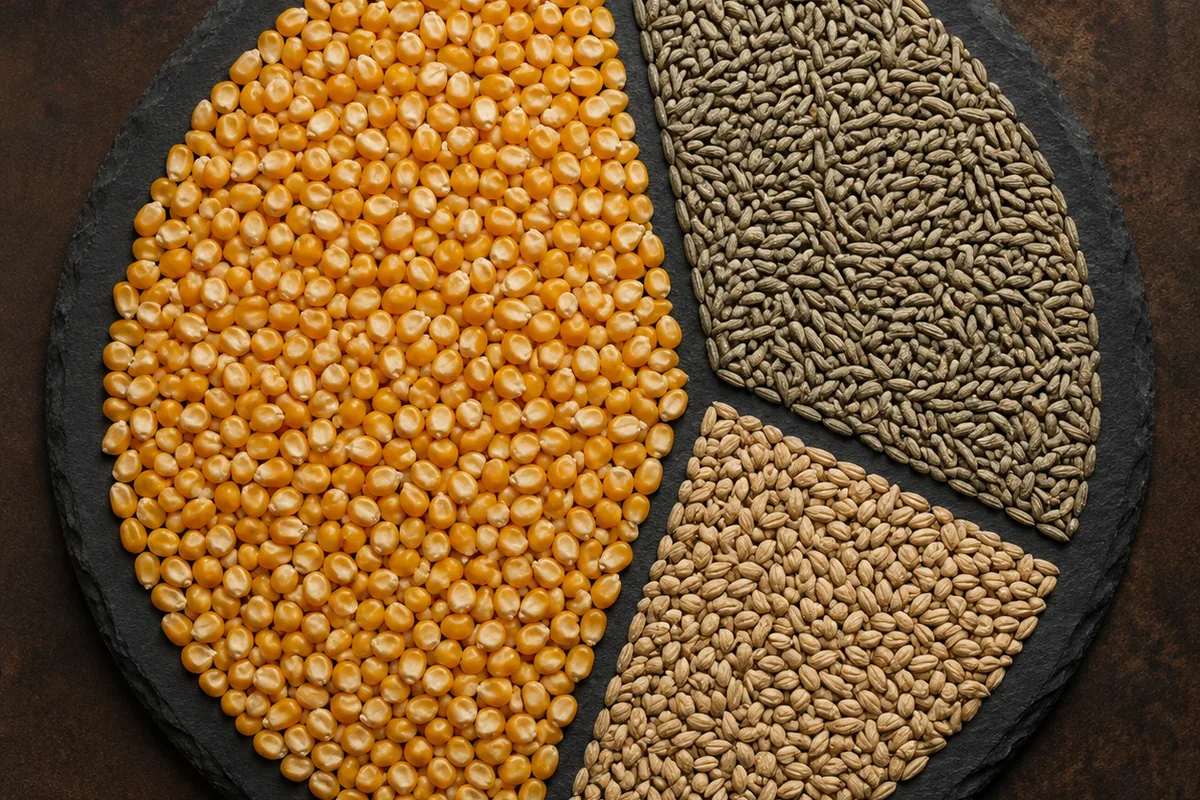
The remaining grain can also include malted barley or other cereals. High rye says nothing about their proportions, the yeast, fermentation, still configuration, cut points, warehouse, age, or bottling proof.
For the full identity and legal baseline, see the bourbon profile. The relevant point here is which conditions remain fixed when rye occupies more of the mash.
Those fixed conditions keep the spirit within bourbon because corn leads the mash and the distillation, new-charred-oak entry, and bottling limits still apply.
Straight bourbon, and the bonded designation that fixes age and proof together, add further conditions, including at least two years in charred new oak and restrictions on added colouring, flavouring, or blending materials. High rye does not mean straight, and straight does not quantify rye.
A printed number of years answers a separate question because younger and older high-rye bourbons can share a mash bill while differing in extraction, oxidation, concentration, and texture.
Read each term once: bourbon sets the legal identity, high rye gives a relative mash description, straight adds maturation and composition conditions, and an age statement supplies time information.
Barrel-entry proof also matters because it changes the solvent balance that meets the oak. The federal ceiling is 62.5 percent ABV at entry, but a producer may enter lower, so the maximum cannot be treated as the recipe used for every bottle.
Charred new oak is a bourbon requirement, yet char level, seasoning, cooperage, warehouse movement, and cask selection are production choices rather than consequences of the rye percentage. Those choices can create spice-like or sweet oak cues that overlap the language used for rye.
Bottling proof can then amplify or soften what you perceive. Proof is not a quality score, and comparing two whiskeys at different strengths without measured dilution can make alcohol concentration look like a grain effect.
Why rye percentage cannot promise spice
Rye can contribute dry grain, herbal, pepper-like, or baking-spice associations, which is why the shortcut persists.
The problem begins when a tendency becomes a guaranteed tasting note.
Peer-reviewed sensory work has not found a clean line from mash bill to category flavour. In one consumer study, participants could not reliably sort bourbon and rye samples according to the legal grain categories.
A later trained-panel study examined 24 American whiskeys and again found that producer and age effects mattered; mash bill did not dictate one sensory profile, even though individual products differed.
More rye can influence flavour without deciding it. Fermentation, distillation, barrel treatment, maturation, proof, and blending can strengthen, redirect, or cover the cues a grain contributes.
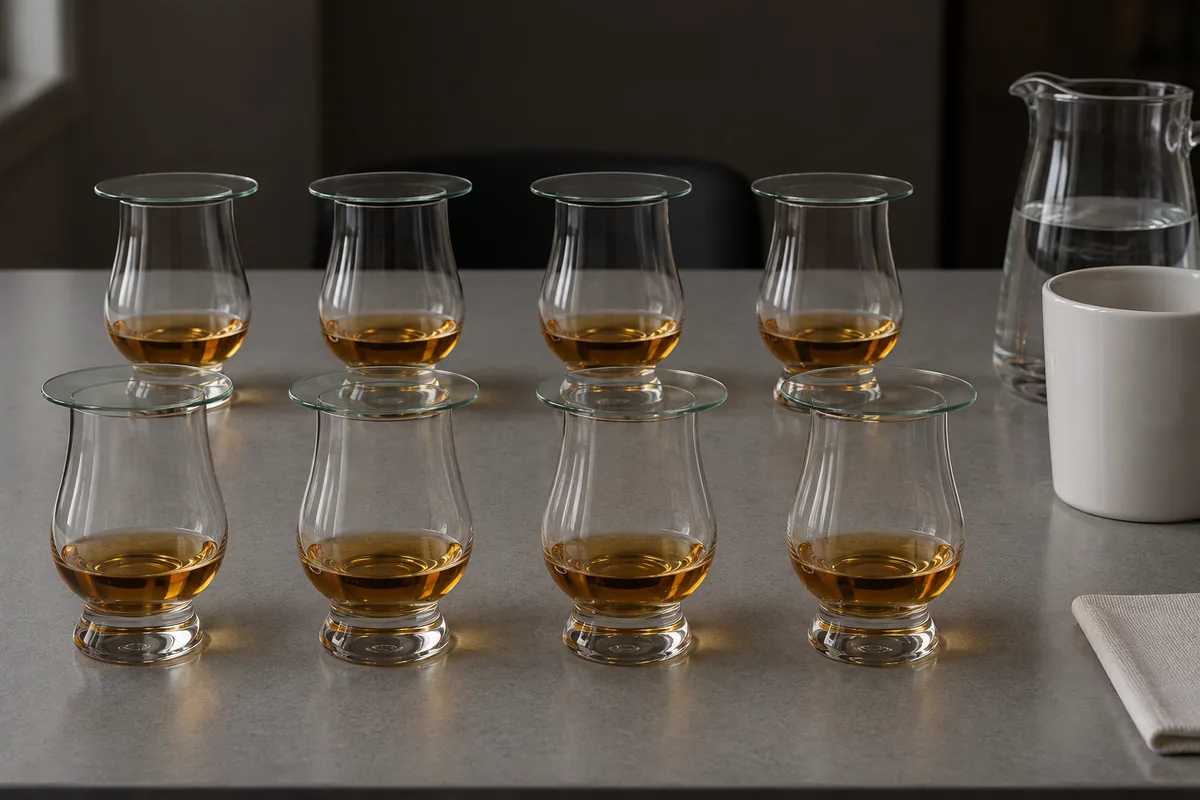
This does not mean rye is sensorially irrelevant. It means an ingredient percentage operates inside a system, and the exact aroma in your glass is evidence about that bottling rather than proof of a universal rule.
Use producer tasting language as a hypothesis, then assess the whisky systematically if the distinction matters; the controlled whisky tasting method separates aroma, taste, texture, dilution, and finish so expected rye spice does not control the result.
The 2019 trained-panel study is especially useful because it tested 24 American whiskeys with a developed sensory vocabulary rather than asking whether people liked a label. Individual samples differed, yet mash-bill category did not predict a single set or combination of sensory attributes.
Producer and age effects were more informative in that sample, consistent with yeast, fermentation, still configuration, cut points, barrel char, warehouse position, blending, and proof all acting after grain proportions are chosen.
- Rye contribution
- Rye changes the available starch, flavour precursors, and fermentation matrix, so it can matter without working alone.
- Fermentation and distillation
- Congener formation and separation determine which grain-derived and microbial compounds reach the barrel.
- New charred oak
- Extraction and transformation add vanilla, toast, spice, tannin, colour, and other cues that can overlap grain expectations.
- Age and proof
- Time changes spirit and wood compounds, while serving strength changes volatility, heat, texture, and perceived intensity.
A consumer may reasonably find one high-rye bourbon peppery and another floral, fruity, woody, or caramel-led. The category allows all of those outcomes because it describes a relative ingredient choice inside a much larger production system.
Confirmation bias becomes likely when the expected word appears first, so record aroma before comparing it with the mash and producer description.
Measured water can help when high proof masks quieter aromas, but dilution may also expose tannin or bitterness. Compare equal starting volumes and note the dilution so a repeat tasting can distinguish a serving change from a bottle difference.
Rye can influence flavour without dictating it, which is a more useful conclusion than either extreme. Treating rye as irrelevant ignores the raw material; treating rye percentage as a guaranteed flavour ignores the rest of production.
What else shapes high rye bourbon during production?
The mash bill establishes which grains enter fermentation, but it does not specify how efficiently their starches are converted, which yeast performs the fermentation, how long the ferment runs, or which flavour compounds reach the still.
Rye percentage is one input among several connected production choices. Rye can make a mash more viscous because its grain chemistry behaves differently from corn, so distillers manage milling, cooking, enzymes, water, and temperature to obtain a workable fermentation.
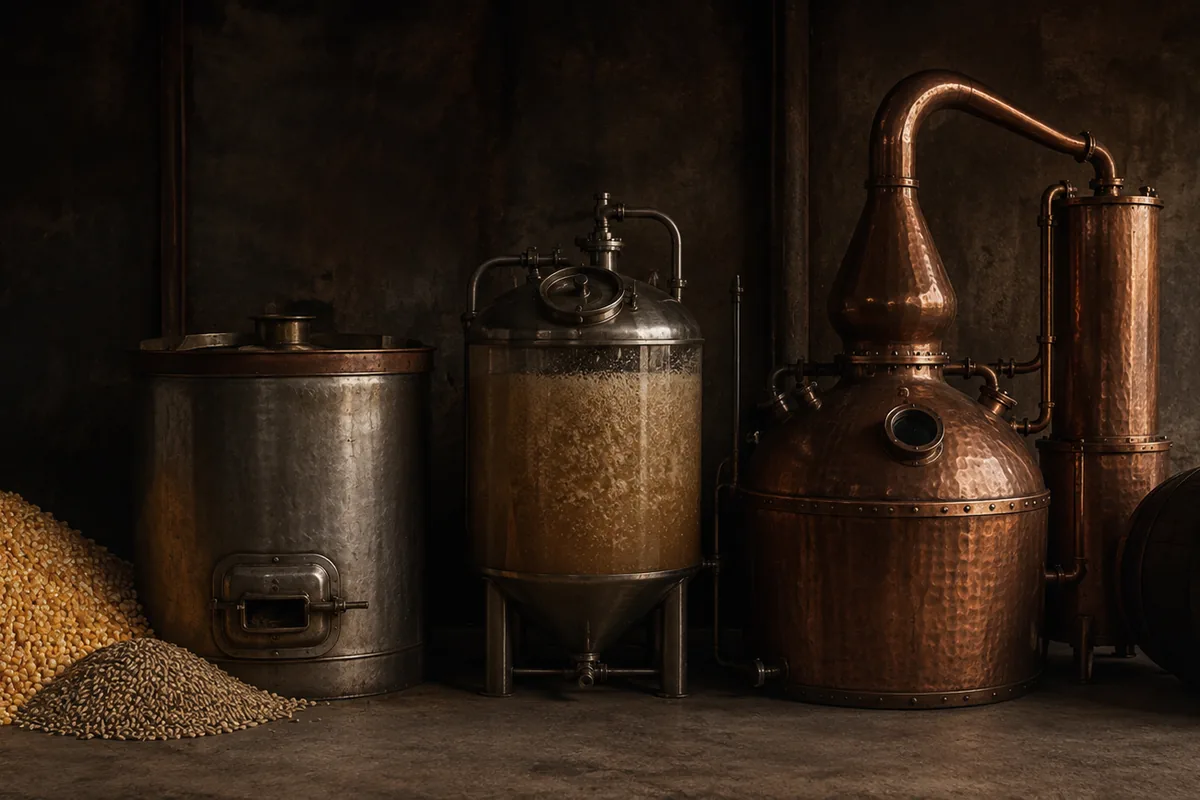
Yeast strain and fermentation conditions affect acids, esters, higher alcohols, and other aroma precursors.
Two producers using similar corn and rye proportions can therefore send materially different liquids to distillation.
Still design, cut points, reflux, and distillation proof determine which volatile and heavier compounds remain. Federal rules set a maximum distillation proof for bourbon, but they leave producers a substantial operating range below that ceiling.
A lower proof does not automatically mean better or more flavourful whiskey. It changes the balance of compounds carried forward, and its effect depends on the fermented liquid, equipment, cut decisions, and later maturation.
| Production variable | What it can change | What the label may not reveal |
|---|---|---|
| Grain preparation | Starch access, mash handling, and fermentation consistency | Mill setting, cook schedule, or enzyme use |
| Fermentation | Fruit, floral, cereal, spice, and heavier aroma precursors | Yeast strain, temperature, acidity, and duration |
| Distillation | Congener concentration, texture, and new-make weight | Still geometry, reflux, and precise cut points |
| Barrel entry | Extraction rate and the balance between spirit and oak | Entry proof unless the producer discloses it |
This is why a mash bill comparison is informative but incomplete.
It describes grain composition; it does not reconstruct the production decisions that turned those grains into mature whiskey.
What does new charred oak contribute?
Every straight path from high rye bourbon to the bottle passes through a new charred oak container because that is part of the bourbon standard. The barrel supplies colour and can contribute vanilla, caramel-like aromas, toast, smoke, tannin, coconut-like notes, and drying structure.
Char level, oak seasoning, cooperage, barrel size, entry proof, warehouse position, climate, and time all alter the exchange. A stronger oak signature can cover delicate grain cues, while a shorter or gentler maturation can leave more cereal and fermentation character apparent.
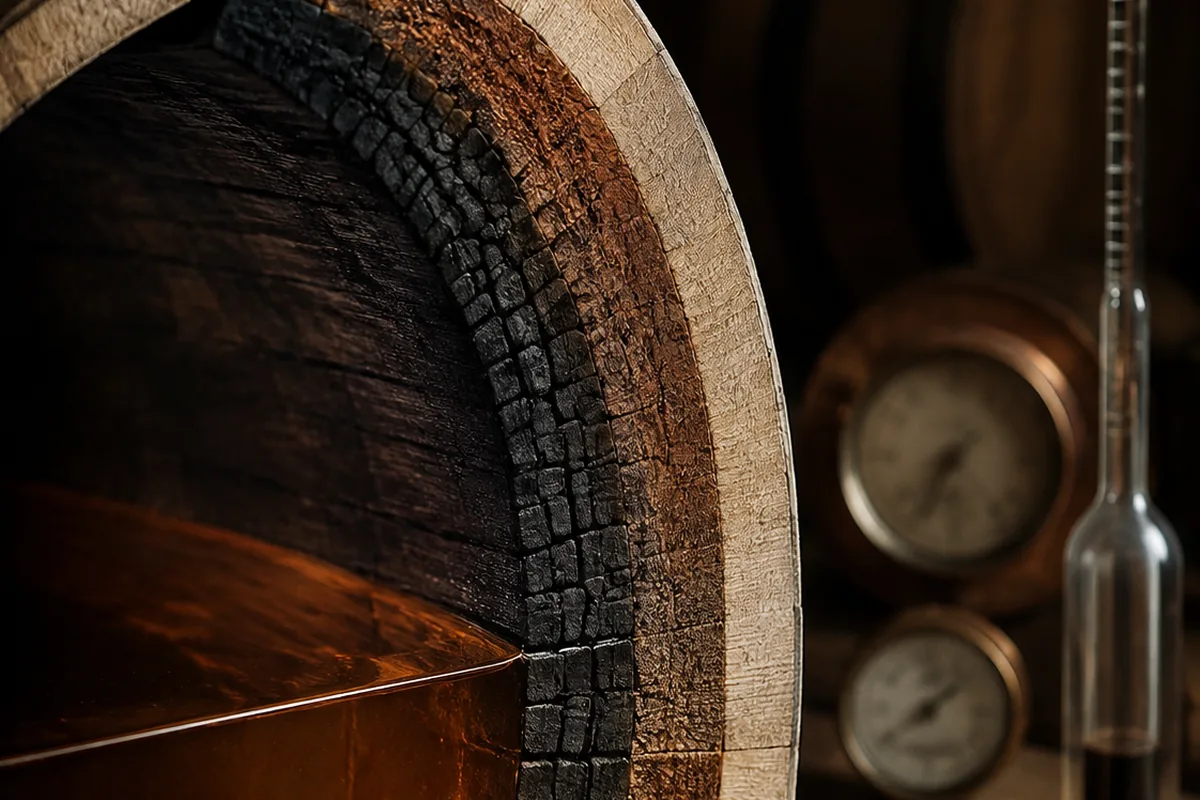
Age statements give the age of the youngest whiskey in the stated blend under the applicable rules; they do not reveal warehouse location, barrel treatment, or sensory quality.
No-age-statement bourbon still matured in new charred oak, but the label gives less time information.
Very old is not automatically preferable for a rye-forward balance. Extended extraction can deepen oak, dryness, and spice until those sensations are hard to separate from any grain-derived character.
When a bottle tastes spicy, the sensation may reflect rye, fermentation compounds, oak, alcohol strength, or their interaction. The flavour alone cannot prove a particular rye percentage.
How is high rye bourbon different from rye whiskey?
High rye bourbon remains corn-majority bourbon.
United States rye whiskey crosses a different legal grain boundary because its mash contains at least 51 percent rye, while wheated bourbon keeps corn at 51 percent or more and uses wheat rather than rye as a prominent secondary grain. Push corn further still and the spirit leaves bourbon in the other direction, toward corn whiskey.
The categories can overlap in sensory language without becoming interchangeable.
A high rye bourbon may seem drier or more herbal than one bourbon, yet a particular rye whiskey can taste softer because proof, age, distillation, and oak pull in another direction.
| Style | Majority grain rule | Useful expectation | Unsafe shortcut |
|---|---|---|---|
| High rye bourbon | At least 51% corn; no federal high-rye cutoff | Rye has a comparatively larger role within that producer's bourbon range | Assuming a universal rye percentage |
| Rye whiskey | At least 51% rye | Rye is the legal majority grain | Assuming every rye whiskey tastes hotter or spicier |
| Wheated bourbon | At least 51% corn; wheat is a secondary grain | Useful contrast when the mash bill is disclosed | Assuming wheat guarantees sweetness |
A bottle labelled both bourbon and high rye gives the legal category first and the producer's comparative description second. If the exact mash bill is absent, that hierarchy is still clear even though the number remains unknown.
How should high rye bourbon be served?
Start with a measured pour in a clean glass at a moderate room temperature when the goal is comparison. A tulip-shaped tasting glass concentrates aroma, while a wider rocks glass makes room for ice and changes how quickly aromas disperse.
A few drops of water can lower local alcohol concentration and change which aromas reach you.
Add water gradually because the useful amount depends on bottling proof, pour size, and personal sensory comfort.
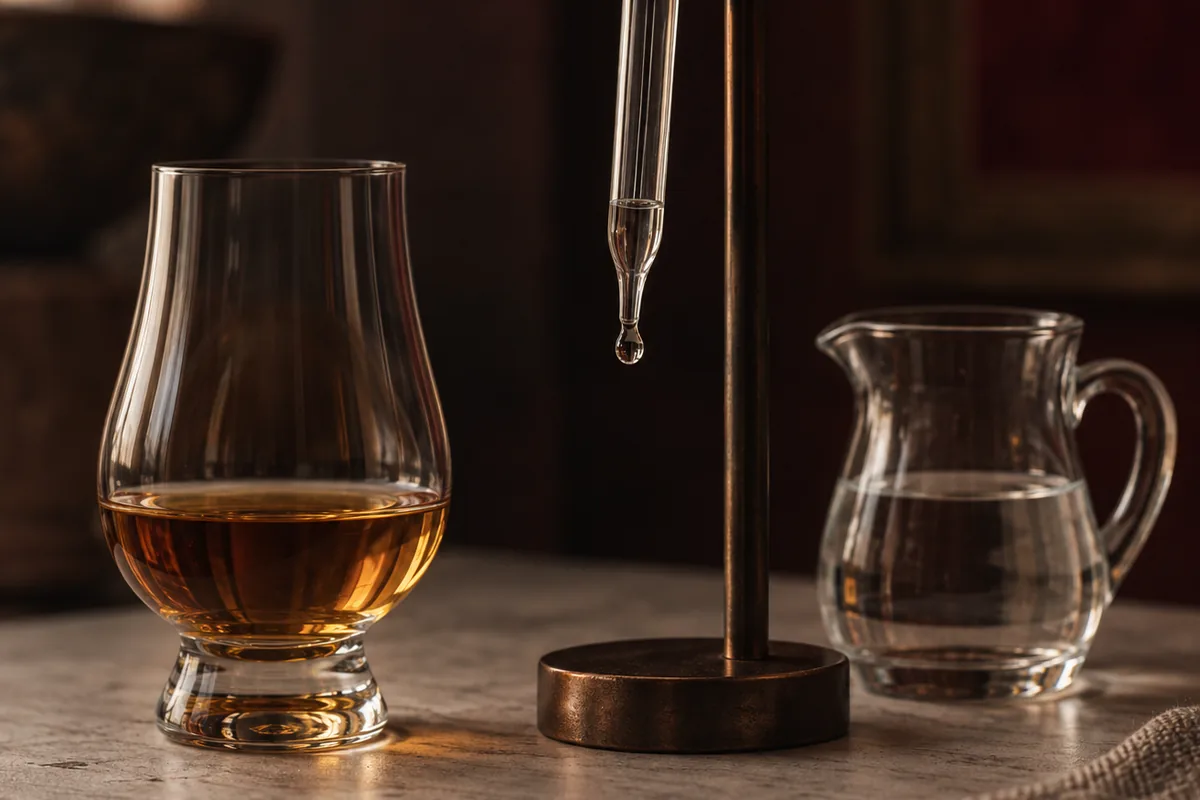
- Read first: note the ABV, age statement, mash bill if disclosed, and whether the high-rye language is producer-defined.
- Measure the pour: use the same volume when comparing bottles so glass level does not become a hidden variable.
- Smell without rushing: keep your nose above the rim if alcohol vapour feels sharp.
- Add water deliberately: record the amount rather than turning dilution into guesswork.
- Recheck after time: observe whether fruit, grain, oak, or drying spice becomes more apparent.
In cocktails, compare proof and flavour weight before substituting high rye bourbon for another whiskey. The measured recipe belongs with the cocktail, while the bottle's proof and flavour explain why the substitution may make the drink drier, more oak-forward, or simply stronger.
Clean glassware matters because detergent film, stale rinse water, or a strongly scented cabinet can imitate or hide aromas. Rinse thoroughly and allow the vessel to dry without a fragranced towel.
Which foods pair with high rye bourbon?
Foods with browned edges, moderate fat, toasted grains, or restrained sweetness often give high rye bourbon enough intensity to remain distinct.
The pairing should respond to the bottle's actual oak, proof, and spice rather than the marketing term alone.
| Bottle cue | Food direction | Why it can work |
|---|---|---|
| Dry spice and toast | Roast pork, grilled mushrooms, rye bread, or toasted nuts | Browning and grain flavours echo the whiskey without adding much sugar |
| Vanilla and caramel | Roast squash, pecan, aged cheese, or lightly sweet barbecue | Fat and browned sweetness soften tannin and alcohol heat |
| Fruit-led character | Apple, pear, cherry, or firm cheese | Acidity keeps the combination from becoming heavy |
| High proof and firm oak | Richer meat or dark chocolate in a modest portion | Stronger food intensity avoids disappearing beside the whiskey |
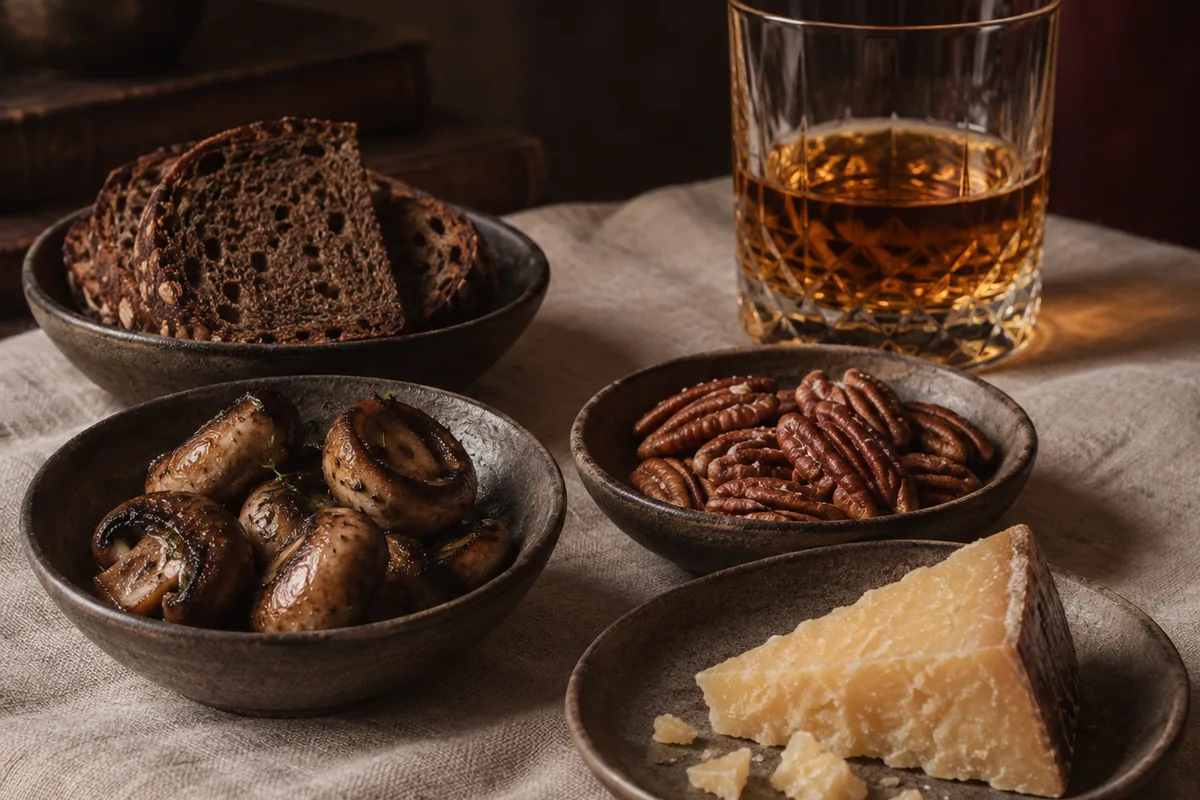
Very hot chilli can magnify alcohol burn, and a sugary dessert can make a dry whiskey seem harsher. Water and alcohol-free drinks alongside the food help keep the tasting deliberate.
How should an opened bottle be stored?
Store high rye bourbon upright with the closure tight, away from direct sunlight and repeated heat cycles. Whiskey does not continue barrel maturation in glass, although oxygen exposure and volatile loss can slowly alter aroma after opening.
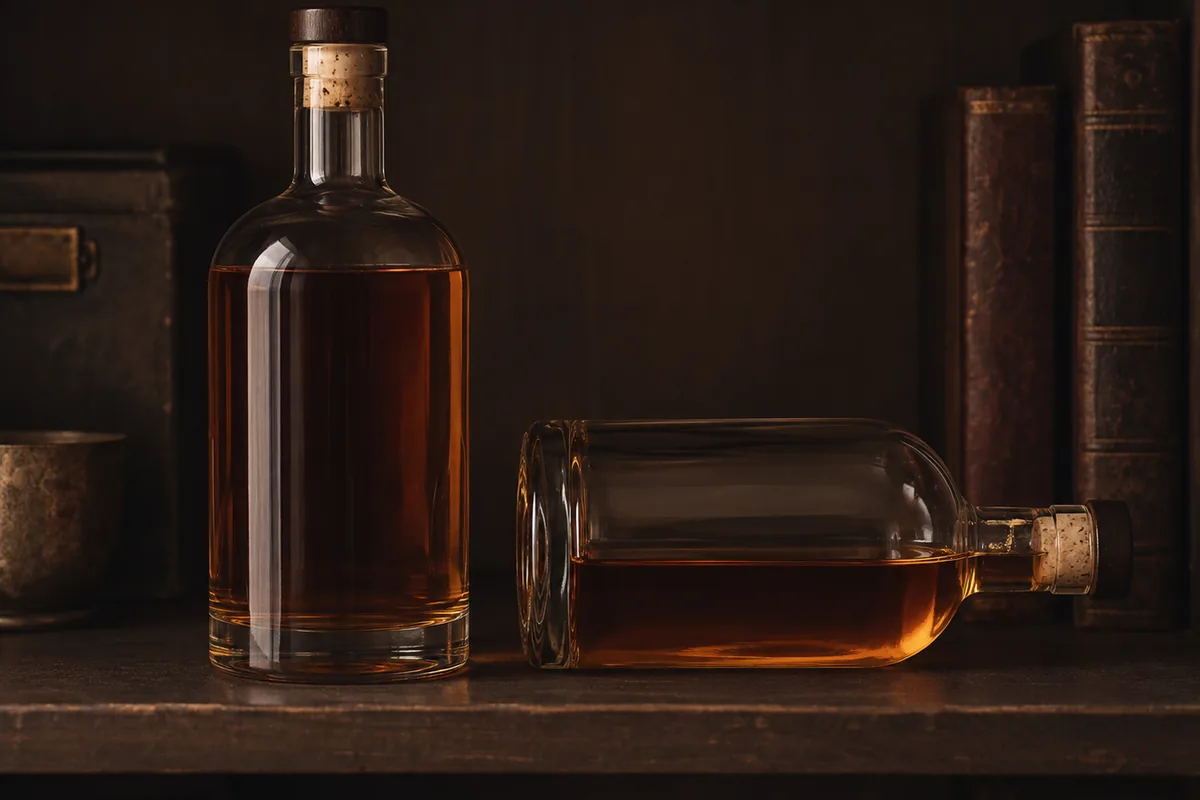
As the fill level drops, the bottle contains more headspace and receives fresh air whenever it is opened.
A clean smaller bottle can reduce headspace for a small remainder, provided it is clearly labelled and has a compatible closure.
- Keep it upright: prolonged contact with high-strength spirit can damage some closures.
- Use stable temperatures: a cupboard is usually better than a sunny shelf or hot kitchen.
- Protect the identity: never top up the bottle with another whiskey.
- Discard on concrete warning signs: a failed closure, foreign material, unknown refill, or strongly abnormal odour matters more than a small flavour change.
Refrigeration is not normally needed for an intact bottle of bourbon. Cold storage can suppress aroma during service and adds little protection compared with a sound seal and stable dark storage.
How does proof affect the responsible serving decision?
High rye describes grain emphasis, not alcohol quantity. The amount of alcohol in a serving depends on both the pour volume and the ABV, so a higher-proof bourbon can deliver substantially more alcohol in the same glass.
For a 40 percent bourbon, the United States standard-drink reference is about 1.5 fluid ounces, or 44 millilitres.
A generous pour or a higher bottling proof changes that calculation, even when ice or water later lowers the concentration.
Measure volume and read the ABV. Spice, sweetness, smoothness, water, food, coffee, or time spent tasting cannot establish that someone is unimpaired or safe to drive.
Anyone who is pregnant, below the legal drinking age, taking an interacting medicine, managing a condition worsened by alcohol, or responsible for driving or another safety-critical task needs an alcohol-free choice. The high-rye label supplies no personal risk information.
A sound conclusion stays narrow: the high-rye phrase describes grain emphasis, while the measured volume and the printed ABV are the only two things that describe the alcohol in the glass.
How do you compare two high rye bourbons?
Start with the mash bill when it is disclosed.
It tells you whether two producers mean roughly the same thing by high rye, while an undisclosed recipe leaves the claim unquantified.
- Mash bill: compare actual rye percentages, not different producers' use of the same adjective.
- Proof and age: strength affects concentration and alcohol heat, while time and warehouse conditions change oak extraction.
- Barrel and producer detail: cask treatment, maturation, and stated sensory aims can explain differences the grain share cannot.
A higher proof is not automatically better, and an older whiskey is not automatically more balanced. Each number changes the comparison, but neither supplies a quality verdict by itself.
For mixing, follow a measured recipe and expect a high-rye bottling to alter balance only when its actual flavour supports that expectation. Complete formula, ice, dilution, garnish, and yield remain with the relevant cocktail entry.
Store an opened bottle upright, tightly closed, and away from direct heat and light. Check alcohol by volume before pouring, because neither the high-rye phrase nor elapsed time can establish that someone is unimpaired or safe to drive.
For a bottle comparison, record mash bill, age statement, straight designation, ABV, and disclosed barrel information before tasting so the relative term cannot outweigh comparable facts.
If one mash bill is undisclosed, compare the evidence you do have rather than estimating the rye share from aroma. A pepper-like note can support a sensory description, but it cannot reverse-engineer an exact percentage.
| Your intended use | Evidence to prioritise | Likely failure |
|---|---|---|
| Neat comparison | Similar ABV, measured water, age, and the same glass and temperature | Calling proof heat or heavy oak a rye effect |
| Stirred drink | Proof, dryness, oak, bitterness, and the measured formula | Changing spirit strength and grain profile at the same time |
| Sour or long drink | Aroma intensity after citrus, sugar, chilling, and dilution | Assuming a spicy label will remain obvious in the finished balance |
| Food pairing | Actual sweetness, oak, fruit, grain, and alcohol concentration | Pairing to the word rye instead of the tasted profile |
Foods with char, toasted grain, cured meat, firm cheese, or baking spice may echo common bourbon cues, while fruit or acidity provides contrast and delicate food remains vulnerable to heavy oak or high proof.
When mixing, keep the complete measured formula in charge of the decision. Changing from one bourbon to another can alter total alcohol, perceived sweetness, bitterness, and dilution needs, so adjust only after identifying which change the finished drink requires.
A sealed bottle stored upright and away from heat should remain stable for a long time, but opening introduces oxygen and repeated pours increase headspace. Slow aroma change is a storage issue rather than maturation, because whisky does not continue cask ageing in glass.
Which comparisons are unsafe shortcuts?
Smoothness cannot establish lower strength: alcohol warmth, texture, sweetness, temperature, and dilution affect the sensation, and none supplies a reliable estimate of ABV or impairment.
That disciplined reading also makes comparisons repeatable when a producer changes proof, age, or barrel selection in a later release.
The best use of high rye is therefore comparative and specific: it helps identify a bourbon in which the producer considers rye unusually prominent. The mash bill, legal terms, age, proof, and your controlled tasting decide what that prominence means for the bottle in front of you.
Common questions
- What percentage of rye makes a bourbon high rye?
- No federal percentage defines high-rye bourbon. Only a producer-disclosed mash bill can quantify the rye, and producers may use the term relative to their own recipes.
- Is high-rye bourbon the same as rye whiskey?
- No. High-rye bourbon must still contain at least 51 percent corn, while United States rye whiskey must contain at least 51 percent rye.
- Does high-rye bourbon always taste spicy?
- No. Rye can contribute dry, herbal, or spice-like cues, but sensory studies show that producer, age, fermentation, distillation, barrel, and proof also shape the result.
Sources
-
27 CFR 5.143, Standards of identity for whisky, Alcohol and Tobacco Tax and Trade Bureau
Accessed 4 September 2026.
-
Lahne, Abdi, Collins, Heymann (2019), Bourbon and Rye Whiskeys Are Legally Distinct but Are Not Discriminated by Sensory Descriptive Analysis
Published 2019. Accessed 10 September 2026.
-
Lahne, Collins, Heymann (2016), Replication Improves Sorting-Task Results Analyzed by DISTATIS in a Consumer Study of American Bourbon and Rye Whiskeys
Published 2016. Accessed 10 September 2026.
More in Spirits
-
 American single malt whisky
01
What is American single malt whisky, and what does it guarantee?
-
 Australian whisky
02
How is Australian whisky defined, and by which law?
-
 Black rum
03
What is black rum, and does the colour mean anything?
-
 Blended American whiskey
04
What is blended American whiskey, and how much of it is whiskey?
-
 Blended Irish whiskey
05
Blended Irish whiskey: which word counts the distilleries?
-
 Blended Scotch
06
Blended Scotch: what is in it, and why does the recipe change?